


Promote your event until it sells out
Promote an event until the tickets sell: the chain of ads, event landing page and tracking, plus channel choice, timeline and the metrics that count.
In short: No single ad will promote an event until the tickets are sold. That takes a closed chain: ads that reach the right people, a landing page with exactly one goal (buy a ticket) and tracking that shows which ad sells. If one link is missing, you lose tickets and budget. Vienna-based Maze & Friends builds this chain for conference and trade fair organisers under one roof.
You’ve planned a conference, a specialist trade fair or a larger event. The programme is set, the speakers are confirmed, the venue is booked. Now comes the part that decides between profit and loss: ticket sales. This is where many organisers in the DACH region (Germany, Austria, Switzerland) fail, rarely because of the programme and mostly because of the marketing.
The typical pattern: a few posts on LinkedIn, an ad pointing to the homepage of your own website, a bit of email to the old mailing list, then waiting. Ticket numbers trickle in, panic sets in three weeks before the date, and in the end there are discounts to fill the room somehow. That has little to do with marketing and a lot to do with hope.
This article shows how to promote an event so that tickets actually get sold in the end. At its centre is the chain of ads, landing page and tracking that carries the ticket funnel.
How do I promote an event so that tickets get sold?
Instead of thinking in individual pieces, you build a funnel. A funnel is the path a person travels from “has never heard of your event” to “has bought a ticket”, narrowing at every step like the kitchen utensil it is named after. Each stage has exactly one job.
Almost all organisers make the same mistake and treat event promotion as a reach problem: more posts, more channels, more visibility. But reach without a goal is wasted effort. If your ad leads to the homepage and visitors first have to search for where the event even is, you’ve lost them. People who click on ads are impatient and give you a few seconds.
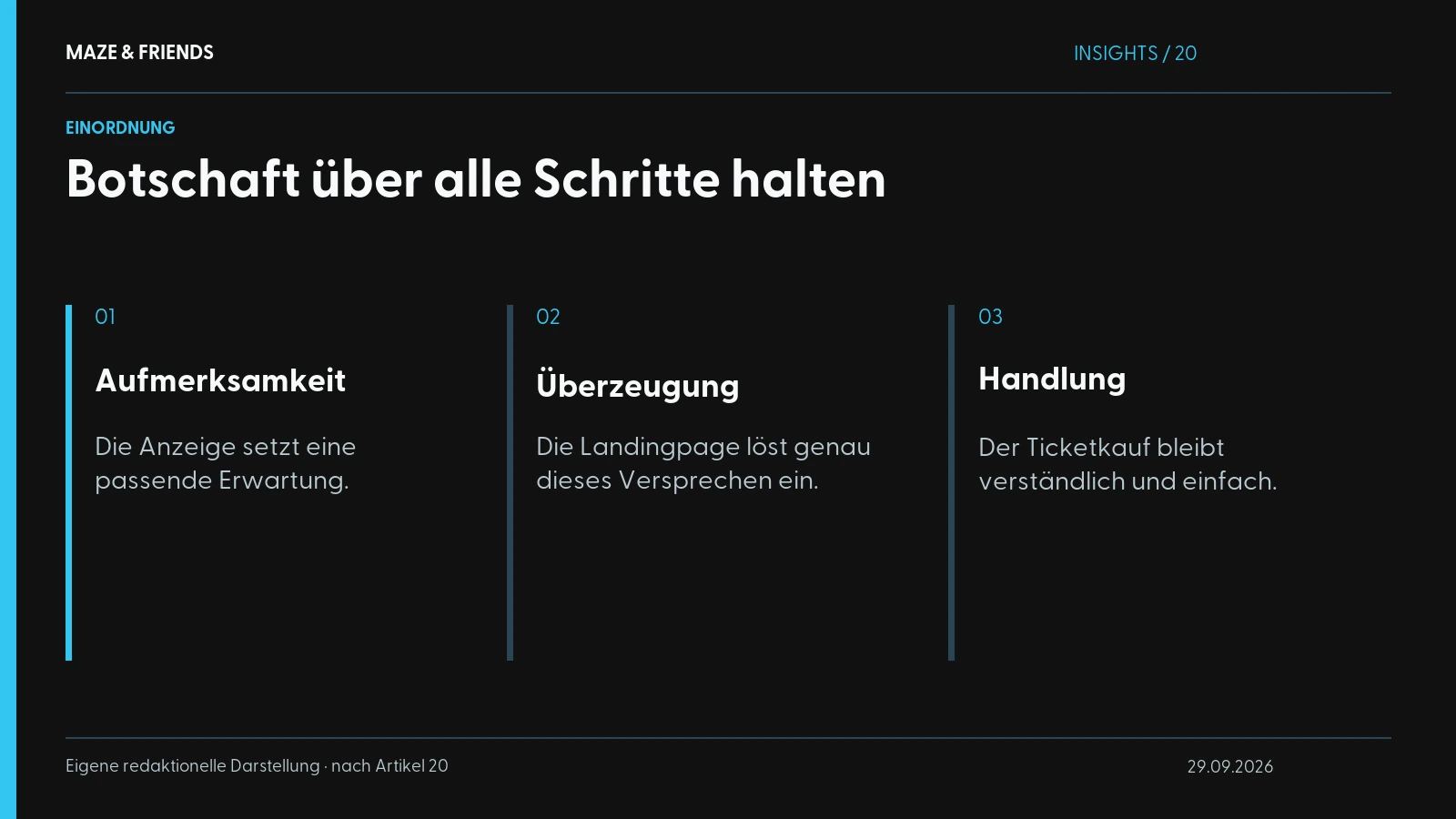
The chain that actually sells has three links:
- The ad brings the right people to the right page at the right time.
- The landing page has exactly one goal: buy a ticket. Distractions and navigation to your other offers are deliberately left out.
- The tracking measures which ad actually triggers purchases, so you can steer your budget to where it brings in tickets.
If one of these links is missing, the chain breaks. A good ad pointing to a bad page wastes your advertising budget. And with a good page but no tracking, you optimise in the dark and replace figures with gut feeling.
What actually is a ticket funnel?
A ticket funnel is the concrete path from first contact to purchased ticket, in measurable stages. Unlike the classic lead funnel, it ends with a real transaction rather than an enquiry. You sell directly, without a long sales process.
In practice, a clean ticket funnel for a conference looks like this:
| Stage | What happens | Target metric |
|---|---|---|
| Reach | Cold audience sees the ad | Impressions, reach |
| Click | Prospect clicks on the ad | Click-through rate (CTR) |
| Landing page | Visitor reads the offer, sees the value | Time on page, scroll depth |
| Ticket selection | Visitor chooses a ticket category | Selection / basket |
| Purchase | Ticket is paid for | Conversion, revenue |
With this breakdown you see exactly where people drop out. If nobody responds to the ad, the audience or the message is wrong. If they click but don’t buy, the problem is the landing page or the price. Without this view, you treat symptoms instead of causes.
How do I build an event landing page that sells?
The landing page is the heart of the chain. This is where it’s decided whether a click becomes a sold ticket. An event landing page is therefore a sales tool with exactly one call to action.
One thing above all sets it apart from a normal website page: an event landing page has no main navigation. Every link that leads away is an exit from the purchase. If your visitor suddenly ends up in your blog or on the “About us” page, the chance of a ticket sale is gone.
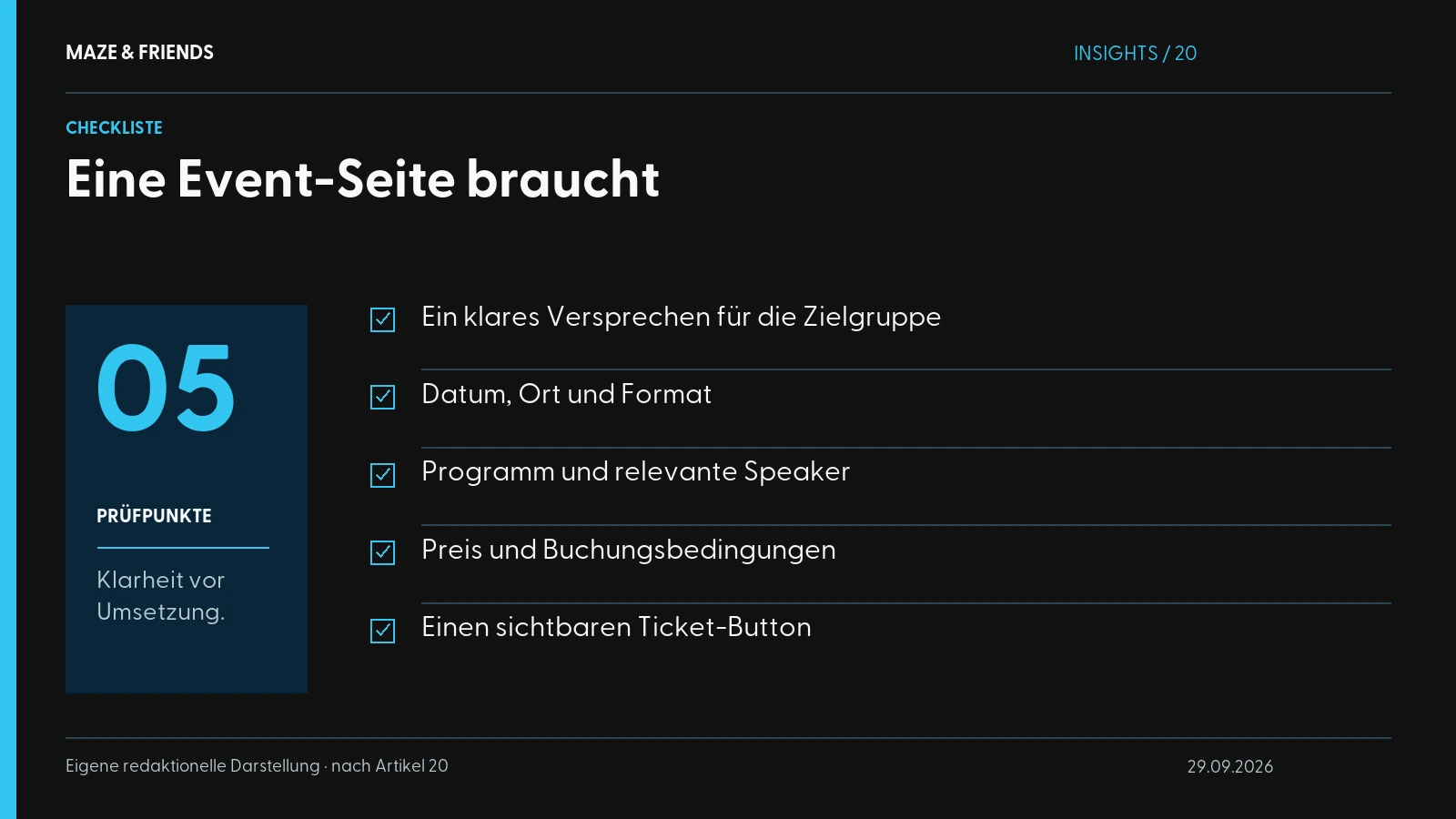
These elements belong on a landing page that sells tickets, in this order:
- Above the fold (the area visible straight away without scrolling): the event name, date, location, a crystal-clear value proposition and a ticket button. Within the first few seconds it has to be clear: what is this, when, where, why go.
- The value: what does the attendee take away? Instead of “high-calibre speakers”, this is where you state concretely which questions get answered and which problem gets solved. People buy results, not an agenda.
- Social proof: logos of attending companies from last year, genuine voices from previous visitors, figures from the last edition, and only real ones. Trust comes from proof, not adjectives.
- The programme: compact, scannable. Speakers with a photo and one line on why their talk is relevant.
- The ticket table: categories, prices, what’s included. Clear and honest, no hidden costs.
- Scarcity, if it’s real: early-bird deadline, limited places. But only if it’s true. Your visitors see through fake countdown timers.
- Repeated ticket button: after every major section. The impulse to buy strikes different people at different points.
In practice we build these pages in Webflow, because it lets us test quickly and build in clean tracking without detours. The tool itself is secondary; what counts is the principle: one page, one goal, no way out.
How do I write the message for the landing page?
Address the one person you want to reach and their concrete problem. Instead of “The leading conference for digital transformation”, you write “Two days in which you learn how other mid-sized companies have automated their processes without tripling their IT department.” The first is interchangeable, the second hits home.
Leave out empty superlatives. Nobody believes “unique” or “the most important event of the year”, because everyone writes it. Concrete, verifiable statements sell: who is really speaking, what the attendee really takes away.
How do I advertise my conference?
On to the ads side of the chain. Advertising a conference means bringing the right people to the landing page: better a few who fit than many at random. A full room with the wrong people doesn’t help you; a half-full one with the right audience does.
Which channels should I use to promote an event?
Your choice of channel depends on whom you want to reach. For social media in a B2B context, meaning specialist conferences and trade fairs, there’s usually no way around LinkedIn, because it lets you reach decision-makers by job title, industry and company size.
| Channel | Strength | Best suited for |
|---|---|---|
| LinkedIn Ads | Precise B2B targeting by role and industry | Specialist conferences, B2B trade fairs |
| Meta (Instagram/Facebook) | Large reach, good retargeting | Public events, broader audiences |
| Google Search | Catches active searchers | Established events with name recognition |
| Email to existing contacts | Usually the best conversion, cheapest channel | Early birds, returning attendees |
Organisers often spread themselves too thin. Better to run one or two channels properly than five half-heartedly. Your existing email list is almost always the strongest lever, because these people already know you. Before you burn cold budget, collect the tickets that are closest to hand.
How do I build ads that match the landing page?
The principle behind it is called message match: whatever the ad promises, the landing page has to deliver immediately. If someone clicks on “Early-bird ticket until Friday”, exactly that offer has to be at the top of the page. Otherwise the visitor bounces.
For the ticket funnel, you usually need two types of ad:
- Cold ads for people who don’t know your event yet. These have to win attention and explain the basic benefit, usually via the problem or curiosity.
- Retargeting ads for people who have already been on the landing page but haven’t bought. This is often the most profitable group: these ads remind, clear up objections (“Only a few places left”) and close the sale.
Retargeting doesn’t work without clean tracking, because you need to know who visited the page. That’s why the third link in the chain is no afterthought.
Why does clean tracking decide ticket sales?
Because without tracking you’re blind. You might know that 200 tickets were sold, but not which ad, which channel or which audience brought them in. So you can’t steer your budget to where it brings in tickets. When promoting an event, that’s the difference between scaling and guessing.
Clean tracking specifically means: every ticket purchase is assigned to a source. For that you need:
- GA4 (Google Analytics 4), to follow the entire path on your landing page, from arrival to purchase.
- Server-side tracking and CAPI (Meta’s Conversions API connects your server directly with the platform), so that purchases are reported back cleanly to the ad platforms even when browser protection features or ad blockers get in the way. Today this is the standard that decides between good and bad campaign results. It doesn’t replace consent, though: even server-side, marketing tracking needs your visitors’ permission. According to the European Data Protection Board’s Guidelines 2/2023 (version 2.0 of 16 October 2024), tracking pixels and tracking links fall under Article 5(3) of the ePrivacy Directive.
- Consistent UTM parameters (tags in the link URL), so that every click stays assigned to its campaign, ad and audience. According to Google’s Analytics help (in German), utm_source, utm_medium and utm_campaign are mandatory.
That’s why we build ads, landing page and tracking together rather than as three separate jobs. Only when the three systems speak the same language can you see in the end which euro of ad budget brought in which ticket. The technical implementation is described in our guide Setting up conversion tracking properly.
If your event is also a lead engine for your core business, such as a trade fair meant to generate enquiries, it pays to look beyond the ticket. What trade fair contacts can turn into afterwards is covered in the article on the trade fair funnel and lead follow-up.
Which timeline works for promoting an event?
Timing counts too. Promoting an event takes weeks, and if you only start three weeks beforehand, you pay dearly for the lesson. A realistic roadmap for a conference, counted from the campaign launch:
| Phase | Time before the event | Focus |
|---|---|---|
| Set-up | 10–8 weeks before | Landing page live, test tracking, start early bird |
| Reach | 8–5 weeks before | Cold ads, email to the list, build social proof |
| Intensification | 5–2 weeks before | Ramp up retargeting, use scarcity honestly |
| Final sprint | last 2 weeks | Last places, reminders, personal outreach |
The order matters most: landing page and tracking are in place before you put a single euro into ads. Sending advertising to an untested page means burning budget while you’re still hunting for errors. The time frames are a guideline: a small, local event needs less lead time, a large conference with a high ticket price can take more.
And think about what comes afterwards: the best sales lever for the next edition is created during the current one. A strong review, an aftermovie or event recap, becomes the ad that sells next year’s early-bird ticket. Ticket marketing doesn’t end with the event; that’s where it starts for the next round.
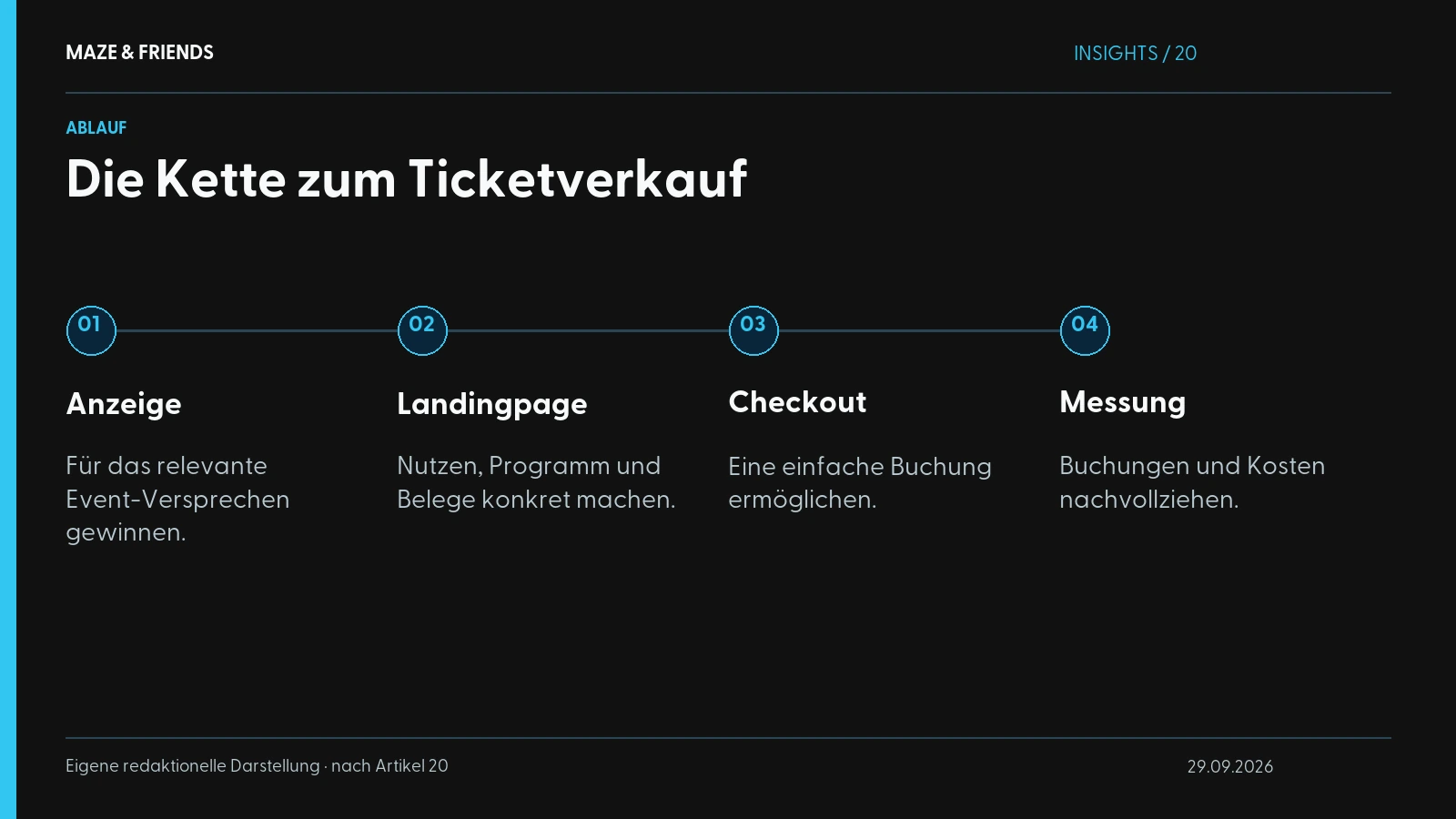
Only the whole chain sells tickets
If you want to promote an event, you need a chain rather than three separate building sites: ads for the right audience, a landing page with a single goal and tracking that assigns every ticket purchase to its source. Only then do you know which euro brought in which ticket, and you can shift your budget accordingly.
Maze & Friends builds ads, landing page and tracking for conference and trade fair organisers under one roof. In an initial call, we look at your event and tell you where the biggest levers are and whether your planned chain will hold.
From the studio: Ghezzo Events: website film · aws: event film for the Austrian Business Angel Day. More about the service: event content.
Frequently asked questions
How do I advertise an event?
Advertising for an event works as a closed chain of ads for the right people, a landing page with exactly one goal and tracking that attributes sales.
If one link is missing, you lose tickets and budget. A good ad pointing to a weak page wastes advertising budget; a good page without tracking means optimising in the dark. Start with the cheapest channels: your email list, previous attendees, and speakers and partners who share the event in their networks. A few posts and an ad pointing to the homepage, by contrast, are more hope than marketing.
What is meant by a ticket funnel?
A ticket funnel is the measurable path from first contact with your event to a purchased ticket, divided into stages that each have one job.
Typical stages are reach, a click on the ad, a visit to the landing page, choosing a ticket category and purchase. Unlike the classic lead funnel, it ends with a real transaction rather than an enquiry. The breakdown shows you where people drop out. If nobody responds to the ad, the audience or message is wrong. If many click but don’t buy, the problem is the landing page or the price.
What belongs on an event landing page that sells tickets?
An event landing page that sells shows the name, date, location, benefit and ticket button straight away and has no navigation that leads away from the purchase.
- At the top: what, when, where, why go, plus the ticket button
- The value: which questions get answered and which problems get solved
- Proof: logos and voices from last year, real figures from the last edition
- A compact programme, ticket categories that are clear and free of hidden costs
- Scarcity only if it’s real, and the ticket button after every section
Every link that leads away is an exit from the purchase.
Which channels should I use to promote a conference?
For B2B conferences, LinkedIn, your own email list and retargeting via Meta are usually the strongest combination; Google Search pays off mainly for well-known events.
LinkedIn lets you reach decision-makers precisely by role, industry and company size, but on its own it’s rarely enough. Your email list usually brings the best closing rate at the lowest cost, because these people already know you. Meta offers large reach and good retargeting, especially for public events. Google Search catches active searchers and assumes someone already knows your event’s name. Better to run one or two channels properly than five half-heartedly.
How much budget do I need to promote an event?
The advertising budget for an event depends on ticket price, audience and ticket target; you work it out reliably backwards from the target rather than with a flat figure.
If you don’t yet know your conversion rate, meaning the share of visitors who buy, start with a small test budget. Then measure the cost per ticket sold and only scale once the chain is selling cleanly. Use that cost per ticket to project how much budget your ticket target needs, and check whether that adds up against the ticket price. Distribution matters too: never burn the whole budget in week one.
How far in advance should I start promoting an event?
For a conference with a significant ticket price, start around eight to ten weeks beforehand, with a finished landing page and tested tracking.
A realistic roadmap: 10 to 8 weeks before, landing page live, test tracking, start early bird. 8 to 5 weeks before, cold ads and emails to the list. 5 to 2 weeks before, ramp up retargeting and only use genuine scarcity. In the last two weeks, last places, reminders and personal outreach. Small local events need less lead time. And the best lever for the next edition is created during the current one, for example an aftermovie for the next early-bird ticket.
What is retargeting, and why does it matter so much for ticket sales?
Retargeting means showing ads again to people who have already been on your event landing page but haven’t bought yet.
This group is often the most profitable in the entire funnel, because it already knows the event and has shown interest. Retargeting ads remind, clear up objections and close the sale, for example with an honest note about limited places or the end of the early-bird deadline. It only works with clean tracking, because you need to know who visited the page. Retargeting is strongest in the intensification phase, around five to two weeks before the event.
What tracking do I need for ticket sales?
For ticket sales you need tracking that assigns every purchase to a source: GA4 on the landing page, server-side reporting to the ad platforms and consistent UTM parameters.
GA4, short for Google Analytics 4, shows the path from arrival to purchase. Server-side tracking and the Conversions API report purchases back to the ad platforms even when browser restrictions slow down the pixel. UTM parameters are tags in the link that assign every click to its campaign, ad and audience. Important: server-side tracking doesn’t replace consent; marketing tracking still needs your visitors’ permission. Test the measurement fully before the campaigns go live.
How do I measure whether my ticket funnel is working?
You measure whether your ticket funnel is working by the rate at each stage: clicks to visitors, visitors to ticket selection, selection to purchase.
The stage with the biggest drop-off shows you where to start. A low click-through rate means the ad’s audience or message doesn’t fit. Many visitors but few ticket selections point to the landing page or the price. Many selections but few purchases suggest hurdles in the payment process. The most important figure in the end is the cost per ticket sold per channel, because that’s what you use to redistribute the budget.
Which matters more, the ad or the landing page?
The ad and the landing page matter equally, because they are links in the same chain. In practice, though, the biggest untapped lever is usually the landing page.
A brilliant ad won’t save a weak page, and a perfect page gets no visitors without a matching ad. Many organisers send ads to their homepage instead of a dedicated sales page. There, visitors first have to look for the event, and people who click on ads only give you a few seconds. In the end, message match is what counts: whatever the ad promises has to be delivered immediately at the top of the page.
Which message sells conference tickets?
Conference tickets are sold by a message that speaks to a specific person about their specific problem and says what they will be able to do or know after the event.
“The leading conference for digital transformation” is interchangeable. “Two days in which you learn how other mid-sized companies have automated their processes without tripling their IT department” hits home. Nobody believes empty superlatives like “unique”, because everyone writes them. Verifiable statements sell: who is really speaking and what attendees really take away. People buy results, not an agenda.
Where can I list my event for free?
You can usually list events for free in regional event calendars, on city and regional media portals, in industry association calendars and on ticketing platforms.
Especially for public events, such listings bring visibility and sometimes visitors. For B2B conferences with a significant ticket price they are just an add-on, because you reach decision-makers more precisely through LinkedIn and your mailing list. Make sure every listing links to your event landing page and carries UTM parameters. Then you can see whether a portal actually brings in tickets or just creates work.
Is there a free registration tool for events?
Yes, for free events there are registration and ticketing tools with no base fee; for paid tickets, providers usually earn through fees per ticket sold.
More important than the price is whether the tool fits your funnel. Check whether ticket purchases can be embedded on your landing page instead of redirecting visitors to someone else’s site, and whether purchases can be reported back to GA4 and the ad platforms. Without that reporting, you don’t know which ad made the sale. Also look for a short checkout that works on mobile and for attendee data being processed in line with data protection rules.
How do I use early-bird tickets and scarcity properly?
Early-bird tickets and scarcity work when they are genuine: a real early-bird deadline and places that really are limited, communicated openly.
Along the way, early-bird offers show you early on whether your message is landing. Use scarcity honestly in the last weeks before the event, when retargeting ramps up. Your visitors see through fake countdown timers, and squandered trust costs you tickets at the next edition. If you panic and discount three weeks before the date, you also teach your audience to wait for the discount next time.
Can I build a ticket funnel myself, or do I need an agency?
You can build the individual parts of a ticket funnel yourself; support pays off when time or experience is lacking and real ticket budget is at stake.
The hard part is the handovers: ads, landing page and tracking have to speak the same language, otherwise you won’t see in the end which euro brought in which ticket. If the three links are built by three different providers, the chain often breaks right there. That’s why Maze & Friends builds ads, landing page and tracking under one roof, in practice usually with Webflow for the page. The principle counts for more than the tool.
Next step
Want to know which of this fits your company? We will work it out together in 30 minutes. Free and without obligation.
Pick a time
Manuel Zellnig has been building visibility for companies since 2018: brand film, personal branding, performance marketing and AI visibility. Qualified advertising specialist (Werbeakademie Wien), Bachelor in Business Management (Carinthia University of Applied Sciences), author of the book ‘Mobile Apps zur Messung der Kundenzufriedenheit’ (2017, in German) and creative expert for the Austrian Economic Chamber (WKO) in two transformation guides. He measures before he recommends and writes here about what actually works in projects.
Publications and interviews: WKO transformation guide for printers (in German) · WKO transformation guide for florists (in German) · Interview with Ghezzo (in German) · ‘Heute’ on Viennese start-ups (in German)