



Make your trade fair leads count
Make your trade fair leads count: capture stand contacts cleanly, prioritise them, follow up fast and measure your trade fair ROI with tracking.
In short: Most trade fair leads are not lost at the fair itself but in the days that follow, because nobody captures, prioritises and follows up on them properly. If you want to turn trade fair leads into business, you need an end-to-end funnel: capture on the stand, tracking behind it and a follow-up that starts within 48 hours. Maze & Friends from Vienna builds this chain for exhibitors and organisers.
After four days at the fair, the stand crew is exhausted, the roll-up banner goes back into storage, and somewhere there is a pile of business cards and a half-filled lead pad. You had plenty of conversations and sensed genuine interest. Then, all too often, nothing happens, or it happens far too late.
That is the most expensive leak in the entire trade fair business. Stand rental, build-up and catering cost money, but you lose the most through the leads you took home and then left lying around. For you as an organiser or exhibitor, this means the week after the fair, in other words the follow-up, decides what most of your trade fair budget was worth.
Here is why that happens and how to build a trade fair funnel that only really gets to work after the last day of the fair.
Why are so many trade fair leads lost after the fair?
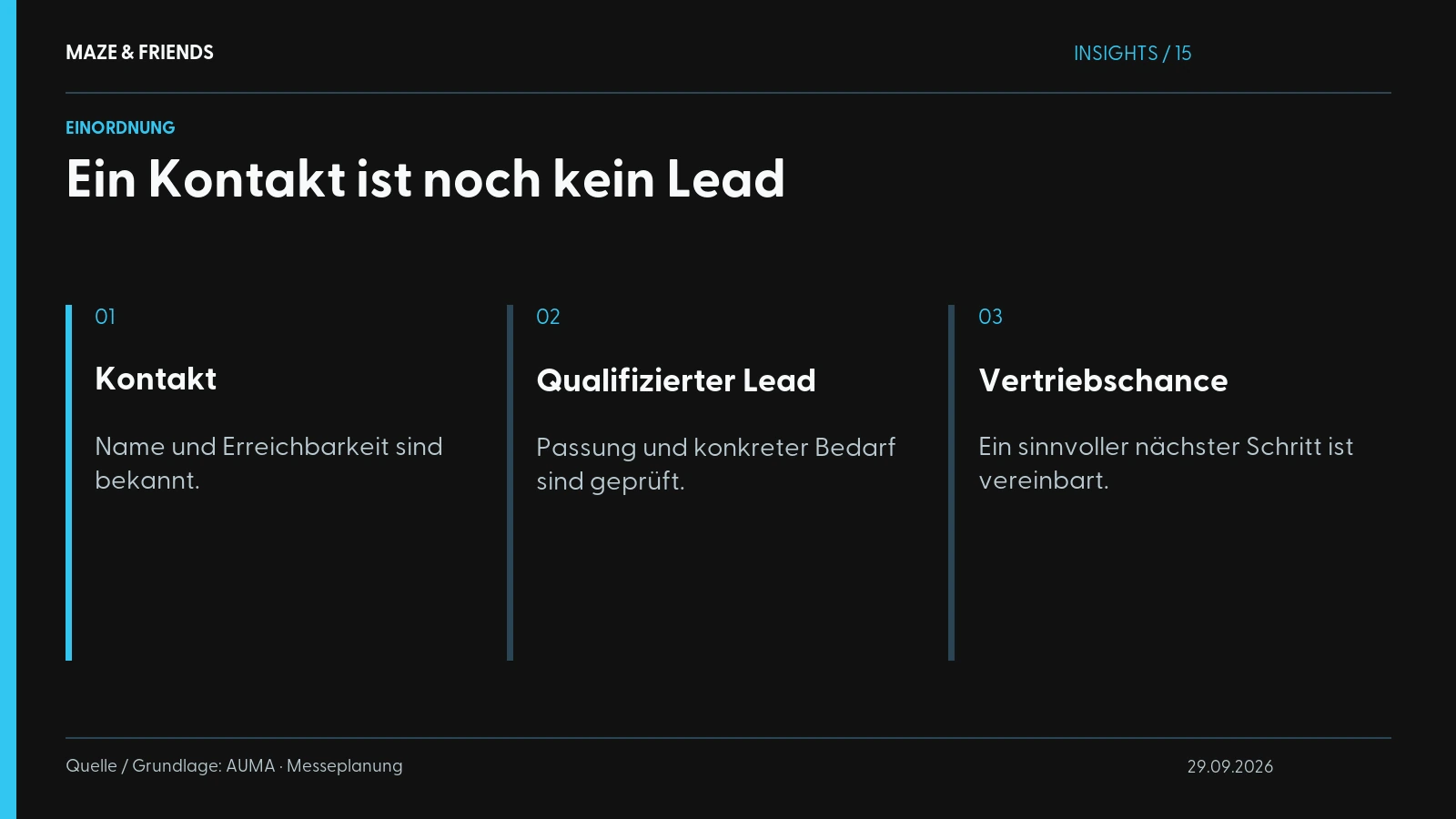
So that we are talking about the same thing: a trade fair lead is any contact who showed recognisable interest, from a business card swap to a concrete request for a quote. A funnel is the path that contact takes from the first handshake to the signed deal. The problem almost always lies in the handover between the two.
That a large share of trade fair leads goes unused has been an open secret in the industry for years. Exactly how large that share is depends on the industry, the team and the definition. Treat individual figures with caution. The direction, however, is clear: most of the contacts made at a trade fair are never seriously followed up. The reasons are surprisingly mundane:
- Capture is chaotic. Handwritten notes, business cards in five different jacket pockets, a lead scanner that half the team never used. After the fair, nobody remembers who was hot and who just wanted a coffee.
- Nobody owns it. Sales thinks marketing is handling the follow-up. Marketing thinks the opposite. In the end, nobody does it.
- The timing is too slow. After the fair, day-to-day business returns. Emails, ongoing projects, the next quarter. By the time someone touches the leads, two weeks have passed and the window has closed.
- There is no prioritisation at all. Every lead ends up in the same pot. The prospect with a concrete budget gets the same standard email as the person who only wanted to take a pen.
Lead generation at the trade fair usually works quite well: people come by, talk and leave their contact details. What is missing is the machinery behind it, and no traditional stand builder will build that for you. Stand builders take care of the stand, the lighting and the graphics. What happens afterwards is funnel and tracking work, which is a different craft.
The fair does not end on the last day of the fair
Most people plan a trade fair up to the dismantling. In funnel thinking, the real work only begins on the last day of the fair. If you think your stand presence through in every detail and treat the follow-up as an afterthought, that is exactly where you give away the money you worked so hard for beforehand.
When you plan your trade fair presence, the follow-up concept belongs at the very start. It determines whether everything else pays off.

How do I generate leads at a trade fair and turn them into business?
Generating leads is one half of the job; turning them into business is the other, more demanding half. We recommend three phases for it.
1. Capture that does not end in chaos
Before the fair starts, you need a single, consistent way of capturing contacts. No matter who is on the stand, everyone captures the same way. That sounds trivial, but it is the most common breaking point.
A practical minimum set for every contact:
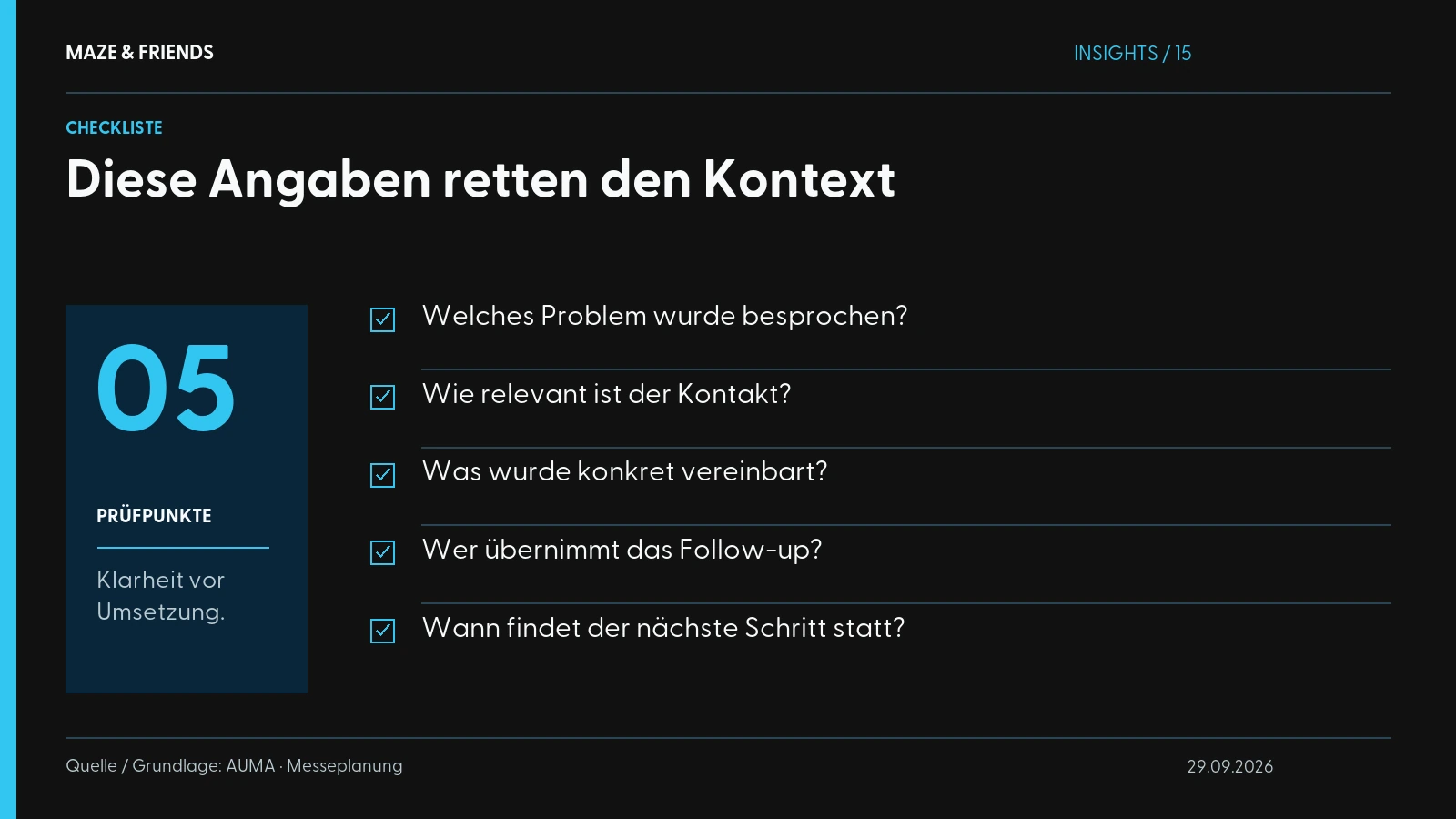
- Contact details (name, company, role, email; a business card or scan is enough)
- An interest level on three tiers (hot / warm / cold; not a science, more gut feeling with structure)
- A concrete next step (send a quote / meeting / information email / follow up later)
- One sentence of context (what did you talk about?)
- Newsletter consent (yes/no, actively obtained on the stand or in the form, and documented)
The one sentence of context is worth its weight in gold. Nothing makes a follow-up more credible than a reference to the actual conversation, and nothing is forgotten faster after two weeks. If your team notes three keywords on the stand, your follow-up has a genuine hook instead of a template email.
Tools help, but they come second. A properly filled-in Google Sheet beats any app that nobody uses. More important than the software is that everyone sticks to the same format. Brief the team clearly once before the fair: five minutes that rescue a great deal of ROI.
2. Qualification and prioritisation
Straight after the fair, ideally the same day or the next, the leads get sorted. Not every contact deserves the same energy. In B2B lead generation, prioritisation often matters more than volume, because a single lead that is followed up properly can create more value than fifty that disappear in a mailing list.
A simple grid:
| Tier | Characteristic | Response time | Channel |
|---|---|---|---|
| Hot | concrete interest, budget, timeline | within 24-48 h | personal (phone call or individual email) |
| Warm | genuine interest, but no concrete occasion | within a week | semi-individual email + offer of a conversation |
| Cold | polite, but non-committal | newsletter/nurture only with consent | automated |
The grid is deliberately simple. The classification does not have to be perfect. What matters is that sorting happens at all and that hot leads are handled immediately and personally, instead of drowning in the same mass email as everyone else.
3. Turning leads into business in the funnel
This is where the actual event funnel takes over. The three groups take different paths:
- Hot leads go straight to sales, with the one sentence of context in their luggage. Goal: a meeting.
- Warm leads receive a short follow-up sequence that feels personal, with a clear offer such as a demo, a call or documents.
- Cold leads, provided they have given consent, move into automated lead nurturing, which delivers substance over weeks instead of nagging with “Buy now” after three days.
This way you avoid two extremes: treating every lead the same, or only touching the three hottest and throwing the rest away. Both cost you revenue.
A word on the legal position: in Austria, under section 174 of the Austrian Telecommunications Act (TKG 2021) (in German), you need prior consent for newsletters and automated marketing emails, in B2B too. Obtain it actively, on the stand or through your form, document it and have it confirmed by double opt-in so that you can prove it. An email that someone explicitly asked you for on the stand, such as the quote, the documents or a proposed meeting date, is something different from a marketing newsletter. If in doubt, clarify the details with the Austrian Economic Chamber (WKO) or a legal adviser.

How do I follow up well after a trade fair?
The trade fair follow-up decides whether the whole investment pays off. In practice, four principles make the difference:
1. Speed beats perfection. The first 48 hours after the fair are the open window. The memory of the conversation is still fresh and the person is still in trade fair mode. A solid email after two days achieves more than a perfectly worded one after two weeks. If you wait, you are suddenly competing with the returning daily routine, and you usually lose.
2. Refer back instead of using a template. A sentence like “Great that we talked about your topic X on the stand” beats any generic thank-you email by a mile. That is exactly why you captured the one sentence of context in phase 1. Use it.
3. Offer a clear next step. “Feel free to get in touch if you have any questions” is a dead sentence. A concrete, low-threshold offer works better, such as a 20-minute call, a short demo or a relevant document. Make it easy for the lead to say yes.
4. Do not give up after one email. Someone who does not respond to the first email is usually just busy. Two or three friendly follow-ups over two or three weeks are normal and rarely perceived as pushy, as long as they have substance and say more than “just checking in again”.
A compact checklist for the time after the fair:
- Day 0-1: Merge all leads from capture into one system
- Day 1: Sort into hot / warm / cold
- Day 1-2: Contact hot leads personally (phone call or individual email)
- Day 2-3: Write to warm leads with a follow-up sequence + offer
- Day 3-5: Add cold leads with consent to the nurture programme
- Week 2-3: Follow up with everyone who has not responded
- Ongoing: Document every response so that nothing slips through
In the DACH region, reliability counts
In the DACH region (Germany, Austria and Switzerland), B2B often runs on genuine relationships and reliability, and aggressive sales tactics go down badly. In Vienna we notice this particularly clearly. A follow-up written as one equal to another, that takes its time and genuinely engages with the conversation, works better here than any timed US-style sales sequence. This has little to do with politeness alone; it is about conversion: if you follow up too forcefully in DACH B2B, you burn the trust you have just built at the fair.
How do I measure trade fair ROI?
How do you actually measure whether the fair was worth it? Many people fail at this question, even though it makes the biggest difference.
Trade fair ROI is a simple calculation: what did the fair cost (stand rental, build-up, staff, travel, materials), and what revenue did you generate from the leads that came out of it? The formula rarely causes problems. It gets difficult because most companies never properly record the second figure.
If a lead is captured on a business card, passed to the sales team by word of mouth and then closed by phone at some point, there is no continuous trail. At the end of the year, nobody knows which order originally came from which fair. What you cannot measure, you can neither optimise nor defend in the next budget discussion.
This is where clean tracking comes in. Hardly anyone associates it with a trade fair, yet it holds everything together:
- Give every trade fair lead a source. A simple field “Source: Trade fair XY 2026” in your CRM is enough to start with. That way the origin stays visible all the way to the signed deal.
- Use dedicated landing pages and links for the fair. If you use a QR code, a campaign page or a form on the stand, give the page a unique URL with UTM parameters (small additions to the address that show your analytics tool where a visitor came from; Google help page in German). Then you can see in GA4 how many of the fair visitors continue their path digitally.
- Connect your CRM and web tracking. Only when your CRM (where the deal lands) and your web tracking (where the digital path is visible) are connected can you see the whole chain, from the handshake on the stand to the signed order.
- Measure the earlier stages too. ROI is about more than revenue. The number of qualified leads, the meeting rate and the quote rate show you early on whether the funnel is working, long before the first order comes in.
How to set up this tracking in practice, from the UTM structure to the CRM connection, is covered in our guide to setting up conversion tracking. Without this foundation, trade fair ROI remains an estimate; with it, it becomes a figure you can plan and argue with.
Why tracking is the real lever
Trade fair leads are rarely lost in the follow-up out of laziness; usually, visibility is missing. If nobody can see what a lead is worth and where it currently sits in the funnel, nobody can sensibly decide where to put their energy. Tracking makes that visible, and suddenly the team touches the right leads first, because it can see which ones they are.
As an organiser who also keeps an eye on the ticket and attendee funnel, you already know this principle from event promotion: if you measure the chain from the ad to the registration, you can steer it. With trade fair leads it is exactly the same, just one level deeper.
The trade fair funnel at a glance
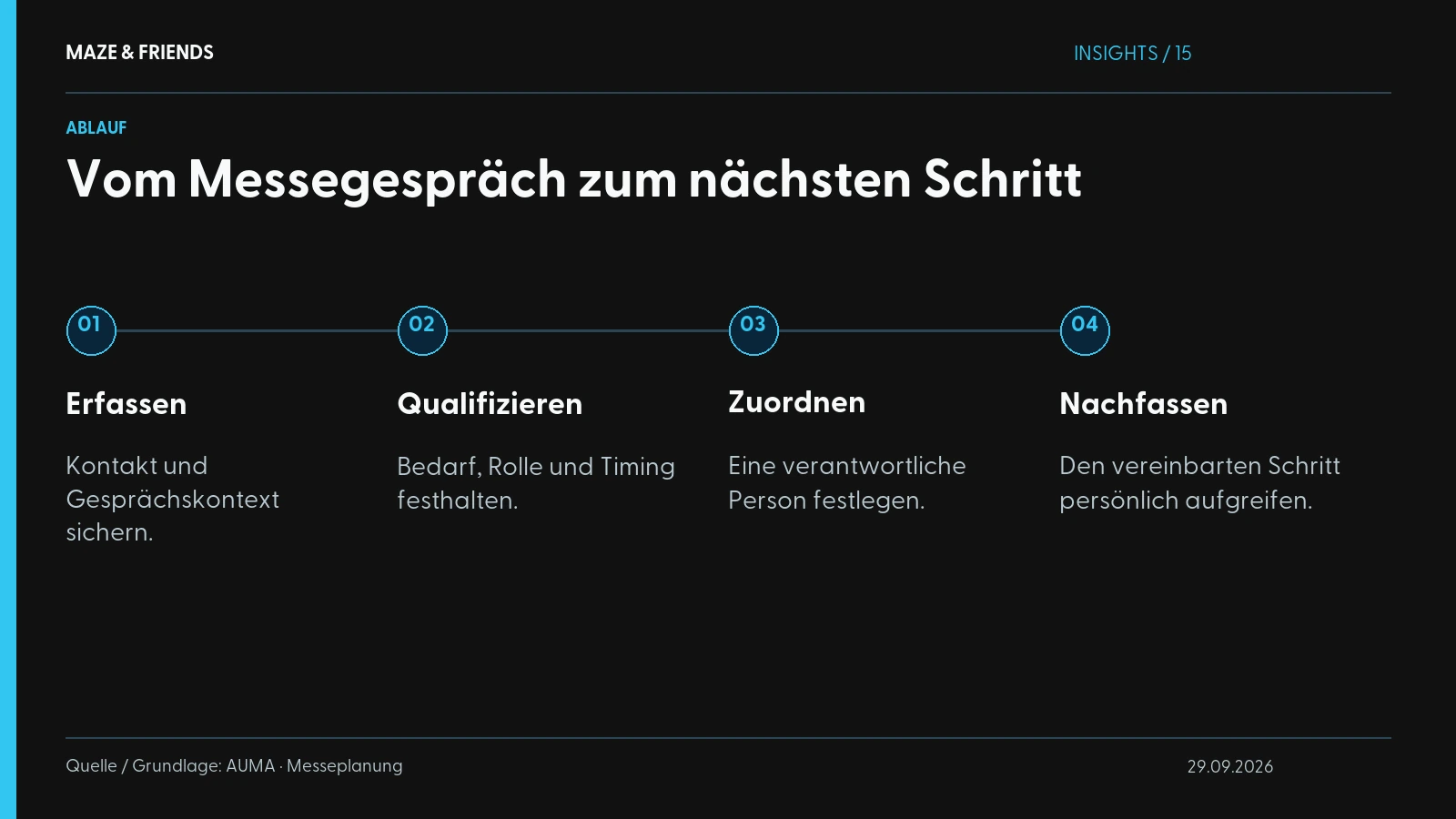
A working trade fair funnel has three levels that interlock:
- On site: consistent lead capture with interest level and one sentence of context.
- Behind it: tracking that gives every lead a source and connects the CRM with the web, so that ROI becomes measurable.
- Afterwards: a follow-up that starts within 48 hours, is prioritised and is personal.
None of these building blocks is rocket science; the value only appears when they come together. A good stand without follow-up is money given away, a follow-up without tracking is flying blind, and tracking without clean capture on the stand has nothing to measure. Only the chain turns your trade fair presence into an investment that pays off and that you can defend with figures when the next budget is set.
Make your next trade fair presence measurable
If you do not want to bring home another pile of unused leads from your next fair, set up the funnel before the fair.
Maze & Friends builds exactly this chain: capture that works, tracking that makes ROI visible, and a follow-up concept that turns leads into business instead of leaving them lying around. Consulting that also delivers.
If you are planning your next trade fair presence, let us build the follow-up concept in from the start. Drop us a line about which fair is coming up: together we will look at where your funnel is currently leaking and how to seal it.
From the studio: Wirtschaftsagentur Burgenland: event photography · Kazakhstan export project: market trip and event. More about the service: Event content.
Frequently asked questions
What is a trade fair lead?
A trade fair lead is a contact from a trade fair who showed genuine interest, from a business card swap to a concrete request for a quote. In sales, a lead means a prospect, in other words a possible sales opportunity.
Typical examples are a stand conversation about a project need, a scanned business card with a note or a form someone filled in via a QR code on the stand. Not every lead is worth the same: only when need, budget and timeline are recognisable does it count as hot and get followed up personally straight away.
What is a trade fair funnel?
A trade fair funnel is the continuous path of a trade fair contact from the first handshake on the stand to the signed deal, with fixed steps for capture, tracking and follow-up. It is called a funnel because many contacts at the top become a few orders at the bottom.
On site there is consistent lead capture, behind it tracking that gives every lead a source, and afterwards a prioritised, personal follow-up that starts within 48 hours. The value comes from the parts interlocking: a good stand without follow-up is money given away, a follow-up without tracking is flying blind.
How can I capture trade fair leads?
Capture trade fair leads digitally and in one consistent format that everyone on the stand uses in the same way, instead of on loose slips of paper with business cards in five jacket pockets. A practical minimum set per contact:
- Name, company, role and email, from a business card or scan
- Interest level: hot, warm or cold
- A concrete next step, such as a quote, a meeting or an information email
- One sentence of context: what did you talk about?
The one sentence of context is the most valuable part, because it gives your follow-up a genuine hook instead of a template email. Brief the team on this format shortly before the fair and test the capture process in advance.
Which app is suitable for capturing leads at trade fairs?
You do not need a special app to start: a well-kept Google Sheet or form with fixed fields beats any software that nobody uses. More important than the tool is that everyone sticks to the same format.
Lead apps with business card or badge scanning and a connection to your customer relationship management system, the CRM, save typing and transfer errors. They pay off as soon as the team uses them consistently. Also ask the trade fair organiser whether they offer exhibitors a scanning solution. Either way, you need a source field that clearly assigns every contact to the fair.
How do I tell whether a trade fair lead is hot, warm or cold?
A hot trade fair lead has concrete interest, a budget and a timeline, a warm one shows genuine interest without a concrete occasion, and a cold one was polite but non-committal. This determines how quickly and on which channel you respond:
- Hot: personally within 24 to 48 hours, by phone or individual email
- Warm: a semi-individual email with an offer of a conversation within a week
- Cold: a short email offering a conversation; into automated nurturing only with consent
The grid is deliberately simple. What matters is that sorting happens at all, ideally on the day after the fair, and that hot leads do not end up in the same mass email as everyone else.
How quickly should I follow up after a trade fair?
Start the follow-up within 48 hours of the fair; ideally, contact hot leads the same day or the next. In this window, the memory of the conversation is fresh and the contact is still in trade fair mode.
After that, day-to-day work returns and your email competes with everything else. A solid message after two days achieves more than a perfect one after two weeks. As a rhythm for the first stretch: sort on day 1, contact hot leads personally on days 1 to 2, write to warm leads on days 2 to 3, move cold contacts with consent into nurturing on days 3 to 5 and, in weeks 2 to 3, follow up with everyone who has not responded.
What do I write in a follow-up email after a trade fair?
A good follow-up email after a trade fair refers to the specific stand conversation and offers a clear, low-threshold next step. A sentence like “Great that we talked about your topic X on the stand” beats any generic thank-you email, and that is exactly why you note the context of the conversation on the stand.
Instead of “Feel free to get in touch if you have any questions”, you offer something concrete, such as a 20-minute call, a short demo or a relevant document. In the DACH region, a tone between equals that takes its time works better than a forceful sales sequence that burns the trust you have just built.
How often can I contact a trade fair lead without seeming pushy?
Two or three friendly follow-ups over two to three weeks are normal in B2B and rarely perceived as pushy, as long as every message has substance. Someone who does not respond to the first email is usually simply busy.
Bring something new with every follow-up: an answer to a question from the conversation, a relevant example or a document. Pure “I just wanted to check in again” emails cost trust instead of building it. Document every response so that nothing slips through and nobody writes twice.
Why do so many trade fair contacts fizzle out after the fair?
Trade fair contacts usually fizzle out because capture, ownership and speed are missing, and rarely because of a lack of interest. Nobody sorts them, nobody feels responsible, and by the time someone follows up, two weeks have passed. On top of that comes a lack of prioritisation, so the prospect with a budget gets the same standard email as someone who only wanted a pen.
Exactly how large the share of unused leads is depends on the industry and the team, and individual figures should be treated with caution. The direction, however, is clear: most teams are good at collecting contacts on the stand, but turning them into business afterwards fails for lack of a process behind it.
Who should take over the follow-up after the trade fair?
The trade fair follow-up needs one named person in charge, otherwise sales thinks marketing is taking care of it, and vice versa. Settle this responsibility before the fair.
A practical split: hot leads go straight to sales together with the context of the conversation, while one person is responsible for the follow-up emails to warm and cold leads and, for contacts with consent, for nurturing. A traditional stand builder does not take on this part, because funnel and tracking work is a different craft. If you lack internal capacity, a partner such as Maze & Friends can set up capture, tracking and follow-up as one continuous chain.
Can I automate the follow-up after the trade fair?
Partly: cold leads with consent belong in automated nurturing, hot leads always in personal hands, by phone or individual email. For warm leads, a semi-individual sequence with a clear offer works, such as a demo or a short call.
For marketing email sequences you need prior consent, in B2B too. Good automation delivers substance over weeks instead of pushing “Buy now” after three days. The mistake is to treat every lead the same: if you put hot contacts into the mass email, you give away precisely the conversations that would have made the fair worthwhile.
Can I add trade fair contacts to my newsletter?
In Austria and Germany, you can generally only add trade fair contacts to a newsletter with their consent, because marketing emails require prior permission. Ask actively on the stand whether you may send information, note the consent in your capture format and have it confirmed by a confirmation email, the so-called double opt-in.
An email the contact explicitly asked for in the conversation, such as a quote or a document, is something different from a marketing newsletter. This overview does not replace legal advice; if in doubt, clarify the details with a lawyer or, in Austria, with the Austrian Economic Chamber (WKO).
What does a trade fair lead cost?
You calculate the cost per trade fair lead by dividing the total cost of your presence by the number of leads; the same calculation per qualified lead is more meaningful. The total cost includes stand rental, build-up, staff, travel and materials.
There is no reliable flat figure, because fairs, stand sizes and lead definitions vary widely. Even more important than the price per lead is how many leads later turn into meetings, quotes and orders. These intermediate figures show you early on whether your funnel is working, long before the first order arrives.
How do I attribute later orders to a specific trade fair?
Give every trade fair lead a unique source in your CRM, your customer relationship management system, such as “Trade fair XY 2026”, so that the origin remains visible until the deal is signed. For digital trails, use dedicated landing pages, QR codes and links with UTM parameters, small additions to the address from which your analytics tool recognises where a visitor came from.
Only when your CRM and web tracking are connected can you see the chain from the handshake on the stand to the signed order. Without this trail, trade fair ROI remains an estimate; with it, it becomes a figure you can use to defend the next budget.
Next step
Want to know which of this fits your company? We will work it out together in 30 minutes. Free and without obligation.
Pick a time
Manuel Zellnig has been building visibility for companies since 2018: brand film, personal branding, performance marketing and AI visibility. Qualified advertising specialist (Werbeakademie Wien), Bachelor in Business Management (Carinthia University of Applied Sciences), author of the book ‘Mobile Apps zur Messung der Kundenzufriedenheit’ (2017, in German) and creative expert for the Austrian Economic Chamber (WKO) in two transformation guides. He measures before he recommends and writes here about what actually works in projects.
Publications and interviews: WKO transformation guide for printers (in German) · WKO transformation guide for florists (in German) · Interview with Ghezzo (in German) · ‘Heute’ on Viennese start-ups (in German)