


Aftermovies and event recaps done right
What is an aftermovie, and what is an event recap? How to turn one event shoot into content until the next edition, with a shot list and a 12-month plan.
In short: An aftermovie is a short, emotionally edited film that captures the mood and the key moments of an event in 60 seconds to three minutes. The real lever lies in the raw footage: from one event shoot you pull recap clips, soundbites, speaker snippets and social clips that keep your content running until the next edition. Vienna-based Maze & Friends produces aftermovies and event content for conferences, trade fairs and congresses.
You spend months planning your conference or trade fair, the attendees love it, and three weeks later everything goes quiet. The content calendar is empty, and ticket sales for the next edition start from almost zero. Yet there is enough footage on the hard drive for an entire year. It just never gets used.
Here you’ll learn what separates an aftermovie from a recap video, how to treat an event as a source of content for months, and why this is an often overlooked ticket lever for B2B organisers.
What is an aftermovie?
An aftermovie is a short, emotionally edited film that sums up an event after it’s over. The typical length is 60 seconds to three minutes. It thrives on fast cuts, music, people and energy, and it’s meant to trigger a feeling in anyone who wasn’t there: “I want to be there next time.”
The term originally comes from the festival and music world. Tomorrowland and other big festivals made the aftermovie famous, with lavishly produced films that build the hype for the next edition while the credits are still rolling. At B2B conferences, specialist trade fairs and corporate events, the principle works the same way; only the tone is different. Instead of drops and confetti, it’s about an expert audience, substance, networking and proof that something relevant is happening here.
A quick orientation, because the terms are often used interchangeably:
- Aftermovie: the emotional hero film. Mood, music, pace. Your flagship.
- Recap video (or event recap): more factual, often more informative. What happened, who was there, which topics. Can be longer and can include interviews.
- Event film: the umbrella term for any film material around an event, from the aftermovie and recordings of speakers to testimonials.
In practice the line is blurred. What matters most to you as an organiser is that both formats come from the same footage. That’s exactly the point most people leave on the table.

What is a recap video, and how does it differ from an aftermovie?
A recap video recapitulates. It sums up what happened in terms of content. The aftermovie mainly conveys emotion (“That was a great event”), the recap video information (“These were the three key topics, this is what the speakers said, this is what you take away”).
For a B2B event recap, this is often the more valuable format, because your audience of decision-makers, trade visitors and potential exhibitors comes for the content. For them, the party is a side note. A recap clip in which a speaker makes a bold claim or an attendee explains why the trip was worth it sells your next ticket more credibly than any tracking shot in the aftermovie.
On average, the difference looks like this:
| Aftermovie | Recap video | |
|---|---|---|
| Primary goal | Emotion, pull, hype | Substance, proof, information |
| Length | 60 sec – 3 min | 2 – 8 min (or a series of short clips) |
| Core footage | B-roll, atmosphere, music | Soundbites, speakers, interviews |
| Where it runs | Landing page header, ads, hero | LinkedIn, newsletter, YouTube |
| Role in the funnel | Attention (TOFU) | Trust & proof (MOFU) |
The good news: if your shoot is planned properly, both come out of the same footage. You don’t need two productions. You need one shoot that is designed for reuse from the very start.

How do I use event footage beyond the event itself?
This is where the real value lies. That’s why we at Maze & Friends never sell an event as “We’ll make you an aftermovie”, but as a content production. A well-filmed event is a stockpile of raw material. The only open question is whether you mine it systematically or leave most of the footage sitting unused on the drive.
The mistake in thinking: one event = one film
Many organisers order “an aftermovie”, get a nice two-minute film, post it once, and that’s it. The raw footage, often several hours of it, is never touched again. It’s like buying a whole cow and only eating the fillet.
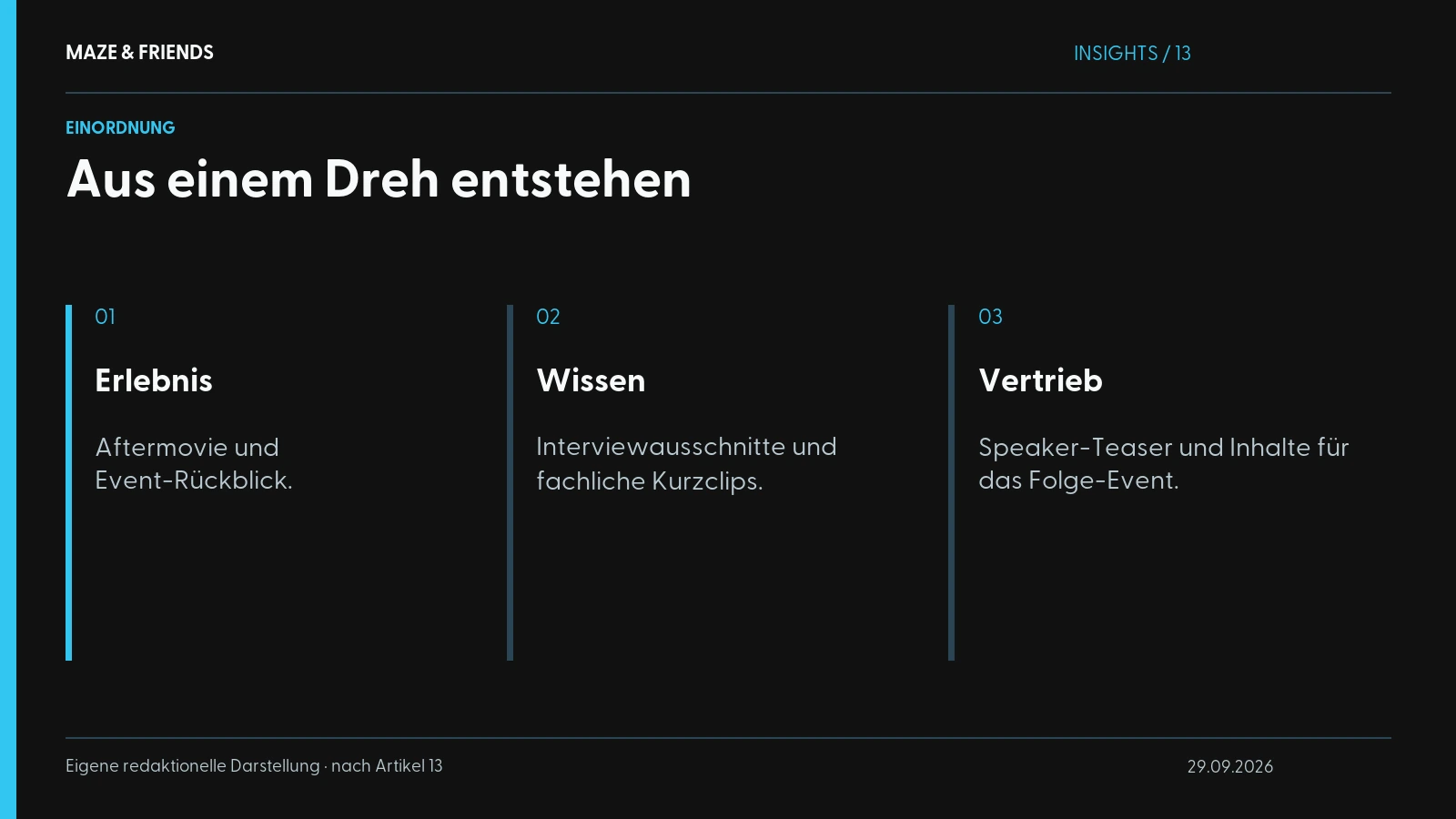
You’re better off treating the event shoot as a content library. One shoot, many formats, rolled out over months. Here is what that looks like in practice.
The content cascade from one event
A single, well-planned shoot typically produces:
- The aftermovie (1): your hero film for the event landing page and paid ads for the next edition.
- Recap clips (3–5): cut by topic, e.g. “The keynote in 90 seconds”, “What exhibitors say”.
- Speaker snippets (5–15): individual strong statements as short social clips, ideal for LinkedIn.
- Testimonials (3–8): soundbites from attendees on why the visit was worth it. Content that sells tickets directly.
- Photo assets: stills from the video footage or a parallel photo shoot for newsletters, the website and presentations.
- B-roll library: atmospheric footage you reuse later for trailers, sponsor decks and sales materials.
Do the maths. If you post three speaker snippets a week, those alone will last you more than a month. Add recap clips, testimonials and photo content, and with a little discipline you can cover the whole stretch until the next edition, ideally as part of ongoing social media marketing.
The 12-month rhythm for event content
Timing matters more than volume. Content you fire off all at once in week one is forgotten by week four. So spread it along your ticket funnel:
Months 1–2 (straight after the event): The aftermovie as your hero. A “thanks for coming” recap. The strongest moments, while memories are still fresh. The aim is afterglow, reach and early goodwill towards the next edition.
Months 3–6 (the quiet phase): This is exactly where many organisers disappear. Now you bring out the speaker snippets and topical recap clips. “Remember this claim?” Every clip keeps the event top of mind and turns it into a place for relevant content rather than a date in the calendar.
Months 7–9 (the ticket run-up): Now testimonials and numbers recaps move to the front. “This many attendees, this many countries, this is what they took away.” This proof content is what turns “interesting” into “I’m booking”. Link it to the start of ticket sales.
Months 10–12 (the final sprint): Best-of compilations, “last call” clips with the most emotional moments, combined with the aftermovie as a reminder of why people want to be there. The circle closes, and the shoot for the new edition is just around the corner.
To see which clip brings in tickets in which phase, add UTM parameters to every link. How that works is explained in the Google Analytics help on campaign URLs (in German). How a shoot that works for a whole year pays off is covered in the article on the ROI of event marketing.

How do you plan an event shoot that lasts 12 months?
Whether you end up with one aftermovie or a content library is decided in the planning and on the day of the event. The edit is too late. If the footage is missing, not even the best editor in the world can conjure it up. These are the points we watch most closely in event productions.
Before the event: plan the shot list backwards
Don’t ask “What are we filming?”. Ask “Which formats do we want to roll out over twelve months?” and derive the shot list from that. If you need testimonials, plan a quiet spot with good sound where you can bring attendees. For speaker snippets you need clean audio from the lectern; room sound won’t do.
- Sound matters more than picture. People forgive a shaky shot, never bad sound. For soundbites and speakers: lavalier or shotgun mic, no camera audio.
- More B-roll than you think. Hands, conversations, details, networking, coffee, name badges. This footage is the connective tissue for every later clip.
- Collect testimonials actively. They don’t happen by themselves. Plan fixed slots and approach attendees directly while they’re in the mood.
During the event: capture the short-lived moments
Some formats have a very short window. A “live from the event” clip for social has to go out the same day; in three weeks nobody will care. Keep one person or a light setup ready to cut and post quickly, while the rest of the footage goes into post-production at a calmer pace.
After the event: the edit plan, not the edit
Before the first clip is cut, the plan is in place: which formats, in which order, for which channel. A good editor who knows the footage is meant to become twelve assets cuts differently from one who is only supposed to deliver “the one film”. They set the soundbites aside, mark the strong moments and think in building blocks.
So an event shoot is a production with a clear output plan, not a creative accident. That includes an honest view of which footage is worth it and which isn’t. Not every conference needs the big cinematic aftermovie. Sometimes ten honest speaker snippets are worth more.

Aftermovie, recap or brand film?
When briefing a production, you should know which format does which job:
- Aftermovie: looking back, emotional, tied to the event. Shows what it was like.
- Recap video: looking back, informative. Shows what happened.
- Brand film: not tied to any event. It’s about your organisation, your format and your stance, and shows who you are.
A brand film for your event format can be made perfectly well from event footage. It uses the same images but tells the story of “this is what this conference stands for” rather than “this was the 2026 event”. If you’re unsure which format does which job, this overview helps: What is a brand film, and when do you need one?
For most event organisers, the point is less about one format and more about the raw footage from which you pull the right format for each phase. That costs less than three separate productions and delivers far more content.
Who is a content shoot worth it for, and who not?
Not every event justifies a strategic content shoot.
It’s worth it if:
- Your event recurs (annually, twice a year) and you need to win tickets, exhibitors or sponsors for the next edition.
- Your audience needs trust and proof before booking, typically at B2B conferences and specialist trade fairs.
- You have a content calendar to fill anyway and are currently empty-handed.
It’s less worthwhile if:
- The event is a one-off internal format with no follow-up edition.
- There are no channels on which the content will be rolled out (then the multiplier is missing).
If your event recurs and has a ticket funnel, the content library is usually the more economical choice than the classic one-off aftermovie.
One day of event, twelve months of content
The aftermovie is the flagship; the real value lies in the raw footage. Plan the content shoot as part of the event concept, with a shot list, clean sound and an edit plan, and roll out the footage along the ticket funnel until the next edition. How event content fits into the ticket funnel is shown in the article How to promote your conference properly.
From the studio: aws: event film for the Austrian Business Angel Day · Vienna Region: RIZ UP GENIUS 2026.
Frequently asked questions
What does aftermovie mean?
An aftermovie is a short, emotionally edited film that sums up an event after it has ended, usually in 60 seconds to three minutes.
It thrives on fast cuts, music, people and energy and is meant to trigger a feeling in everyone who wasn’t there: “I want to be there next time.” The format became famous through big music festivals such as Tomorrowland. At conferences, specialist trade fairs and corporate events, the principle works just the same, only with a different tone. Instead of confetti, the film shows an expert audience, substance and networking.
What is an event recap?
A factual review of an event that shows what happened in terms of content: topics, speakers, key statements and voices from attendees.
“Recap” is short for “recapitulation”, in other words a review or summary. A recap video can run for two to eight minutes, but often works better as a series of short clips, such as “The keynote in 90 seconds” or “What exhibitors say”. In B2B it is often the more valuable format, because the audience comes for the content. A speaker with a bold claim sells the next ticket more credibly than any tracking shot.
What is the difference between an aftermovie and a recap video?
An aftermovie mainly conveys emotion and mood, a recap video mainly information about what happened in terms of content.
The aftermovie runs for 60 seconds to three minutes, thrives on atmospheric shots and music and works as the flagship on the landing page and in ads. It creates attention. The recap is built on soundbites, speakers and interviews, runs on LinkedIn, in the newsletter or on YouTube, and creates trust. You don’t need two productions for this. If the shoot is planned properly, both formats come out of the same footage.
What is the difference between an aftermovie, an event film and a brand film?
Event film is the umbrella term for film material around an event, and the aftermovie is part of it. The brand film is not tied to any event.
The aftermovie looks back emotionally at what it was like. The recap shows informatively what happened. The brand film shows who you are: your organisation, your format, your stance. A brand film for a conference format can be made perfectly well from event footage and then tells the story of “this is what this conference stands for” rather than “this was the 2026 event”. That’s why most organisers are best served by raw footage from which the right format emerges for each phase.
How long should an aftermovie be?
For social media and ads 60 to 90 seconds, for the event landing page up to three minutes.
Shorter usually beats longer, because the aftermovie is meant to create pull. Documenting is not its job. For vertical platforms, a dedicated vertical version is worth it rather than a cropped horizontal one. A recap video with interviews can run for two to eight minutes, but is better broken down into several short clips that you roll out over weeks. Plan the lengths and formats you want before the shoot, so the camera delivers the right footage.
How much does an aftermovie cost?
That depends on the length of the shoot, the size of the team, the equipment and the number of formats you want. That’s why there are no reliable flat figures.
What makes a difference is, for example, whether one or several camera operators are filming, whether interviews are recorded with clean sound, whether photos are taken in parallel and how many edits are produced. What matters is the calculation behind it. A shoot that yields twelve months of content costs far less per finished clip than three separate productions. So always ask about the output per shoot in your briefing.
How do I make an aftermovie?
A good aftermovie is made before the event. You decide which formats you need over the next twelve months and derive the shot list from that.
On the day of the event, sound matters more than picture, so speakers and testimonials need lavalier or shotgun mics instead of camera audio. Shoot more atmospheric footage than you think you need: hands, conversations, details, networking. Collect testimonials actively in fixed slots in a quiet spot while attendees are in the mood. After the event, the edit plan comes first and the edit second, meaning which formats, in which order, for which channel.
What happens in the post-production of an event film?
After the event, the footage is turned into finished films: reviewing, editing, mixing sound, correcting colour, adding music and subtitles, exporting.
With event content, it starts with an edit plan. An editor who knows the footage is meant to become twelve formats cuts differently from one who only has to deliver one film. They set soundbites aside, mark strong moments and think in building blocks. The result is versions for every channel, for example vertical with subtitles for social media. Feedback rounds are standard and should be clearly defined in the quote.
How do I keep using event footage after the aftermovie?
Treat the raw footage as a content library. Besides the aftermovie, a well-planned shoot produces many other formats for months.
- 3–5 recap clips, cut by topic
- 5–15 speaker snippets with individual strong statements, ideal for LinkedIn
- 3–8 testimonials from attendees on why the visit was worth it
- Photos for newsletters, the website and presentations
- Atmospheric footage for trailers, sponsor materials and sales
Many organisers post the aftermovie once and never touch the raw footage again. That’s why Maze & Friends plans event shoots as a content production from the start.
How do I spread event content over twelve months?
Along the ticket funnel: first the afterglow, then content for the quiet phase, then proof for the start of ticket sales and finally the final sprint.
In months 1–2, the aftermovie and a “thanks for coming” recap run while memories are still fresh. When most organisers go silent in months 3–6, speaker snippets and topical clips keep the event top of mind. For the start of ticket sales in months 7–9, testimonials and numbers recaps move to the front. Months 10–12 bring best-of compilations and “last call” clips.
Which events is an aftermovie worth it for?
Above all for recurring events that need to win tickets, exhibitors or sponsors for the next edition.
This applies especially to B2B conferences and specialist trade fairs whose audience needs trust and proof before booking, and to organisers who have a content calendar to fill anyway. It’s less worthwhile for one-off internal formats with no follow-up edition, or if there are no channels on which the content will be rolled out. Not every conference needs the big cinematic aftermovie. Sometimes ten honest speaker snippets are worth more.
How do I measure whether an aftermovie works?
By how many viewers click through to the event page and buy tickets or register their interest there. Views alone say little.
With video posts and ads, you usually don’t see individual viewers, only aggregated figures such as views, watch time and clicks. It becomes meaningful when every link carries UTM parameters, meaning tags in the link, and purchases are reported back cleanly. Then you can see which clip brings in tickets in which phase. Also compare early-bird sales with and without event content running.
What are the legal points to consider when filming at an event?
Inform attendees in advance, get consent for interviews and testimonials, and clear the usage rights for the music.
It’s common practice to point out at registration and on site that photos and video are being taken. Anyone who speaks directly to camera should agree in writing to how the footage will be used. For music in the aftermovie you need a licence, for example from a licensed music library. Well-known songs without a licence can lead to blocking or muting on platforms, on YouTube, for example, via Content ID (in German). Have your templates checked once by your legal adviser.
How quickly should the first event content go live?
On the same day, for example as a short “live from the event” clip for social media. The aftermovie follows in the first few weeks afterwards.
For the same-day clip, you need one person or a light setup that can cut and post quickly while the rest goes into post-production at a calmer pace. The aftermovie has the strongest effect in the first one to two months, while memories are still fresh. Content you publish all at once in week one is forgotten by week four. Spread it across the year.
Can I shoot an aftermovie myself, or do I need a professional team?
You can shoot quick social clips on the day of the event yourself with a smartphone. For the aftermovie, speaker recordings and testimonials, a professional team is worth it.
The difference lies less in the camera than in the sound and the planning. People forgive a shaky shot, never bad sound, and clean audio from the lectern takes equipment and experience. This split has proven itself: the professional team shoots the footage for the big formats, while someone from your team posts short clips on the same day.
Next step
Want to know which of this fits your company? We will work it out together in 30 minutes. Free and without obligation.
Pick a time