


Generating B2B leads without cold calling
Generating B2B leads without cold calling: 7 methods compared honestly by effort, speed and lead quality, plus a starter plan for mid-sized DACH firms.
In short: Generating B2B leads without cold calling means collecting demand instead of interrupting people. Seven methods work reliably for mid-sized companies in the DACH region (Germany, Austria, Switzerland) in 2026: LinkedIn content, SEO, Google Ads, paid social, lead magnets with an email sequence, trade fairs and systematic referrals. None of them works overnight, but combined properly they deliver qualified meetings you can plan for. Vienna-based Maze & Friends builds this system with mid-sized B2B companies.
You know the pattern: sales works through call lists, the hit rate is low, and the pipeline depends on how two or three people feel that day. A good month, a bad month, and very little you can plan. Meanwhile the buyers on the other side are getting younger, doing their own research and hanging up on unannounced calls faster than ever.
That is rarely the sales team’s fault. It’s the method. Cold calling relies on catching people at the wrong moment. Modern B2B lead generation turns this around: it makes sure the right decision-makers already know you, or are actively looking for you, when the need arises. Seven methods do exactly that, and each one is rated honestly here by effort, time to results, cost and lead quality.
What is B2B lead generation, and what is a qualified lead?
B2B lead generation is the systematic process of winning contacts at companies that might need what you offer, including permission to start a conversation with them. A lead is initially just a contact who has shown interest. What counts is the next step.
Because not every contact is worth the same. The distinction that matters day to day:
- Lead: someone has signalled interest, through a download, a form or a click.
- Marketing qualified lead (MQL): broadly fits your ideal customer profile and has shown interest more than once.
- Sales qualified lead (SQL): has a concrete need, a budget and the authority to decide. This is where a conversation pays off.
If you want to generate qualified leads, you need the right list, and size alone does little. Ten SQLs beat a thousand anonymous addresses. It sounds obvious, yet it gets mixed up all the time, and it’s the reason so many “lead generation” campaigns create plenty of activity and little revenue.
The second pair of terms you need: inbound means the customer comes to you (they search, find you and get in touch). Outbound means you go to the customer (you approach them actively). Cold calling is the crudest form of outbound. The seven methods below are mostly inbound or warm outbound, in other words anything except “unknown number, cold call”.

Can B2B companies really win new customers without cold calling?
For the vast majority of mid-sized companies, yes, and usually with better results. Winning new B2B customers today works mainly through trust built in advance and through demand that already exists. If the first time anyone hears of you is a cold call, every conversation starts from zero.
Then there is the legal framework, which makes cold telephone canvassing a delicate matter in the DACH region. In Austria, marketing calls and marketing emails without prior consent are prohibited under section 174 of the Austrian Telecommunications Act (TKG 2021) (in German), and the wording does not exempt businesses. In Germany, a marketing call to a company requires at least presumed consent under section 7 of the German Unfair Competition Act (UWG) (in German), and marketing emails without express consent are practically ruled out there too. That makes lead generation without cold calling the more pleasant route, and often the cleaner one.
Targeted, well-researched outreach is not dead: a thoughtful LinkedIn conversation with someone who fits your profile is something else entirely from a call list worked through by phone. But as the foundation for predictable growth, cold calling no longer holds up in 2026. The following seven methods do.

Which 7 methods bring predictable B2B meetings in 2026?
A word up front: this is not a buffet where you take everything. No mid-sized company can run seven channels properly at the same time. Read the list as a map; in the end you choose two, three at most.
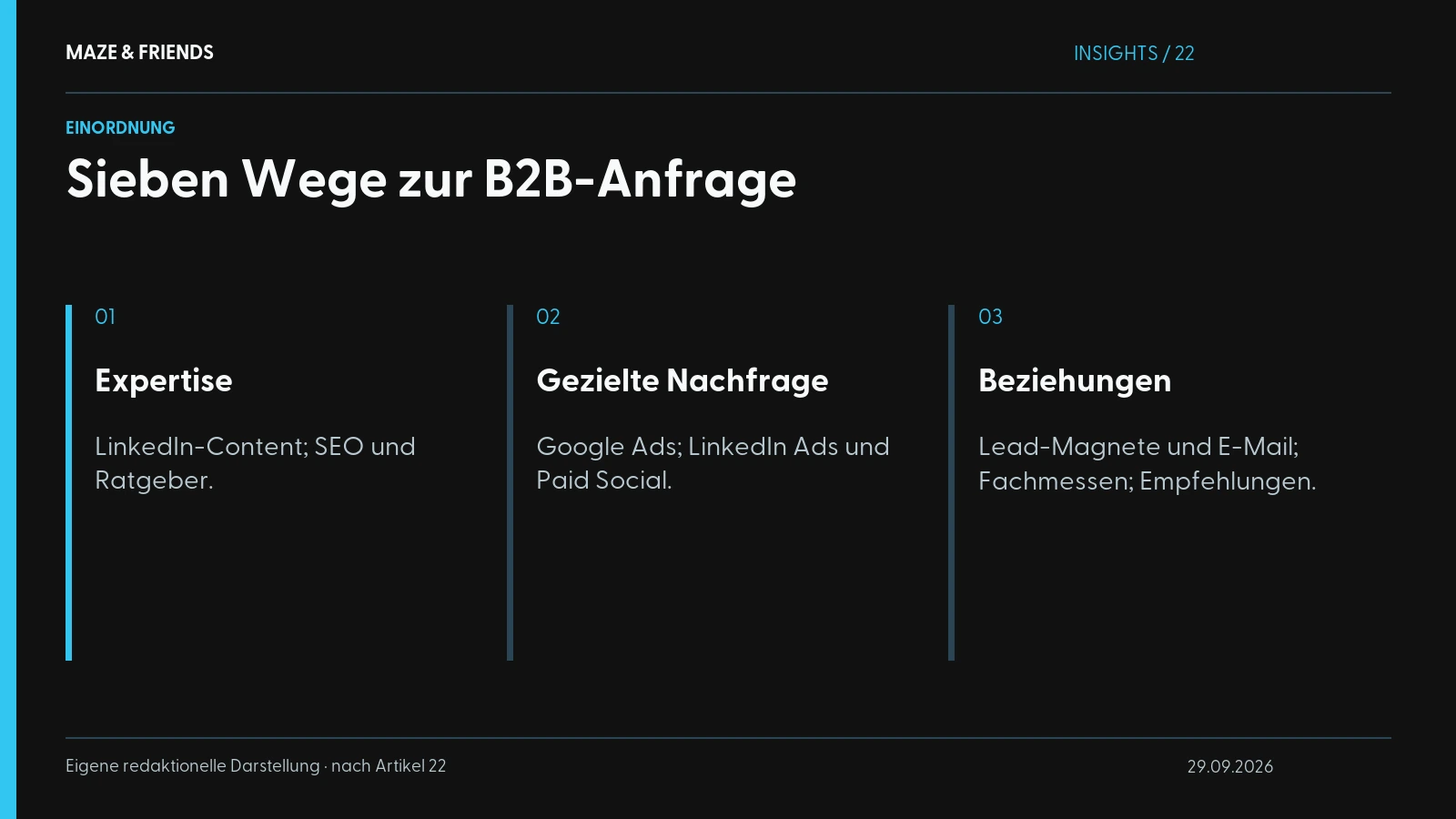
1. LinkedIn content & thought leadership
As managing director or subject-matter expert, you post regularly about your topic, right where your decision-makers spend their working time. Who it suits: almost every B2B business, especially expensive services that need explaining. Effort: high in time and consistency (realistically a good hour a week for months), low in budget. Return: medium to long term, but with very high lead quality, because people get in touch already warmed up and pre-qualified. Honest verdict: not a channel for next week, but the strongest head start in trust in DACH B2B, because the field here is far less crowded than in the US market. How to approach it methodically is covered in thought leadership on LinkedIn and in personal branding for B2B decision-makers.
2. SEO & guide content
With content marketing you answer exactly the questions your buyers google before they buy. Search engine optimisation (SEO) means placing your pages where demand already exists. Who it suits: anyone with an offer that needs explaining and topics people actively search for. Effort: high up front, slow to take effect (roughly three to nine months until traffic becomes noticeable). Return: it compounds, because a good page delivers leads for years without a cost per click for each contact. Honest verdict: the channel that demands the most patience, but in the long run the cheapest per lead. The article you are reading right now is exactly that kind of building block.
3. Google Ads (search ads at the moment of purchase)
Paid ads that appear exactly when someone is actively searching for your offer. Who it suits: anywhere there is search volume with genuine purchase intent. Effort: budget plus a clean setup, a convincing landing page and ongoing management. Return: fast, with first enquiries often within a few days, but only for as long as you pay. Honest verdict: the fastest route to meetings, ideal for getting things moving. The catch: without clean conversion tracking you spend money blind and never know which ad actually brings customers. How to measure this reliably is explained in setting up conversion tracking properly.
4. LinkedIn Ads & paid social
Paid ads targeted precisely by job title, industry and company size, as listed in LinkedIn’s help page on targeting options (in German). Who it suits: clearly defined niche audiences and higher-priced offers. Effort: budget (cost per click and per lead are well above Google) plus an attractive offer such as a white paper, webinar or demo. Return: medium; it rarely works for direct sales, but works well for lead magnets. Honest verdict: precise, but expensive. It only pays off above a deal value that comfortably carries the high contact costs. The wrong channel for a €3,000 contract, often exactly right for a €50,000 one.
5. Lead magnets & email nurturing
A genuinely useful piece of content such as a checklist, calculator or guide in exchange for an email address, followed by an automated email sequence that builds trust until the contact is ready to talk. Who it suits: anyone with traffic that is not yet ready to buy. Effort: build the asset and the sequence once, and from then on it runs largely on autopilot. Return: medium to high, because “not quite there yet” eventually turns into “let’s talk”. Honest verdict: the glue between all the other channels. Without it, exactly the traffic you paid dearly to build through SEO and ads drains away. This is how you generate qualified leads from anonymous visitors instead of letting them pass by once.
6. Trade fairs & industry events
Industry trade fairs, specialist conferences and your own events bring personal contact with purchase intent. Who it suits: classic mid-sized industrial companies, where a handshake and a face still count for a lot. Effort: high, with stand costs, travel, staff and preparation. Return: high lead quality, but the ROI is only decided in the weeks after the fair. Most trade fair leads die in the follow-up, because nobody follows up quickly and in a structured way. Honest verdict: expensive, but hard to beat for trust, provided the follow-up works. Why so much budget evaporates at exactly this point, and how to prevent it, is covered in our guide to the trade fair funnel.
7. Referrals & partnerships
Satisfied customers and complementary partners such as tax advisers, suppliers or neighbouring service providers actively recommend you. Who it suits: anyone with happy existing customers, which means practically every established business. Effort: low in money, but it needs a fixed routine: ask specifically, create occasions, look after partner networks. Return: usually the highest closing rate of all seven methods at the lowest cost, but it can’t be scaled at the push of a button. Honest verdict: a badly underrated channel that almost nobody runs systematically. Turn “happens by itself now and then” into a fixed routine and you tap hidden reserves.
Which channel suits you? The honest comparison
None of these methods is “better”. They have different profiles, and what matters is what fits your situation, your budget and your patience.
| Method | Effort | Time to results | Cost per lead | Lead quality |
|---|---|---|---|---|
| 1 · LinkedIn content | high (time) | months | very low | very high |
| 2 · SEO & content | high (lead time) | 3–9 months | low (long term) | high |
| 3 · Google Ads | medium | days | medium–high | medium–high |
| 4 · LinkedIn Ads | medium | weeks | high | medium |
| 5 · Lead magnet + email | medium (one-off) | weeks | low | medium–high |
| 6 · Trade fairs & events | high | occasional | very high | high |
| 7 · Referrals | low–medium | variable | very low | very high |
The pattern is clear: the cheapest, highest-quality channels (LinkedIn content, SEO, referrals) need time or a fixed routine. For the fast channels (Google Ads, trade fairs) you pay more money. That is why predictable new customer acquisition in B2B almost always works as a combination of one fast and one long-term method.

How do you get started without spreading yourself too thin?
The most common mistake is starting everything at once and giving up everywhere after six weeks. An honest starter plan looks different:
- Be able to measure first. Before you put a single euro into ads, set up clean conversion tracking. Otherwise you optimise blind and, at the end of the quarter, have no idea which channel brought in the customers.
- One fast channel for immediate meetings. For most companies, that is Google Ads or a systematic referral programme; both bring conversations in the short term.
- One slow channel that compounds. LinkedIn content or SEO. After a few months it pays off and makes you independent of your advertising budget.
- Build the glue. A lead magnet with an email sequence, so you don’t lose any contact who isn’t ready to buy yet.
Along the way, measure the cost per qualified lead and the cost per customer won; the bare number of leads tells you little. Only these figures show you where to double down and where to switch off. How to turn existing traffic into more enquiries before you buy more of it is covered in conversion optimisation without the buzzwords.
And if you don’t want to shoulder all this alongside day-to-day business: Maze & Friends builds this system with you, from strategy and content to campaigns and tracking, all from one team.
Two or three methods instead of all seven
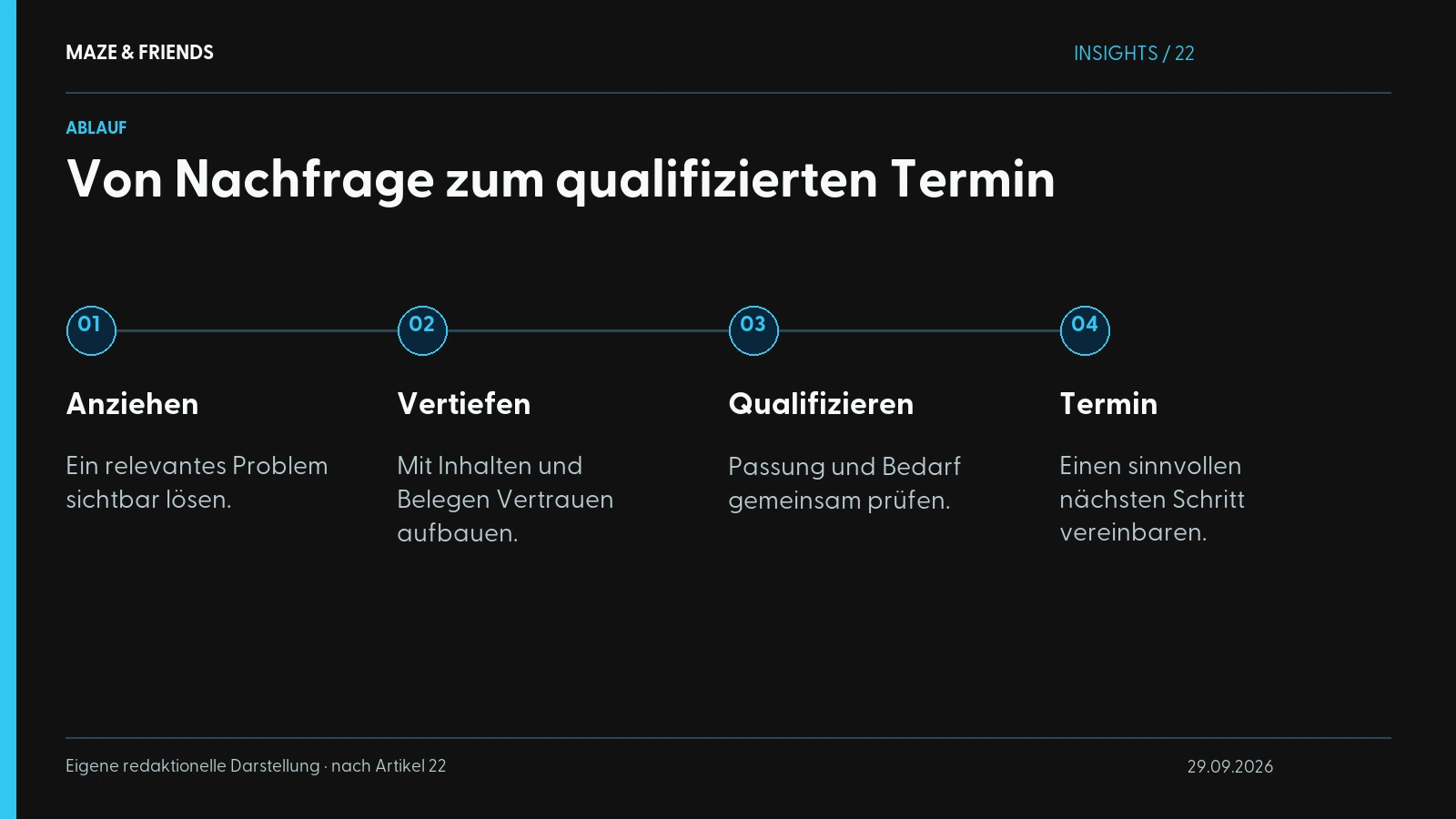
Predictable B2B lead generation is a system of two or three well-chosen methods, measured cleanly and sustained over months. A trick or a single channel won’t get you there. The leverage lies in choosing deliberately and in finally being able to measure what works. More channels rarely help.
If you want to know which two methods will bring your business meetings fastest: book a no-obligation strategy call. You’ll get an honest assessment of your starting position, and we’ll also tell you if a channel makes no sense for you.
From the studio: Nachfolger: campaigns in five countries · Aviation Academy Austria: brand film, reels and performance marketing.
Frequently asked questions
What does B2B lead generation mean?
B2B lead generation is the systematic process of winning contacts at companies that might need your offer, including permission to start a conversation with them. B2B stands for business-to-business, meaning transactions between companies.
A lead is initially just a contact who has shown interest, for example through a download, a form or a click. Ten sales-ready leads beat a thousand anonymous addresses. Modern B2B lead generation makes sure decision-makers already know you, or are actively looking for you, when the need arises.
What is the difference between a lead, an MQL and an SQL?
A lead has signalled interest, a marketing qualified lead (MQL) also fits your ideal customer profile, and a sales qualified lead (SQL) has a concrete need, a budget and the authority to decide. Only at the SQL stage does a sales conversation pay off.
An MQL has usually shown interest several times but isn’t ready for a conversation yet. Many campaigns create a lot of activity and little revenue because these stages get mixed up and every form submission already counts as a success. So measure how many leads actually become SQLs and, eventually, customers.
How do you generate B2B leads without cold calling?
You generate B2B leads without cold calling by collecting existing demand and building trust before you sell, rather than interrupting people at the wrong moment. Seven methods work reliably for mid-sized companies in the DACH region: LinkedIn content, SEO with guide content, Google Ads, LinkedIn Ads and paid social, lead magnets with an email sequence, trade fairs and industry events, and systematic referrals.
No mid-sized company can run all seven properly at the same time. Choose two, three at most, that fit your ideal customers, your budget and your patience, and combine one fast channel with one long-term channel.
How much does a B2B lead cost?
What a B2B lead costs depends on the channel: content and referrals cost mainly time, while Google Ads and LinkedIn Ads need an ongoing budget. That is why there is no reliable flat figure.
By comparison, the cost per lead is very low for LinkedIn content and referrals, low for SEO in the long run and for lead magnets, medium to high for Google Ads, high for LinkedIn Ads and very high for trade fairs. More important than the price per lead is what a won customer costs you. With a high contract value, even an expensive channel can pay off, because the contract comfortably carries the contact costs.
Can you buy B2B leads?
No, you can only buy addresses and contact lists: a purchased data record is not yet a lead, because the contact has not signalled any interest in you. So you have addresses, but no demand.
Then there is the legal framework: cold marketing emails to companies without consent are practically not permitted in the DACH region, cold calls are heavily restricted and, in Austria, not allowed at all without consent. With purchased lists you therefore often end up in exactly the kind of cold outreach that achieves little. It’s more sustainable to win leads yourself, for example through a lead magnet for which prospects give you their address voluntarily.
Is cold calling allowed in B2B?
Only to a limited extent: in Austria, marketing calls and marketing emails need prior consent even in B2B, while in Germany presumed consent is enough for calls. Austria, Germany and Switzerland differ in the details, and a lot depends on the individual case.
So clarify specific plans with a lawyer or, in Austria, with the Austrian Economic Chamber (WKO). Lead generation in which prospects get in touch themselves is more pleasant and often the cleaner route. Cold calling hardly works as a foundation for predictable growth any more, because buyers do their own research and hang up on unannounced calls faster.
Which platform is best for B2B leads?
There is no single best platform: LinkedIn reaches decision-makers through content and precise ads, while Google captures demand at the moment of the search. Which one suits you depends on your contract value and on how much people search for your offer.
LinkedIn content delivers very high lead quality but takes months of consistency; in the DACH region the field there is far less crowded than in the US market. LinkedIn Ads can be targeted precisely by job title, industry and company size, but they are expensive: for a €3,000 contract they are the wrong channel, for a €50,000 contract often exactly right.
How quickly does B2B lead generation bring the first meetings?
B2B lead generation brings meetings fastest through Google Ads, with first enquiries often within days; a systematic referral programme also delivers conversations in the short term. SEO takes roughly three to nine months until traffic becomes noticeable, LinkedIn content several months.
The price of the fast channels: ads cost money continuously, and the effect stops as soon as you switch off the budget. The slow channels compound instead; a good guide page delivers enquiries for years without a cost per click. That is why new customer acquisition usually becomes predictable with a combination of one fast and one long-term method.
Which channels should I start with in B2B lead generation?
Start your B2B lead generation with clean tracking, one fast channel for immediate meetings and one slow channel that compounds, connected by a lead magnet with an email sequence. The order:
- Be able to measure first: set up conversion tracking that shows which channel brings in enquiries
- Fast channel: usually Google Ads or a systematic referral programme
- Slow channel: LinkedIn content or SEO, which makes you less dependent on your advertising budget
- Glue: a lead magnet with an email sequence, so you don’t lose any contact who isn’t ready to buy yet
The most common mistake is starting everything at once and giving up everywhere after six weeks.
What is a lead magnet in B2B?
A lead magnet is a genuinely useful piece of content, such as a checklist, a calculator or a guide, that prospects receive in exchange for their email address. It is followed by an automated email sequence that builds trust until the contact is ready to talk.
It suits anyone whose website has visitors who aren’t ready to buy yet. Once built, the sequence runs largely on autopilot. Without this building block, exactly the traffic you paid dearly to build through SEO and ads drains away. That makes the lead magnet the glue between the other channels.
How do I measure whether my B2B lead generation is working?
Whether your B2B lead generation is working is shown by the cost per qualified lead and the cost per customer won for each channel. The bare number of leads is not enough. The basis is clean conversion tracking across all channels that shows where an enquiry came from and what became of it.
Also work out your own closing rate: how many qualified leads become customers in your business? There is no universal rule of thumb for this; it depends on your offer, price and lead quality. Once you know your rate, the pipeline becomes predictable and you can steer budget to where it works.
What are the most common mistakes in B2B lead generation?
The most common mistake is starting too many channels at once and giving up after a few weeks, instead of sustaining two or three methods for months. Just as expensive are ads without conversion tracking, where nobody knows which ad brings in customers.
On top of that, every form submission is often counted as a success, even though only sales-ready leads bring revenue. Many let visitors who aren’t ready to buy yet slip away because no lead magnet with an email sequence catches them. And LinkedIn Ads get used for small contract values that can’t carry the high contact costs.
What are the trends in B2B sales?
The most important trend: buyers do their own research and hang up on unannounced calls faster, so new customer acquisition is shifting from cold calling to inbound. Inbound means the customer finds you and gets in touch on their own, for example through search engines, expert content or referrals.
At the same time, personal visibility is becoming more important: LinkedIn content from managing directors and subject-matter experts builds trust before the need arises, and the field is less crowded in the DACH region than in the US market. Cold calling no longer works as a foundation for predictable growth in 2026, but targeted, well-researched outreach still makes sense.
Should I do B2B lead generation myself or hire an agency?
Doing it yourself is worthwhile if you have the time in-house, the know-how for tracking and campaigns and the consistency for months of content; otherwise an external partner helps. What matters is that strategy, content, campaigns and tracking are planned together, so you can see in the end which channel brings in customers.
A good partner chooses two or three suitable channels with you instead of selling you all of them, and also tells you when a channel makes no sense for you. Maze & Friends builds this kind of system from one team with mid-sized B2B companies. Either way, make sure the data and the tracking setup belong to you.
How do I turn B2B referrals into a predictable channel?
B2B referrals become predictable when you run them as a fixed routine: ask satisfied customers specifically, create occasions and look after partners who actively recommend you. Suitable partners include tax advisers, suppliers or neighbouring service providers with the same target group.
Referrals usually have the highest closing rate of the seven methods at the lowest cost, but they can’t be scaled at the push of a button. Even so, almost nobody runs them systematically, although practically every established business has satisfied existing customers. Turn “happens by itself now and then” into a fixed routine and you tap hidden reserves.
Next step
Want to know which of this fits your company? We will work it out together in 30 minutes. Free and without obligation.
Pick a time
Manuel Zellnig has been building visibility for companies since 2018: brand film, personal branding, performance marketing and AI visibility. Qualified advertising specialist (Werbeakademie Wien), Bachelor in Business Management (Carinthia University of Applied Sciences), author of the book ‘Mobile Apps zur Messung der Kundenzufriedenheit’ (2017, in German) and creative expert for the Austrian Economic Chamber (WKO) in two transformation guides. He measures before he recommends and writes here about what actually works in projects.
Publications and interviews: WKO transformation guide for printers (in German) · WKO transformation guide for florists (in German) · Interview with Ghezzo (in German) · ‘Heute’ on Viennese start-ups (in German)