


Building thought leadership on LinkedIn
Thought leadership on LinkedIn: what it means, how to become a forward thinker in five steps and why a clear stance builds more authority than reach.
In short: Thought leadership means being seen as a credible voice with strong opinions on a clearly defined topic. You don’t need to post the loudest for that. You need a position that others carry further. You become a forward thinker on LinkedIn by consistently showing real experience and a clear stance in a narrow field over months. Maze & Friends from Vienna supports this with positioning and ghostwriting in your voice.
On LinkedIn, you are reading the same post for the twentieth time: “5 lessons from my failure.” “Why mindset is everything.” Formally neat, interchangeable, instantly forgotten. Somewhere in between, you are supposed to position yourself as a “thought leader” without becoming interchangeable yourself.
The term thought leadership is now so worn out that many people only see it as LinkedIn bingo. But there is something concrete behind it. You become the person people think of when your topic comes up. That is a market position, and it helps determine whether customers, investors or talent actively seek you out.
Here you will learn what thought leadership means, how to become a thought leader in five steps and how to position yourself credibly on LinkedIn, with examples and checklists.
What is thought leadership?
Thought leadership, closest in German to “Meinungsführerschaft” (opinion leadership) or “Vordenkerschaft” (forward thinking), describes the position of being seen as a trusted voice that sets the direction in a clearly defined field. Lots of followers do not make someone a thought leader. What is meant is a person whose perspective shapes the discussion in a field: people quote you, disagree with you, build on your ideas.
The difference from classic personal branding matters. Personal branding is about people knowing and recognising you. With thought leadership, people listen to you on a specific topic and take your assessment seriously. One is visibility, the other is authority. Confuse the two and you produce plenty of content but still earn no respect.
To make this clear, a few distinctions:
| Not thought leadership | Thought leadership |
|---|---|
| Lots of posts about anything and everything | Few, in-depth posts on a narrow field |
| Retelling trends | Putting trends into context and taking a position |
| “How to do X” (standard how-to content) | “Why the common view on X is wrong” |
| Reach as the goal | Reach as a side effect of real substance |
| Rehashing the consensus | Standing up to disagreement and giving reasons |
The core fits into one sentence: thought leadership begins where you claim something not everyone would sign up to, and can back it up properly. If you only spread platitudes everyone agrees with, you are at best a good aggregator. That is not enough to be a forward thinker.
Why German speakers keep the English term
There is no perfect German translation. “Meinungsführer” (opinion leader) sounds like political communication science; “Vordenker” (forward thinker) fits best in substance but can sound a little stilted in everyday use. In practice, most people in the DACH region (Germany, Austria and Switzerland) use the English term and mean expert authority with a clear stance. In this article, we deliberately use “thought leader”, “forward thinker” and “opinion leadership” as synonyms.

How do you become a thought leader?
Nobody becomes a thought leader overnight, and certainly not with a hack. A seven-day funnel brings reach. It does not bring authority. Forward thinking comes from real substance plus consistent visibility over months. In practice, these five steps carry the weight:
Step 1: Choose a territory instead of many topics. The most common reason it fails is wanting to write “about marketing” or “about leadership”. That isn’t a territory, it’s a continent. Choose a slice you know better than most. Ideally, it sits where your experience, a real market pain and a field in which not everyone holds the same opinion yet meet. So instead of “B2B marketing”, something like “why mid-sized B2B companies sabotage their own tracking”. Narrower is better, because a narrow field sticks in the mind.
Step 2: Formulate a thesis that makes you open to attack. Neutrality brings no authority, a position does. Formulate two or three core theses that you stand for and that not everyone will nod through straight away. Being open to attack is intended here, because only where disagreement is possible does a discussion arise that makes you visible.
Step 3: Collect proof (the “experience” part of E-E-A-T). E-E-A-T stands for experience, expertise, authoritativeness and trust, Google’s criteria for how credible a source is. Today, people and search engines value lived experience above all. Collect your real projects, figures, mistakes and before-and-after situations. Instead of glossy slides, a thought leader shows scars. Someone who speaks from twenty client projects sounds different from someone who has summarised a white paper.
Step 4: Find a format you can keep up. Consistency beats perfection. Two well-thought-out LinkedIn posts a week over six months beat ten posts in one week followed by radio silence. Choose a format that fits your everyday life, such as text posts, carousels, short videos or a newsletter, and stick with it.
Step 5: Enter into dialogue. Forward thinking is not a one-way street. Comment knowledgeably on other people’s posts, respond seriously to disagreement, link to other people’s good ideas. Only ever broadcast and you become a billboard. Discuss and you become a reference.
The five steps interlock. Territory and thesis are the strategy, proof and format the production, dialogue the distribution. Turn only one wheel and you get stuck.
How you can tell it is working
Likes say little. The useful signals are subtler: people message you with “I read your post and wanted to ask …”. Your name comes up in conversations you weren’t part of. You get invited to panels, podcasts or specialist groups. And enquiries arrive already pre-qualified, because people know your stance. This is the point at which visibility turns into genuine positioning in B2B.

How do you position yourself as a forward thinker on LinkedIn?
In the DACH region, LinkedIn is the central stage for B2B thought leadership, because that is where your target group makes decisions: buyers, managing directors, event organisers and potential partners.
Your profile as the foundation
Before you write a single post, your profile has to support your position. Anyone who finds your post interesting clicks on your profile and decides within seconds whether you are credible.
Profile checklist:
- Headline: your position instead of a long string of job titles. Instead of “Senior Consultant | Marketing | Strategy”, say what you move forward for whom and what you stand for.
- About section: the first two lines count most, because LinkedIn cuts off the rest. Put your thesis and your experience up front.
- Featured section: your three best pieces of proof, for example a strong article, a result and a reference project.
- Activity: a profile without posts from recent weeks looks like an empty shop window. Consistency shows here too.
If you want to go deeper into the logic of profiles and brands, you will find more in the article on personal branding for B2B decision-makers.
Content that builds authority
Not every post has to be an epiphany. What counts is the mix. Many people do well with this ratio, although it is a starting point, not a law:
| Content type | Purpose | Share |
|---|---|---|
| Stance posts (thesis + reasoning) | Mark your position, spark discussion | approx. 40% |
| Experience posts (real project, real mistake) | Credibility, E-E-A-T | approx. 30% |
| Context posts (trend/news with commentary) | Topicality, relevance | approx. 20% |
| Personal / behind the scenes | Closeness, recognition | approx. 10% |
What we see most often is too much how-to content (“How to do X in 5 steps”) and too little stance. How-to content is interchangeable and has long been skimmed off by AI answers. Your opinion, your perspective and your reasoning, on the other hand, nobody can copy.
What strong thought leadership posts have in common
You know the individual people yourself. More interesting are the patterns that good thought leadership examples on LinkedIn share:
- The counter-intuitive opening. The first line contradicts the common view, for example with “More reach cost us our best customer.” That makes people read on.
- The concrete proof. Straight after comes a situation from practice with real details. Platitudes have no place here.
- The lesson that applies more widely. At the end comes an idea the reader can transfer to her own situation.
- No forced call to action. There is no “What do you think? Comment below”. Good posts invite thinking instead of begging for engagement.
This is also how you recognise bad examples: they cling to formulas, work with artificial drama (“And then something happened that changed everything …”) and in the end have said nothing.
Buzzwords cost credibility
The fastest way to burn your credibility is buzzword content. “We all need to think AI-first now.” “Authenticity is the new gold.” “The customer is at the centre of everything we do.” Sentences like these sound important and say nothing. People recognise them as filler immediately, and increasingly so do AI systems, which tend to cite sources with more substance.
The test is simple: could the opposite sentence also be true? With “The customer is at the centre”, no: nobody would ever write “We don’t care about the customer”. So the sentence is worthless. “Reach can harm your positioning”, by contrast, is a real thesis, because you can disagree with it. Only sentences like that build authority.

Why is thought leadership becoming more important for small providers?
Many people think forward thinking is reserved for big names. The opposite is true. AI-generated answers are pushing interchangeable standard content into insignificance, because when an AI delivers the summary, nobody needs your how-to post. What remains is what a machine doesn’t have: a lived, reasoned stance.
For small and mid-sized providers in the DACH region, this is a real opportunity. You can’t win through advertising budget the way a corporation can. In your narrow field, though, you can be the clearest, most honest voice, and that is harder to copy than any campaign. If you want to amplify this organic authority later, you can run the posts as ads with Thought Leader Ads on LinkedIn, with the consent of the person who wrote them. How campaigns like this fit into an overall budget is part of performance marketing for B2B. It only makes sense once the substance is in place. Advertising amplifies a stance; it cannot replace one.

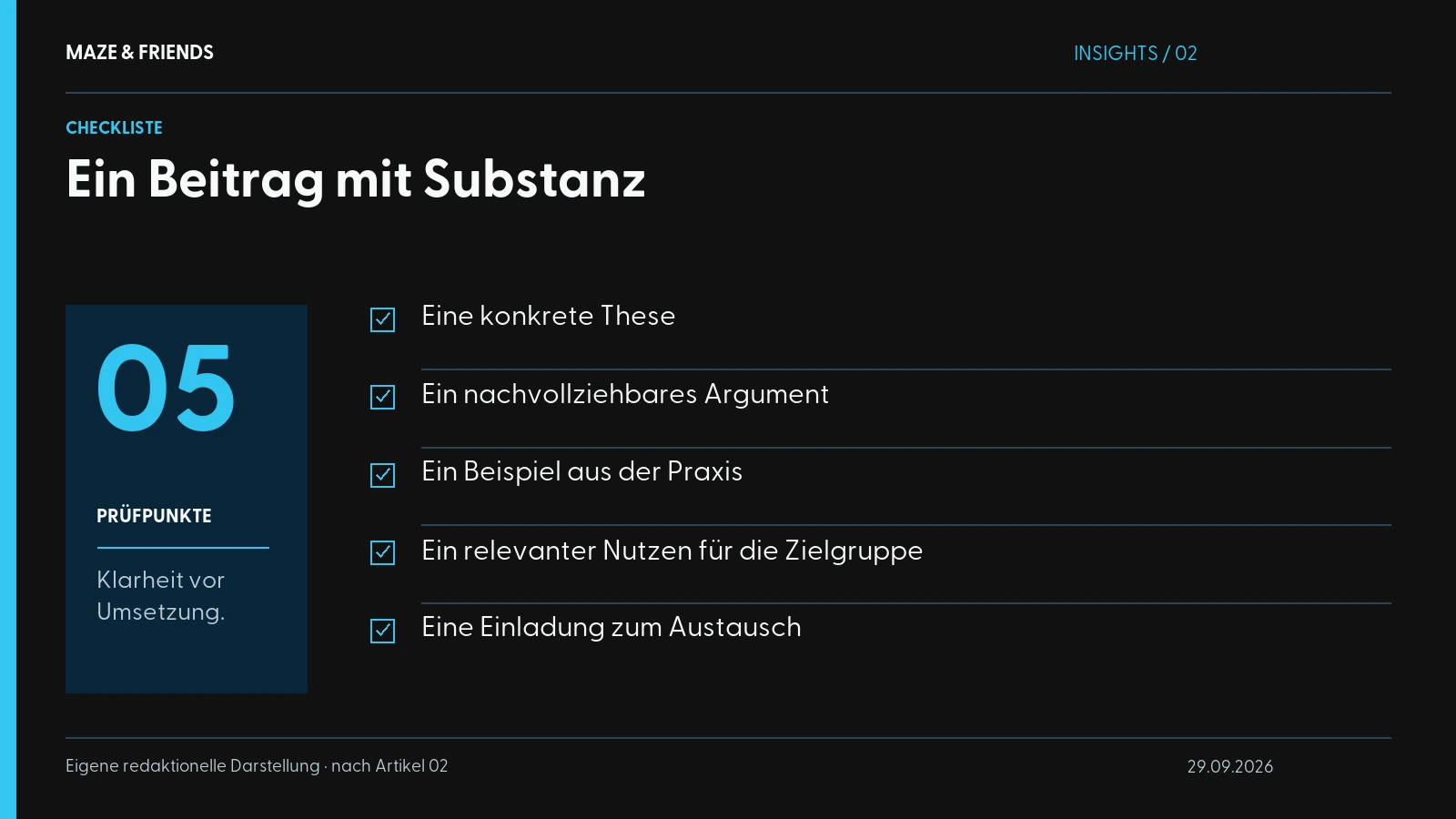
The checklist for getting started
If you want to start this week, this is the minimum:
- Define your territory. One sentence: “I am the voice for [topic] because [reason].” Narrower than your first impulse.
- Write down three theses. Statements people can disagree with and that you can back up.
- Sharpen your profile. Align your headline and the first two lines of your About section with your position.
- Collect ten pieces of proof. Real projects, figures, mistakes and turning points from your work.
- Settle on a format and keep it up for 90 days. Consistency before perfection. Reach comes as a side effect.
Stance before reach
Thought leadership grows out of stance, substance and staying power. Reach may follow from it or it may not, but it is never the goal. Choose a narrow field, stand for reasoned theses and show them consistently on LinkedIn over months. The article on personal branding for B2B decision-makers describes the next step. The clear position comes before the content.
From the studio: Milan Milic: personal branding · PIXIT Design: design concept and personal branding videos.
What “professional” means on social media today and how the algorithm and content relate to each other is something Manuel Zellnig explained in an interview with Ghezzo (in German).
Frequently asked questions
What does thought leadership mean?
Thought leadership means being seen as a credible voice with strong opinions in a clearly defined field, whose perspective shapes the discussion.
Lots of followers alone do not make someone a thought leader. What is meant is a person others quote, disagree with and whose ideas they build on. It begins where you claim something not everyone would sign up to, and can back it up properly. If you only spread platitudes everyone agrees with, you are at best a good aggregator. In short: expert authority with a clear stance.
Is there a German word for thought leadership?
The closest are “Vordenkerschaft” (forward thinking) and “Meinungsführerschaft” (opinion leadership). There is no perfect translation, which is why most people in the DACH region use the English term.
“Meinungsführer” sounds like political communication science; “Vordenker” fits best in substance but can sound stilted in everyday use. In practice, it always means expert authority with a clear stance in a specific field. You can therefore use thought leader, forward thinker or opinion leader as synonyms. More important than the word is that the people around you see you as the reference point for your topic.
What is the difference between personal branding and thought leadership?
Personal branding makes sure people know you. Thought leadership makes sure people listen to you on a specific topic and take your assessment seriously.
One is visibility, the other is authority. The two interlock. A personal brand can still be well known without shaping its field. Confuse the two and you produce plenty of content but earn no respect. In practice, thought leadership usually builds on a clear personal brand and adds your own theses and documented experience. Authority is the harder and more valuable goal.
How do I become a thought leader in my industry?
You become a thought leader by choosing a narrow field, backing theses that are open to attack with real experience and making them visible over months.
- Choose a territory: a narrow slice instead of “marketing” or “leadership”
- Formulate theses: two or three statements people can disagree with
- Collect proof: projects, figures, mistakes, before and after
- Find a format: one you can keep up for the long term
- Engage in dialogue: comment knowledgeably and take disagreement seriously
There is no hack. Forward thinking comes from substance plus staying power.
What are good examples of thought leadership on LinkedIn?
Good posts open by contradicting the common view, back that up with a real situation from practice and end with a lesson readers can apply to themselves.
An opening like this would be, for example, “More reach cost us our best customer.” A concrete case with details follows. Strong posts also do without forced prompts such as “Comment below”. You can spot weak examples by their formulas, by artificial drama such as “And then something happened that changed everything”, and by the fact that in the end they have said nothing.
Can anyone become a thought leader?
In principle yes, if you have real experience in a narrow field and stand for a reasoned position. Titles, company size or advertising budget are not prerequisites.
Smaller providers in particular have an opportunity here. You won’t win through budget the way a corporation does, but in your narrow field you can be the clearest, most honest voice. It takes substance that others don’t have, and the patience to make it visible over months. Anyone who only retells trends won’t get there, however much effort they put in. Thought leadership is a role that others grant you.
What makes a good thought leader?
A good thought leader combines lived experience, a clear and reasoned stance and a willingness to engage in dialogue. Fame or follower counts alone are not enough.
Being well known is something other than authority. Even very famous people are only thought leaders where their assessment genuinely provides orientation in a specialist field. What matters is whether the right people in your field know your position and take it seriously. A narrow, relevant audience weighs more than many thousands of passive followers. Good thought leaders show scars instead of glossy slides and respond seriously to disagreement.
How do I optimise my LinkedIn profile for thought leadership?
Align your headline, the first two lines of your About section and your Featured posts with your position. Anyone who finds your post interesting checks your profile within seconds.
The headline says what you move forward for whom and what you stand for. A string of job titles doesn’t help. In the About section, your thesis and experience belong up front, because LinkedIn cuts off the rest. In the Featured section, you show your three best pieces of proof, for example a strong article, a result and a reference project. A profile without posts from recent weeks looks like an empty shop window.
What content builds authority on LinkedIn?
Above all, stance and experience posts. As a starting point, a mix of approx. 40% stance, 30% experience, 20% context and 10% personal works well.
Stance posts mark your position with a thesis and reasoning; experience posts with real projects and mistakes create credibility. Context on trends and news keeps you current, personal insights create closeness. Too much how-to content along the lines of “How to do X in 5 steps” does harm, because it is interchangeable and has long been skimmed off by AI answers. Nobody can copy your opinion and reasoning.
What is the biggest mistake in thought leadership?
Buzzword content instead of a stance. Sentences like “The customer is at the centre” sound important but say nothing and burn credibility.
The test is simple: could the opposite sentence also be true? Nobody would write “We don’t care about the customer”, so the statement is worthless. “Reach can harm your positioning”, by contrast, is a real thesis, because you can disagree with it. People recognise filler immediately, and increasingly so do AI systems, which tend to cite sources with more substance. Check every draft for whether it contains a statement not everyone would sign up to.
What role does AI play in thought leadership?
AI makes interchangeable how-to content worthless and a reasoned stance more valuable. Today the machine delivers summaries, but not a lived position.
Once an AI gives the standard answer, nobody needs your “5 tips” post any more. What remains is your perspective, backed by real projects and mistakes. On top of that, AI systems such as ChatGPT and Google’s AI summaries tend to draw on sources with more substance. A clear, well-documented position therefore also pays off for visibility there. AI is fine as a writing aid. If it replaces your own thinking, it undermines exactly the authority this is all about.
How do you measure the success of thought leadership?
By signals of authority: enquiries that refer to your posts, invitations and recommendations. Likes say little.
Typical signs are messages that begin with “I read your post and wanted to ask …”, invitations to panels, podcasts or specialist groups, and enquiries that arrive pre-qualified because people know your stance. You can also watch profile visits from your target group and the quality of the comments. Reach is a side effect. If it rises without anyone from your field responding, your territory isn’t right yet.
Which format and length suit thought leadership posts?
The best format is the one you can keep up for the long term, whether text, carousel, video or newsletter. The length depends on the thesis and the proof.
Consistency beats perfection. Two well-thought-out posts a week over six months have more impact than ten posts in one week followed by radio silence. A post is long enough when it makes a statement, backs it up with a real situation and delivers a transferable lesson. Anything beyond that is filler. Choose the format to suit your everyday life: if you speak well, start with video; if you like writing, start with text.
What are Thought Leader Ads on LinkedIn?
Thought Leader Ads are a LinkedIn ad format that lets companies run posts by individuals, such as members of management, as ads aimed at a defined target group.
The ad comes across as a post by a person rather than advertising from a company page, and it comes with LinkedIn’s precise B2B targeting. It only makes sense once the substance is in place, meaning a clear position and posts that already generate organic resonance. Advertising amplifies a stance; it cannot replace one. Promote weak posts and you are buying reach for content nobody passes on.
How does a company practise thought leadership?
Most effectively through people: management and specialists represent positions personally, while the company page serves as anchor and proof.
Thought leadership marketing means publishing well-founded perspectives, experience and theses that reach customers early in the decision-making process. Product advertising takes a back seat. On LinkedIn, reach comes mainly from personal profiles. A shared line of topics helps, so that several voices strengthen the same territory. Once the organic base is in place, it can be amplified with targeted ads. Without real specialists who take a stance, it remains corporate content with a new label.
Next step
Want to know which of this fits your company? We will work it out together in 30 minutes. Free and without obligation.
Pick a time
Manuel Zellnig has been building visibility for companies since 2018: brand film, personal branding, performance marketing and AI visibility. Qualified advertising specialist (Werbeakademie Wien), Bachelor in Business Management (Carinthia University of Applied Sciences), author of the book ‘Mobile Apps zur Messung der Kundenzufriedenheit’ (2017, in German) and creative expert for the Austrian Economic Chamber (WKO) in two transformation guides. He measures before he recommends and writes here about what actually works in projects.
Publications and interviews: WKO transformation guide for printers (in German) · WKO transformation guide for florists (in German) · Interview with Ghezzo (in German) · ‘Heute’ on Viennese start-ups (in German)