


Personal branding for B2B decision-makers
Personal branding for B2B decision-makers: five steps to a personal brand that brings enquiries, not likes. With examples, channel choice and mistakes.
In short: Personal branding in B2B means that, as a managing director or founder, you deliberately make visible what you stand for professionally, so that decision-makers know you before they need you. In five steps: sharpen your positioning, define your core topics, publish consistently on one channel, collect proof, turn conversations into contracts. What counts is enquiries. Maze & Friends from Vienna builds personal brands like these with positioning, ghostwriting, photography and video.
A competitor who is no stronger than you professionally gets the enquiries because they are present: they turn up in the feed, get mentioned at events and get recommended. You do the better work, but outside your existing client base, nobody knows it.
This is where personal branding comes in. In B2B, it has little to do with self-promotion. It is about the right decision-makers perceiving you as competent and approachable long before a concrete project comes up. It is not an ego project. It is groundwork for sales.
Here is how to build your personal brand in five steps as a busy decision-maker.

What does personal branding mean?
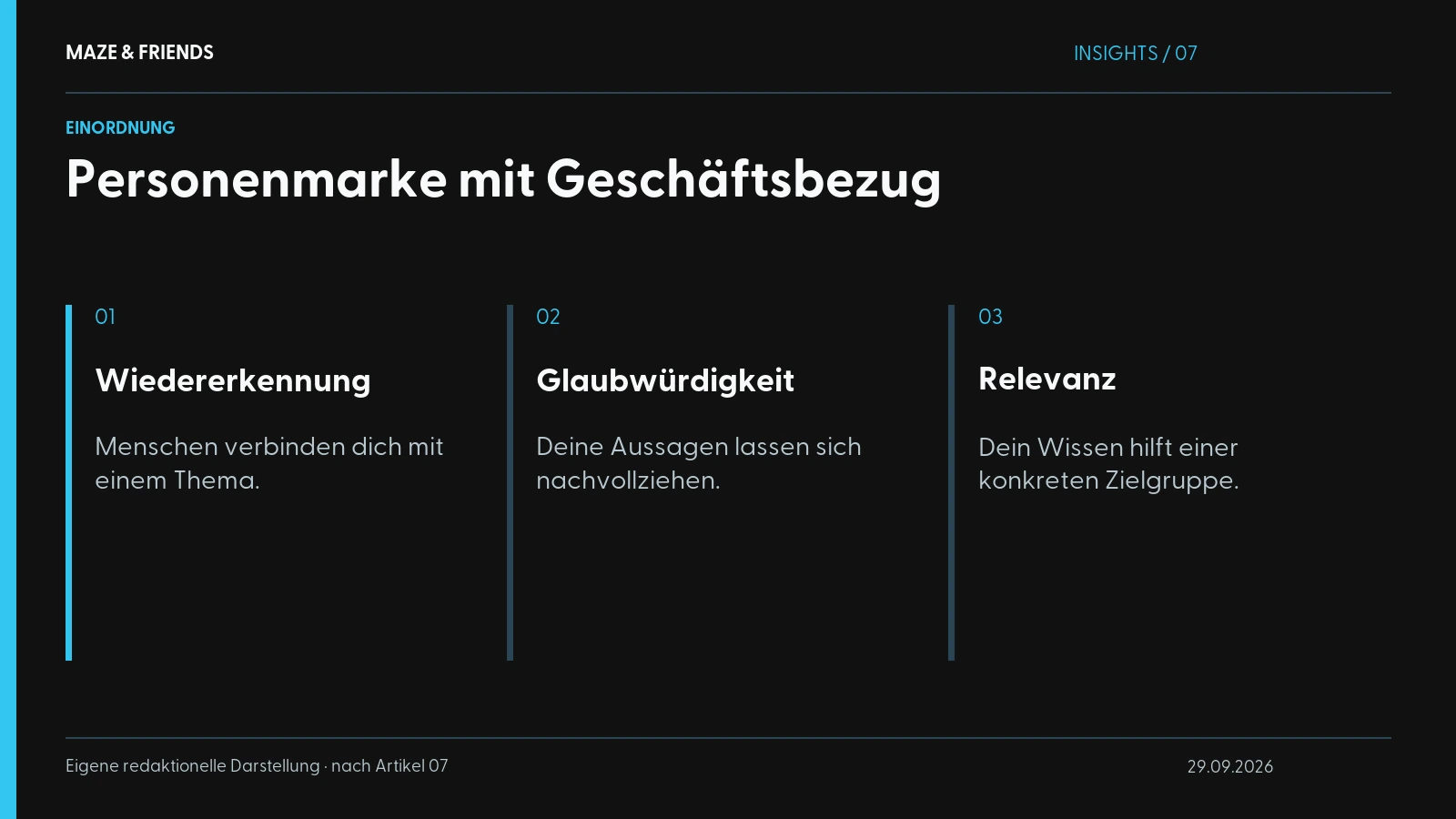
Personal branding is the deliberate building of a personal brand: the reputation you have with a defined target audience, combined with what you actively do to shape that reputation. In the end, it decides between “people know them” and “nobody knows them”.
The distinction matters. A personal brand is something different from your company brand. The company sells services; the person sells trust and conviction. In B2B, people buy from people, especially for complex, expensive services where a wrong decision costs a lot. If the decision-maker on the other side has already experienced you as a thoughtful, reliable person, the hurdle to a first conversation is lower.
Explicitly not meant are:
- Reach for the sake of reach. A large follower count that does not include a single one of your ideal clients will not bring you a single contract.
- Self-congratulation. Constant success posts are irritating and come across as insecure.
- A personality makeover. You do not have to become loud, provocative or “content-y”. Substance beats volume, especially with decision-makers who see straight through it.
Personal branding is building trust in advance. You invest visibility today so that in a few months someone says: “Give them a call, they understand this.”
Why B2B decision-makers in particular benefit
In B2B, buying cycles are long and decisions involve several stages. Between first contact and contract there are often weeks to months and several people involved. During that time, people google you, look at your LinkedIn profile and ask around in their network. If they find little there, no preference forms. If a clear, competent picture emerges, you have a head start.
On top of that, many managing directors of mid-sized companies in the DACH region (Germany, Austria, Switzerland) do not do personal branding at all, or only half-heartedly. That is your opportunity. In German-speaking B2B, the field is far less crowded than, say, the US coaching market.
How do you build a personal brand as a managing director or founder?
In five steps, you build a personal brand that brings in contracts without losing half your working day. The lever is focus.
Step 1: What do you want to be known for?
Before you write a single post, you need an answer to one question: when your ideal clients think of a problem, for which topic should your name come up?
“Management consulting” is too broad, and so is “marketing”. It is narrow enough when it sticks. “The person who moves industrial companies from workshop chaos to a predictable lead pipeline.” Or: “The person who helps trade fair organisers turn one-off event content into year-round ticket sales.”
Focus is the core of every personal branding strategy. A positioning that tries to appeal to everyone appeals to no one. Test your statement against three criteria:
| Criterion | Question for you | Why it matters |
|---|---|---|
| Relevance | Is this a problem someone has a real budget for? | No budget, no contract |
| Credibility | Do you have real references and experience in it? | No substance, no trust |
| Differentiation | Do your three biggest competitors say the same thing? | If so, you are interchangeable |
If you spend more than ten minutes mulling this over, that is a good sign. Positioning is hard work, and everything else builds on it. More on this in our article on building a brand as a founder.
Step 2: Define your three core topics
A personal brand becomes recognisable because it keeps talking about the same two or three topics. That has nothing to do with a lack of ideas: repetition creates memory.
Derive your topics directly from your positioning, just as in good topic planning in content marketing every topic answers a real customer question. An example for a managing director of a mid-sized industrial company who wants to be seen as an expert in lead pipelines:
- Expertise topic: Why most B2B websites produce no enquiries, and what works.
- Conviction topic: Why “let’s do a bit of social media” burns budget.
- Behind-the-scenes topic: How a specific project went, honestly and including the detours.
The mix is what counts. Expertise shows competence, conviction shows character, behind-the-scenes insights show that you really deliver. If you only do one of them, you come across as a textbook, a troublemaker or a show-off. Together, they create a credible picture.
Step 3: Choose one channel and use it consistently
When people build a personal brand, we see one mistake particularly often: starting on LinkedIn, Instagram, a blog, a newsletter and YouTube at the same time, and giving up on all of them after four weeks.
For B2B decision-makers in the DACH region, the answer in most cases is personal branding on LinkedIn. That is where your decision-makers spend their professional time, the context is right, and organic reach for expert content is still comparatively achievable. Instagram, TikTok and the like are a detour for most B2B cases.
Consistent means, specifically:
- Frequency before perfection: Better two well-thought-out posts a week for months than daily posts for two weeks followed by radio silence. The algorithm and your audience reward reliability.
- A realistic system: Block out a fixed slot each week for content, a good hour in which you turn your topics into posts. That is doable alongside day-to-day business.
- Comments count too: Replying and contributing in other people’s comment threads often brings more visibility with the right people than the post itself.
If you lack the time for this, and that is exactly where many decision-makers’ attempts fail, a ghostwriter can translate your thoughts into posts. What makes up the price and what you need to watch out for is covered in our article on LinkedIn ghostwriter costs. The thinking stays with you; you hand over the production work.
Step 4: Proof instead of claims
Claims convince nobody. Proof does, and that is what separates a personal brand that brings in contracts from one that collects likes.
Weave evidence into your visibility instead of only posting opinions:
- Results: “We significantly increased the number of qualified enquiries for a client over six months”, told together with how you got there.
- Way of thinking: Explain how you approach a problem. Decision-makers buy your thought process. Claims they will not buy from you.
- Third-party voices: Recommendations, client quotes, mentions. What others say about you carries more weight than anything you say yourself.
This is also where thought leadership comes in: the aim of having your own well-founded perspective on your topic and standing up for it. That turns you from a “me-too provider” into the reference. How to build this methodically is shown in Thought leadership on LinkedIn.
Step 5: Turn visibility into conversations and contracts
Most people forget the last step, yet it is the most important. Personal branding is not an end in itself. It has to lead to enquiries; otherwise it is an expensive hobby.
Build deliberate bridges from content to conversation:
- A clear invitation: Make it unmistakably clear in your profile, and now and then in posts, what people can approach you about. No hard sell, more of an open door.
- Responding to signals: Anyone who regularly comments on your content or views your profile is sending a warm signal. A personal message without sales pressure is legitimate and effective here.
- A link to your sales process: Without proper follow-up, visibility fizzles out. Anyone who gets in touch needs a clear next stage.
At this point, personal branding stops being “content” and becomes business.

What are some examples of personal branding?
Here are three personal branding examples from a B2B context. We deliberately describe them as patterns and without names, so that you can apply them to yourself.
Example 1: The specialist in a niche mid-sized company. The managing director of a specialised industrial company posts one concrete practical insight from his field once a week, without selling. Over months, he becomes the go-to name in his niche. He hardly needs cold calling any more, because prospects say: “I’ve been following you for a while.”
Example 2: The founder with a clear stance. A founder takes a clear public position on a grievance in her industry. She deliberately polarises, but stays factual. That attracts exactly the clients who share her view and puts off those who would not have been a fit anyway. Her conversations are pre-qualified, because it is clear beforehand what she stands for.
Example 3: The quiet networker. A consultant rarely posts, but comments daily and knowledgeably under the posts of relevant decision-makers. Over months, he builds relationships this way without ever becoming a “content creator”. His personal brand lives almost entirely in comment threads and direct messages, and it works.
What all three have in common is focus, consistency and a clear connection to their own services. None of them treats it as a show. For all of them, it is sales work.

Which mistakes should you avoid?
These five stumbling blocks are the ones we come across most often in practice:
| Mistake | What happens | Better |
|---|---|---|
| Positioned too broadly | Nobody remembers you | Focus narrowly, one core topic |
| Optimised for reach | Lots of likes, no enquiries | Optimise for the right people |
| Too infrequent, then radio silence | No momentum | A reliable rhythm over months |
| Only opinion, no proof | Comes across as hot air | Show results and your way of thinking |
| No path to a conversation | Visibility fizzles out | Build in an open door and follow-up |
Personal branding is a system that builds trust over months; it has little to do with sprints or luck. If you understand that and keep going, you gain a head start in DACH B2B that no advertising budget can buy in the short term.
Focus beats volume
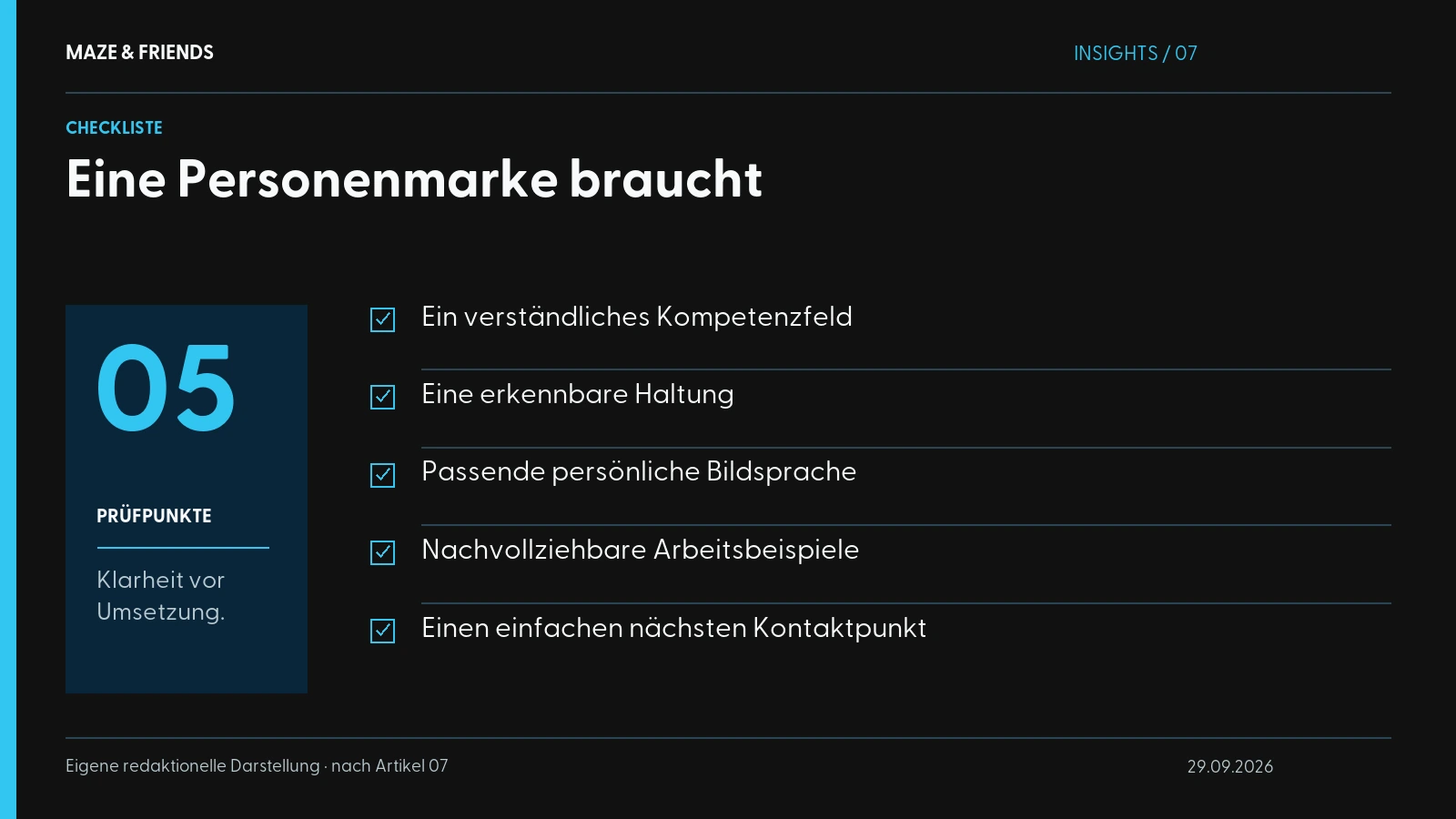
Personal branding in B2B succeeds with focus: a clear positioning, three core topics, one channel, used consistently. If you want to go deeper, read on about how to build a brand as a founder and how thought leadership on LinkedIn works. Start with your positioning. And start this week.
If you lack the time to implement it, Maze & Friends takes on the strategy and production of your personal brand from a single source. Your own effort comes down to one bundled content session a month plus short approvals. Whether a personal brand pays off for you is something we are happy to work out together: book a no-obligation discovery call.
From the studio: Milan Milic: personal branding · PIXIT Design: design concept and personal branding videos.
What “professional” means on social media today and how the algorithm and content are connected is something Manuel Zellnig put into context in an interview with Ghezzo (in German).
Frequently asked questions
What is personal branding?
Personal branding is the deliberate building of a personal brand: your reputation with a defined target audience and everything you actively do to shape it.
In B2B, this means decision-makers perceive you as competent and approachable long before a concrete project comes up. The company sells services; the person sells trust and conviction. With complex, expensive services, this lowers the hurdle to a first conversation, because the person opposite has already experienced you as a thoughtful, reliable person. It decides whether people know you or not.
What is personal branding called in German?
In German, people speak of building a Personenmarke (personal brand) or Expertenmarke (expert brand). The idea is to connect yourself deliberately with a professional topic.
The English term has nonetheless caught on, much like branding, which in German stands for Markenbildung (brand building). More important than the word is a widespread misunderstanding. For many people, a personal brand sounds like self-promotion, but in B2B it is about professional reputation and trust with a clearly defined target audience. If you understand the term that way, you are doing groundwork for sales.
How do you build a personal brand?
In five steps: sharpen your positioning, define your core topics, use one channel consistently, collect proof, turn visibility into conversations.
- Positioning: for which problem should your name come up?
- Core topics: two to three topics drawn from expertise, conviction and behind-the-scenes insights
- Channel: in DACH B2B usually LinkedIn, with a reliable rhythm
- Proof: results, way of thinking, client voices
- Conversations: a clear invitation, responding to signals, a link to sales
More channels do not help. The lever is focus.
What are good examples of personal branding in B2B?
Good B2B examples follow three patterns: the specialist with practical knowledge, the founder with a clear stance and the quiet networker who comments knowledgeably.
The specialist from a niche mid-sized company posts one concrete insight a week, without selling, and becomes the go-to name over months. The founder takes a factual position on a grievance in her industry and, as a result, holds pre-qualified conversations. The consultant rarely posts, but builds relationships in comment threads and direct messages. What they all share is focus, consistency and a clear connection to their own services.
Isn’t personal branding just showing off?
No. Personal branding in B2B is building trust in advance, which means professional substance for a clearly defined target audience.
It does not mean large follower counts without ideal clients, nor constant success posts that tend to come across as insecure. Nor does it require a personality makeover. You do not have to become loud or provocative, because substance beats volume, especially with decision-makers who see through it. If you are good at what you do and talk about it honestly, you come across as helpful. The yardstick is simple: does this post help your target audience understand a problem better?
How much does personal branding cost?
What personal branding costs depends on how much you do yourself and how much you outsource, from doing it all in-house to fully managed production.
If you do it yourself, you mainly invest time, realistically a fixed block each week. It costs money when you outsource parts of it: positioning and strategy, writing in your voice, photo and video production, planning and evaluation. The price drivers are the share of strategy, the number and depth of formats and how much coordination you want to handle yourself. A useful yardstick is the value of a single additional contract. Likes are no use as a yardstick.
What do personal branding photos cost?
That depends on the length of the shoot, the number of motifs and locations, retouching and usage rights. A reliable fixed price is therefore only possible after a briefing.
A quick portrait for your profile is something different from a shoot that provides material for months: portraits, work situations, images with clients or the team, formats for the website and LinkedIn. For personal branding, the latter usually pays off, because photos with a real work context look more credible than posed studio shots. Clarify in advance what you want to use the images for. Then the motifs and rights will fit.
Which channel is best for B2B personal branding?
For most B2B decision-makers in the DACH region, LinkedIn is the first choice. That is where decision-makers spend their professional time, and expert content still achieves comparatively good organic reach.
Instagram, TikTok or YouTube are a detour for most B2B cases and only pay off for specific target audiences. Decision-makers often start on five channels at once and give up on all of them after four weeks. Concentrate on one channel, use it for months and take comments seriously. Contributing in other people’s comment threads often brings more visibility with the right people than your own post.
How much time do I need to set aside for personal branding?
Set aside a fixed slot of a good hour a week for content, plus short windows for comments. That is doable alongside day-to-day business.
Reliability counts for more than volume. Two well-thought-out posts a week over months have more impact than daily posts that stop after two weeks. If you cannot even spare this hour, and for many decision-makers that is the honest reason why attempts fail, a ghostwriter can translate your thoughts into posts. You keep the thinking; you hand over the production.
How long does it take for personal branding to bring in contracts?
Think in months. First reactions often come after a few weeks; concrete enquiries take longer in B2B with its long buying cycles.
In B2B, there are often weeks to months and several people involved between first contact and contract. During this time, people google you, look at your profile and ask around in their network. This is exactly the phase in which personal branding works, which is why the effect shows with a delay. More important than perfecting individual posts is that you keep at it throughout. If you give up after a month, you have sown but never harvested.
How do I win clients on LinkedIn without being pushy?
By deliberately turning visibility into conversations: a clear invitation in your profile, a personal response to signals, a clean link to your sales process.
Make it unmistakably clear in your profile, and occasionally in posts, what people can approach you about, without a hard sell. Anyone who regularly comments on your content or visits your profile is sending a warm signal. A personal message without sales pressure is then legitimate and effective. Anyone who gets in touch must not end up in a void afterwards. Mass messages to strangers damage precisely the trust that your content builds.
Which mistakes slow down personal branding in B2B?
The most common brakes are positioning that is too broad, optimising for reach instead of the right people, and a rhythm that breaks off after a few weeks.
Add to that posts with opinion but no proof, which quickly come across as hot air. And often there is no path from the post to a conversation, so visibility fizzles out. What helps is focusing narrowly and owning one core topic, optimising for ideal clients, keeping a reliable rhythm over months, showing results and your way of thinking, and planning follow-up firmly. Personal branding is a system that builds trust over months.
Who is personal branding in B2B worthwhile for?
For managing directors, founders, consultants and experts who sell complex, expensive services, and especially for small companies without a large advertising budget.
Small providers rarely have the money for broad campaigns, but they do have a face and a story. For them, a focused personal brand is often the most effective and most affordable way to become visible against larger, more anonymous competitors. Many managing directors of mid-sized companies in the DACH region also do no personal branding at all, or only half-heartedly. In German-speaking B2B, the field is therefore far less crowded than, say, the US coaching market.
What does a personal branding agency do?
A personal branding agency takes on the strategy and production of your personal brand: positioning, topic planning, texts in your voice, photography and video, publishing and evaluation.
Positioning, conviction and expert opinion cannot be outsourced; they have to come from you. What can be delegated is the execution: drafting, editing, designing and planning. A good agency draws out your knowledge in regular conversations and has you approve every post. At Maze & Friends, strategy and production come from a single source, and success is measured in enquiries. With every provider, check whether conversations come out of it in the end, or just posts.
How do I measure whether my personal branding is working?
Personal branding is working when qualified enquiries come in, meaning conversations with the right decision-makers. Rising likes alone say little.
Useful signals are profile visits from your ideal target audience, comments from potential clients, direct messages with a concrete request and initial calls in which someone says: “I’ve been following you for a while.” Also watch whether conversations start pre-qualified, because the person opposite already knows what you stand for. Keep a record of where enquiries come from; otherwise you will not be able to prove the effect later.
Next step
Want to know which of this fits your company? We will work it out together in 30 minutes. Free and without obligation.
Pick a time
Manuel Zellnig has been building visibility for companies since 2018: brand film, personal branding, performance marketing and AI visibility. Qualified advertising specialist (Werbeakademie Wien), Bachelor in Business Management (Carinthia University of Applied Sciences), author of the book ‘Mobile Apps zur Messung der Kundenzufriedenheit’ (2017, in German) and creative expert for the Austrian Economic Chamber (WKO) in two transformation guides. He measures before he recommends and writes here about what actually works in projects.
Publications and interviews: WKO transformation guide for printers (in German) · WKO transformation guide for florists (in German) · Interview with Ghezzo (in German) · ‘Heute’ on Viennese start-ups (in German)