


Conversion optimisation for more enquiries
Conversion optimisation without buzzwords: turn your existing traffic into more enquiries with analysis, hypotheses, A/B tests and clear priorities.
In short: Conversion optimisation means increasing the share of your website visitors who take a desired action, which in B2B is usually an enquiry. The reliable route is a four-step cycle: analyse the data, form a reasoned hypothesis, test it in an A/B test and keep only the improvements that are proven. Vienna-based Maze & Friends sets up the tracking and landing pages for this and tests changes instead of rebuilding on gut feeling.
Month after month you spend money on ads and SEO to bring people to your website. And they do come, it’s just that hardly anyone fills in the contact form. For a mid-sized industrial company that is expensive, because every paid click costs money and a noticeable share of visitors drops out just before the finish line. This is where conversion optimisation comes in. It gets more results out of the traffic you already have.
This article shows the method Maze & Friends works with: data-driven and without a miracle framework. By the end you’ll know what conversion optimisation is, which levers count and how to set up a clean optimisation cycle yourself.
What is conversion optimisation?
Conversion optimisation (conversion rate optimisation, or CRO for short) is the systematic process of increasing the percentage of your visitors who complete a defined target action. The conversion rate itself is simple to calculate: target actions divided by visitors, times 100.
A quick word on the jargon. A “conversion” is any action you have defined as a goal in advance. For an online shop, that’s the purchase. For you as a B2B provider it is almost always something else, such as a completed enquiry form, a download of your white paper, a booked initial consultation or a phone call. Define one primary conversion to measure everything against. Otherwise you’re optimising in the fog.
What it explicitly does not mean:
- A redesign “because the site looks dated”. A redesign based on taste can ruin your conversion rate just as easily as improve it. You simply won’t know, because you didn’t measure anything.
- A collection of “10 growth hacks” that worked for some US SaaS company. Your audience, your offer and your price are different.
- A one-off project. Conversion optimisation is an ongoing cycle; there is no box to tick on the to-do list.
What counts for you above all is the leverage. Say you raise your enquiry rate from 1.5 to 2.5%. With the same advertising budget, that mathematically gives you two thirds more enquiries without paying for a single extra click. That is why the work pays off especially for industrial businesses with high cost per click.

How do I increase my conversion rate?
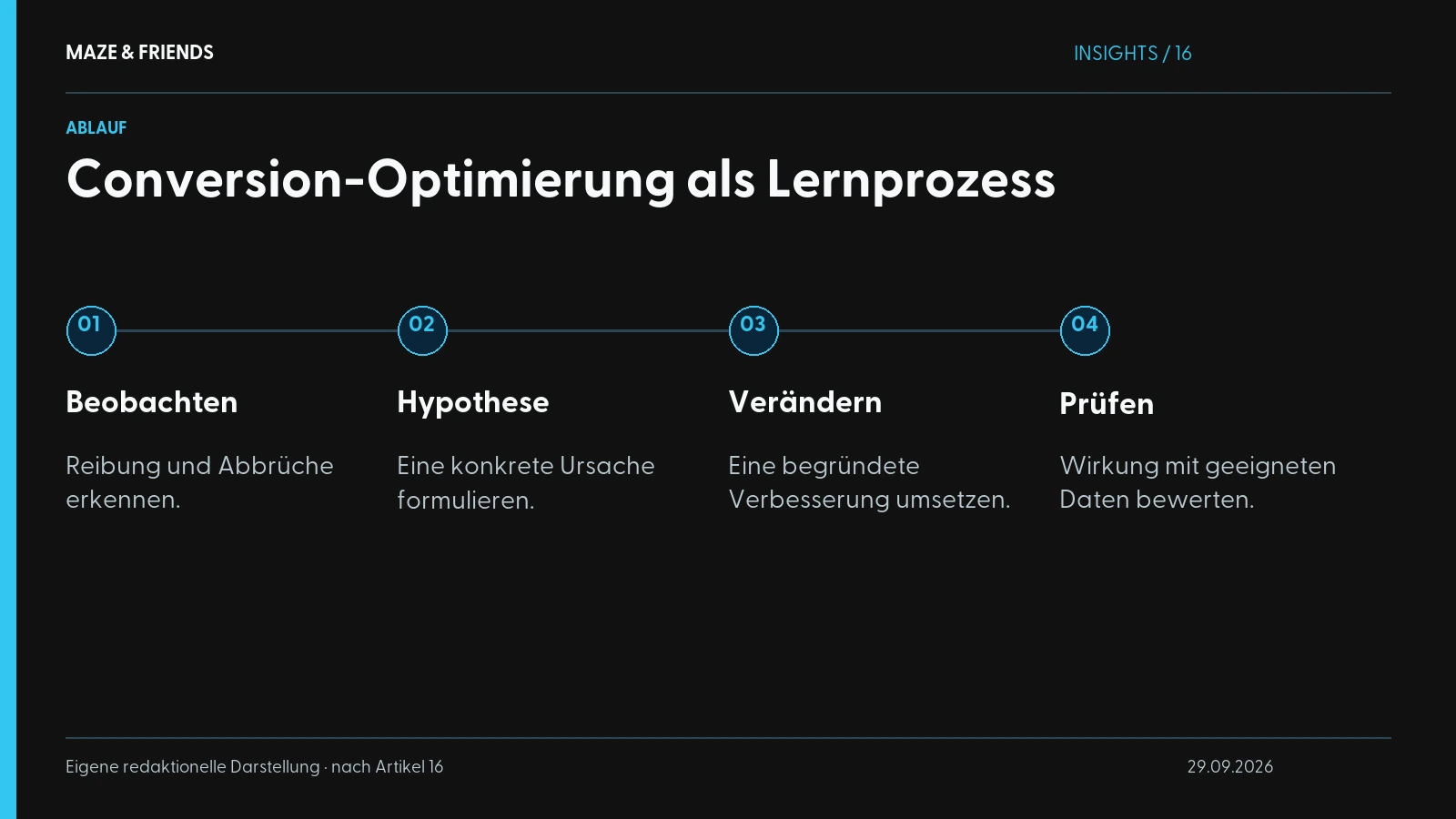
With a cycle rather than a trick. We call it the optimisation cycle. It has four phases that you run through again and again, and it makes conversion rate optimisation repeatable.
1. Analysis: where do visitors drop off?
Before you change anything, you need to know where things are stuck. For that you need clean data. If your tracking is wrong, you’re optimising for random numbers. A correctly configured analytics setup is therefore the foundation. We have described in detail how to build it in our guides on setting up GA4 properly and setting up conversion tracking cleanly.
In the analysis you look specifically at:
- Funnel view: How many visitors land on the page, how many click through to the form, how many submit it? At which stage do the most people drop out?
- Quantitative data: bounce rates, time on page, mobile vs. desktop, entry pages. Mobile often converts worse than desktop, and if so, that’s where to look first.
- Qualitative data: heatmaps and session recordings show you where people hesitate, click or scroll into nowhere. Tools for this include Hotjar or Microsoft Clarity, which according to Microsoft is free and has no traffic limit. This adds the “why” to the numbers.
2. Hypothesis: a reasoned bet
From the analysis you derive a testable hypothesis. An opinion isn’t enough. A clear format helps:

“Because [observation], we expect [change] to improve [metric].”
In practice it sounds like this: “Because a striking number of form abandonments happen at the mandatory ‘Budget’ field, we expect that removing this field will increase the form completion rate.” That is concrete, derived from an observation and verifiable. “Let’s make the form look nicer” is none of these.
3. Test: the data decides
Now you test the hypothesis. The gold standard is the A/B test: you randomly show half of your visitors the old version (A) and the other half the new one (B), and measure which version converts better. Because the two differ only in your change, you can attribute the result causally. Whether the boardroom likes the new version is irrelevant.
There are two limitations. A/B testing needs enough traffic and enough time, otherwise the result is statistically worthless. If your site only has a few hundred visitors a month, you can’t test small effects reliably. In that case you’re better off working with qualitative methods and fixing obvious mistakes. More on that in the next section.
4. Learning: only what’s proven stays
If the new version clearly wins, it becomes the new standard. If it loses or the result is a draw, you discard the change and have still learned something. With every cycle you know more about your audience. That is exactly what we mean by “consulting that also delivers”: we prove a recommendation before we advise you to follow it.
Which conversion measures have the biggest leverage?
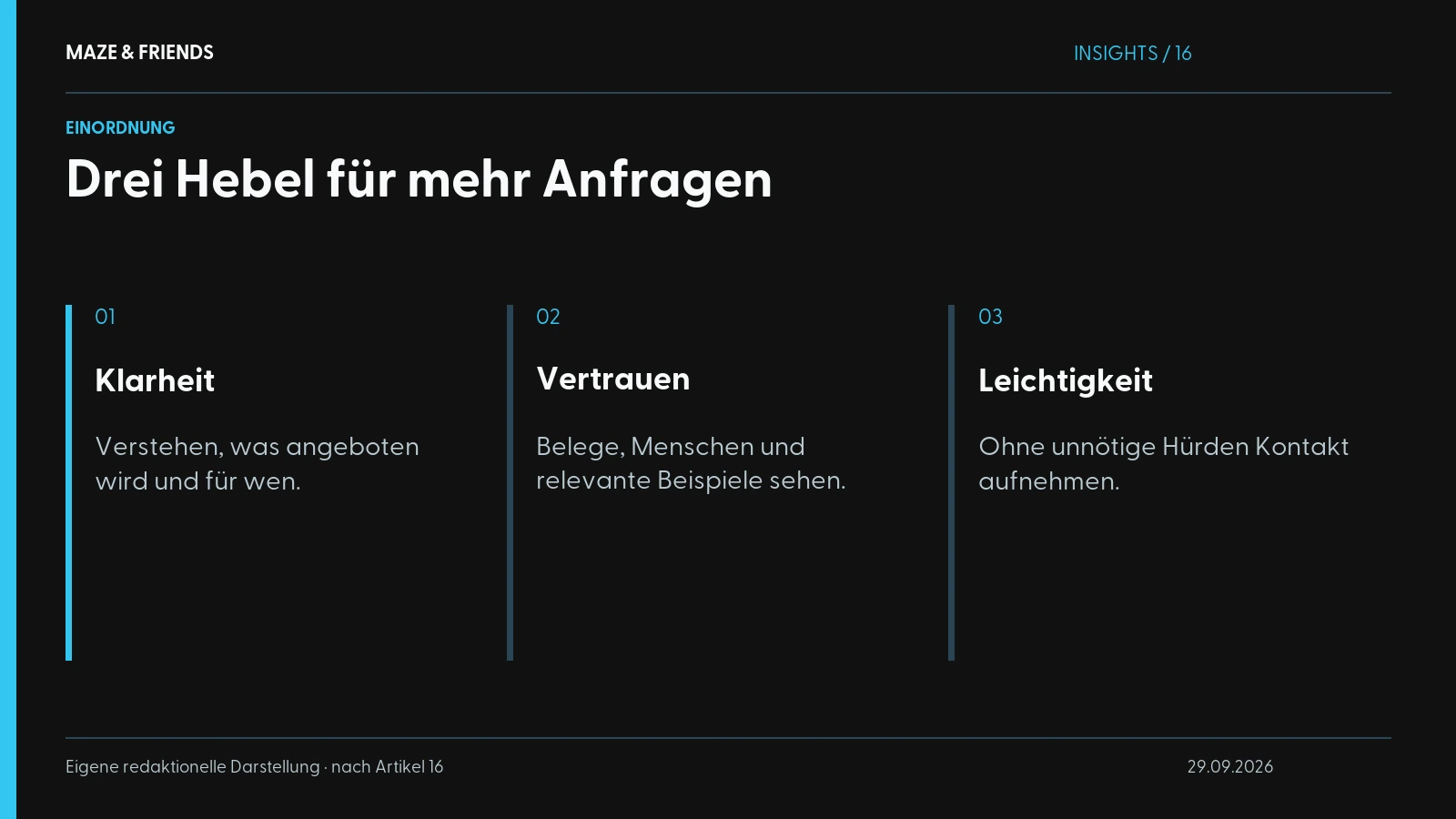
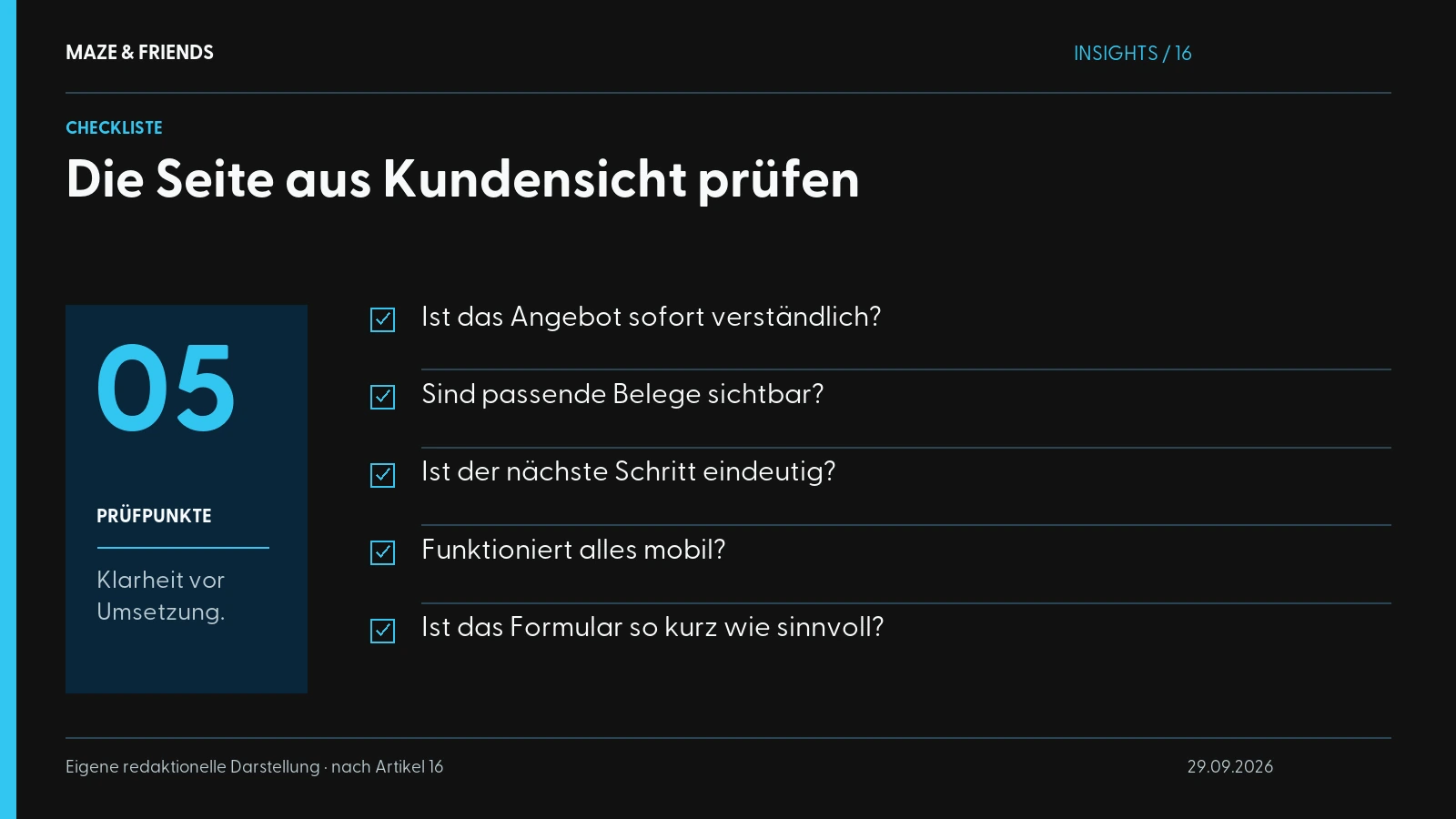
The best changes are those with the most leverage and the least risk. Start with the glaring mistakes that cost you enquiries and save the fine-tuning for later. Our prioritised list for a typical B2B business in the DACH region (Germany, Austria, Switzerland), ordered by impact:
| Measure | What you check | Why it works |
|---|---|---|
| Loading speed | Does the page load quickly on mobile, without a noticeable wait? | Waiting costs you visitors before they’ve read a single word. |
| Clarity of the message | Does a stranger understand at first glance what you offer and for whom? | Confused visitors don’t convert. Clarity beats creativity. |
| One clear call to action | Is there exactly one primary action per page? | Too many options paralyse. One button, one goal. |
| Form length | Do you only ask for what you really need? | Every mandatory field lowers the completion rate. Cut everything optional. |
| Trust signals | Are references, real case studies, contact persons and a legal notice visible? | B2B buyers check whether you’re credible before they write to you. |
| Mobile optimisation | Does everything work on a phone, not just on desktop? | A growing share of your visitors make their decision on mobile. |
The order is deliberate. Technology and clarity first, polish later. Google also describes how fast pages keep users better and achieve higher conversion rates in its developer guide “Why speed matters” on web.dev. In initial audits we regularly see a business debating button colours while its contact form can’t be scrolled on a phone. That’s like adjusting the seat position while the tyre is flat.
The fastest lever for B2B: your contact form
With the mid-sized industrial companies we work with, the biggest and fastest gain almost always lies in the enquiry path itself. Specifically:
- Reduce the fields. Do you really need company size, budget and phone number in the very first enquiry? Every mandatory field you drop increases the likelihood that someone hits send.
- Name the next step. “We’ll call you and suggest two dates” removes the uncertainty. People don’t like filling in forms when they don’t know what happens next.
- Offer an alternative. Some people prefer to send an email or pick up the phone. Make both visible.
This doesn’t cost you a cent of media budget and can often be done in an afternoon.
Do I need an agency for conversion optimisation?
Not necessarily, and we say that as an agency. You can tackle the basics from this article yourself. Cut a mandatory field, make your call to action unambiguous, check the loading time on your phone. For these basics you don’t need outside help, just the willingness to take an honest look at your own site.
A CRO agency is worth it when three things come together: you have enough traffic for meaningful A/B tests, your offer needs explaining, and you lack the time or analytics know-how in-house to run the cycle properly. The value then lies in the method, meaning setting up tracking correctly, prioritising the tests and avoiding false conclusions from badly designed experiments. It has little to do with “making things look nicer”.
You can recognise a reputable CRO agency by the fact that it does not promise you a fixed percentage of improvement. Anyone selling you “we guarantee to increase your conversion rate by 30%” has either not understood how CRO works or is selling you a fairy tale. Serious work sounds more sober: “We find the biggest leaks, test the most promising changes and keep what is proven to be better.”
What does conversion optimisation cost?
What conversion optimisation costs depends on the scope. The do-it-yourself basics such as shortening the form, sharpening the CTA and fixing the loading time cost you mainly time and hardly any budget. A professional conversion audit of your most important pages is a manageable one-off project. An ongoing optimisation cycle with tracking setup, tests and evaluation is a recurring item that depends on your traffic volume. Maze & Friends provides a fixed-price quote for this after the initial call.
More important than the price is the return. If you keep putting budget into paid traffic, even a moderate improvement in your enquiry rate pays off quickly, because it makes every ad and every SEO click more efficient. What website costs depend on is covered in our article on website costs. How we build pages for enquiries from the start is explained on our page about web design for more enquiries.
Fix the one leak first
Conversion optimisation is a cycle of analysis, hypothesis, test and learning. You don’t have to rebuild everything at once. Look at your most important enquiry page and find the one leak that costs you the most enquiries. Usually it’s the form or an unclear call to action.
If you’d like an outside view: Maze & Friends applies the method from this article to your site and shows you where the biggest conversion leaks are and in which order to close them. Tell us which page worries you most.
From the studio: Canal Toys: shop, guides and campaigns · kiwiz: content plan and social ads.
Frequently asked questions
What is meant by conversion optimisation?
Conversion optimisation, also called conversion rate optimisation (CRO), means systematically increasing the share of website visitors who complete a defined target action.
On B2B websites this is usually an enquiry, in online shops the purchase. The route is a cycle of analysis, a reasoned hypothesis, an A/B test and keeping the improvements that are proven. It has little to do with a redesign based on taste or a collection of other people’s tricks. It is ongoing, data-driven work.
What do conversion and conversion rate actually mean?
In marketing, a conversion is any action you have defined as a goal, such as a purchase, an enquiry or a download. German speakers often use the English term or say “Umwandlung”.
The conversion rate is the share of visitors who complete that action. It is the moment a visitor becomes a prospect or a customer. Define one primary conversion to measure everything against, otherwise you’re optimising in the fog.
How do I calculate the conversion rate?
Number of conversions divided by number of visitors, times 100.
An example: 30 enquiries from 2,000 visitors give a conversion rate of 1.5%. Decide whether you use visitors, sessions or clicks as your basis and stick with it, otherwise periods can’t be compared. If the rate rises from 1.5 to 2.5% with the same traffic, you mathematically get two thirds more enquiries without paying for an extra click.
What is a good conversion rate?
There is no universally good conversion rate. It depends heavily on the industry, the offer, the price, the traffic source and what you count as a conversion.
A white paper download converts differently from an enquiry about an industrial plant, and visitors from Google Search differently from visitors from display ads. Blanket benchmarks from the internet are therefore only a rough guide. More reliable is your own rate over time, broken down by channel and device, and the share of enquiries that are actually qualified.
How can I improve my conversion rate?
Most reliably by fixing the glaring mistakes first and then testing reasoned changes with A/B tests. Rebuilding on instinct rarely helps.
The most effective levers for B2B, in a sensible order:
- Loading time and mobile usability
- A clear message: what you offer and for whom
- Exactly one primary call to action per page
- Short forms with only the essential fields
- Trust signals such as references, case studies and contact persons
Technology and clarity first, polish such as button colours later.
What are examples of conversion optimisation in B2B?
A shortened enquiry form, a clearly named next step after submitting and visible alternatives such as phone or email.
A concrete example: if a striking number of visitors abandon the form at the mandatory “Budget” field, the hypothesis is that removing the field will increase the completion rate, and an A/B test checks it. A sentence like “We’ll call you and suggest two dates” removes uncertainty. Changes like these cost no media budget. They can often be done in an afternoon.
Which conversions should I measure as a B2B company?
Above all, qualified enquiries as the primary conversion, complemented by earlier steps such as white paper downloads, booked initial consultations and phone calls.
The primary conversion is the one target action by which you measure success. In GA4 you mark it as a key event (in German). Earlier steps, often called micro-conversions, show you where prospects stand, but shouldn’t be treated as equal to enquiries. Without this definition every department measures something different, and you end up optimising in the fog.
What is an A/B test, and how much traffic do I need for it?
An A/B test randomly shows one group of visitors version A and the other the changed version B, and measures which converts better.
Because only the tested change differs, the result can be traced back to it causally. There is no fixed traffic threshold. The fewer visitors and the smaller the expected effect, the longer a meaningful test takes. With only a few hundred visitors a month, you’re better off relying on qualitative analysis and fixing obvious mistakes.
What is the difference between conversion optimisation and SEO?
SEO brings more visitors to your website; conversion optimisation makes sure more of those visitors become enquiries or customers.
The two belong together. SEO without conversion optimisation is expensive traffic that trickles away, and conversion optimisation without traffic has nobody to optimise for. You get the best results by working on both in parallel. Every improvement in the conversion rate also makes every SEO and ad click more valuable.
How long does it take for conversion optimisation to work?
Simple fixes such as a shortened form work immediately. A proper A/B test takes several weeks.
The test has to collect enough visitors to be statistically robust and should cover whole weeks so that fluctuations between weekdays don’t distort the result. For a complete cycle of analysis, hypothesis, test and evaluation, think in weeks rather than days. Anything shorter is guesswork dressed up with numbers.
Which tools do I need for conversion optimisation?
At the very least a properly configured web analytics tool such as GA4, ideally complemented by a heatmap tool such as Microsoft Clarity or Hotjar.
Analytics shows you where visitors drop off; heatmaps and session recordings show you why. Microsoft Clarity is free. Once you have enough traffic, a tool for A/B tests comes on top. Integrate all of these tools via your cookie banner, like any analytics tool. You can find the first obvious mistakes without any tools, though, by taking an honest look at your own site.
Is a website redesign enough to get more enquiries?
Not reliably. A redesign is often even risky, because it changes many things at once and afterwards you don’t know what helped or what hurt.
A redesign based on taste can lower your conversion rate just as easily as raise it. Targeted, measured changes to individual elements work better. If a relaunch is due anyway, measure the key figures beforehand so you can compare afterwards. Elements that demonstrably work are deliberately carried over to the new site.
What does the effort for conversion optimisation depend on?
On the scope: do-it-yourself basics mainly cost time, an audit is a manageable one-off project, an ongoing test cycle a recurring item.
How large the recurring item is depends on your traffic volume and on whether clean tracking is already in place or still has to be built. More important than the price is the return. If you keep putting budget into paid traffic, even a moderate improvement in your enquiry rate pays off quickly, because it makes every ad and every SEO click more efficient.
How do I recognise a reputable CRO agency?
It doesn’t promise a fixed percentage increase, checks tracking and data first and backs up its suggestions with tests.
Promises like “guaranteed 30% more conversions” show that someone either hasn’t understood CRO or is selling a fairy tale. Serious work sounds sober: find the biggest leaks, test the most promising changes, keep what is proven to be better. An agency is worth it when enough traffic, an offer that needs explaining and a lack of in-house time or analytics know-how come together. You can manage the basics yourself.
How do I measure whether conversion optimisation is working?
By your primary conversion rate and the number of qualified enquiries, each over comparable periods.
Page views or time on page feel good, but say little about new customers. In tests, only a statistically robust result counts; an interim reading after a few days means nothing. Also check with your sales team whether the enquiries are a good fit. More forms with weaker leads are not a success.
Next step
Want to know which of this fits your company? We will work it out together in 30 minutes. Free and without obligation.
Pick a time
Manuel Zellnig has been building visibility for companies since 2018: brand film, personal branding, performance marketing and AI visibility. Qualified advertising specialist (Werbeakademie Wien), Bachelor in Business Management (Carinthia University of Applied Sciences), author of the book ‘Mobile Apps zur Messung der Kundenzufriedenheit’ (2017, in German) and creative expert for the Austrian Economic Chamber (WKO) in two transformation guides. He measures before he recommends and writes here about what actually works in projects.
Publications and interviews: WKO transformation guide for printers (in German) · WKO transformation guide for florists (in German) · Interview with Ghezzo (in German) · ‘Heute’ on Viennese start-ups (in German)