


What is a brand film? When it pays off
What is a brand film? Definition, how it differs from a commercial, brand video and aftermovie, the right length and when a brand film really pays off.
In short: A brand film is a short corporate film that shows who you are, what you stand for and why someone should work with you, told through attitude, people and story rather than a single product promise. It builds trust and recognition instead of selling directly. You need one when your “why” is complex. Maze & Friends produces brand films from Vienna for the DACH region.
Almost every company we talk to in Vienna and across the DACH region (Germany, Austria, Switzerland) says the same sentence at some point: “We could do with a video.” Then the room goes quiet, because nobody really knows which video they mean: a brand film, a commercial, an explainer or simply “something for the website”. Mix up the terms and you order the wrong format, pay for the wrong effect and wonder why the result achieves nothing.
Here you will find a clear definition, clean distinctions and the question that should come before every shoot: do you actually need one?
What is a brand film?
A brand film is a cinematic portrait of your company. It answers the question “Who are you, and why should I care?”, while advertising starts from “What are you selling?”. At its centre are identity, values, people and attitude, not a sales argument for a single product.
We give clients a simple definition: a brand film carries a brand’s sense of itself in moving images. It pays into trust, recognition and loyalty, in other words soft, long-term goals, and therefore works differently from an ad built for a click or a purchase.
Typical building blocks of a brand film:
- A guiding idea: one core message that everything revolves around (for example “We solve problems others consider unsolvable”).
- People instead of logos: the founder, the team, customers. Real faces make the brand credible.
- A story: a common thread with a beginning, tension and resolution, instead of a list of benefits.
- A consistent visual language: colours, music, pace and tone that suit the brand and are recognisable.
One more word on the term corporate film, because it is often used as a synonym for brand film. Corporate film is the umbrella term for any video a company produces about itself. The brand film is its best-known subtype, the one that deliberately relies on emotion and identity. A recruiting film or a location portrait is also a corporate film, just with a different goal.

What is the difference between a brand film and a commercial?
This is the most common mix-up and also the most expensive one. The difference between a brand film and a commercial lies in the goal. In terms of craft, the two can look quite similar.
A commercial wants to trigger an action: buy, click, call, now. It is short, pointed, has a clear call to action and is usually tied to a specific campaign or product. According to Google Ads Help (in German), non-skippable ads before YouTube videos run for 15 to 60 seconds depending on the campaign type (as of October 2026). A brand film, by contrast, wants to build a relationship. It can take its time, tells more and measures its success by whether people see you differently afterwards. The direct sale is secondary.
A simple picture: the commercial is the sales conversation at the trade fair stand. The brand film is the reason you walk over to that stand in the first place.
Both are legitimate; they just solve different problems. If you shoot a brand film and suddenly pile discounts and product benefits into it, you get a bad commercial that runs too long. If you order a commercial and spend five minutes on company history, you lose the viewer before the CTA arrives.

What is the difference between a brand film and a brand video?
This is where things get blurry, and that is fine: both terms mean largely the same thing, and many people use them interchangeably. It is still worth knowing how some distinguish them, because the distinction sets an expectation of effort and effect.
Those who do distinguish usually mean the shorter web version when they say brand video: leaner, designed more for the web and social media, often with less staging. The brand film is then the more elaborate, more cinematic version, with a considered dramatic structure, higher production values and the ambition to act as the brand’s “flagship”.
Roughly speaking:
- Brand video: more flexible, cheaper, good for ongoing communication and social feeds. Rather short shelf life.
- Brand film: higher quality, longer-lasting, good for the website homepage, pitches, trade fairs and employer branding. Shelf life of several years.
There is no official standard for this. What matters is that you and your production company share the same expectation of scope, budget and where the film will be used. That is why we always clarify it explicitly in the initial call; otherwise two sides end up talking about two different films.
For completeness, a third term that often comes up in an event context: the aftermovie. This is the filmed summary of an event such as a conference, trade fair or festival, and it uses the atmosphere and reach of a past event to promote the next one. Not a brand film, but a close relative.
Brand film vs. commercial vs. brand video vs. aftermovie: the overview
| Format | Goal | Length (typical) | Focus | Where it is used |
|---|---|---|---|---|
| Brand film | Trust & identity | 90 sec to 3 min | Who you are, what you stand for | Homepage, pitch, trade fair, recruiting |
| Commercial | Trigger an action (purchase/click) | 15 to 60 sec | One product, one offer, one CTA | Social ads, TV, YouTube pre-roll |
| Brand video | Show the brand, fast & flexible | 30 to 90 sec | A slice of the brand, web-ready | Social feed, landing page, newsletter |
| Aftermovie | Retell & promote an event | 60 sec to 2 min | Atmosphere, highlights, reach | Social, ticket funnel for the next event |
These four cover most “we could do with a video” requests. Once you know which row you mean, half the discussion with any agency is already won.
How long should a brand film be?
As short as possible, as long as necessary, and in the vast majority of cases much shorter than you think.
A practical rule of thumb:
- 60 to 90 seconds for use on the website homepage and on social media. Here the first few seconds decide whether someone keeps watching.
- 2 to 3 minutes for the “big” version you show in pitches, at trade fairs or in recruiting, where people already bring interest and take their time.
- Over 3 minutes only with a very good reason, such as a real story that carries it. Length in itself is more of a risk than a mark of quality.
The most common mistake is a film that runs too long. Attention is scarce, and every second that tells nothing costs you viewers. A tight 80-second film that delivers one clear message cleanly almost always beats the four-minute film that tried to fit everything in.
A practical tip from the workshop: plan several cut lengths from the same shoot right from the start. A long version for recruiting conversations, a 60-second version for the website and a few 15-second cutdowns for social. That way one shoot gives you several formats, which is far more economical than producing each video separately. What that costs in total is broken down in our overview of brand film costs in 2026.
When do you really need a brand film, and when not?
Not every company needs a brand film, and sometimes the money is better spent elsewhere.
A brand film pays off if:
- your “why” is complex and hard to explain in text (products that need explaining, B2B industry, consulting).
- trust is a central buying factor: long sales cycles, large investments, sensitive topics.
- you want to stand out from interchangeable competitors and your people and your attitude are the difference.
- you use the film several times: website, sales pitch, trade fair, recruiting. A brand film that sits in one place only rarely earns its keep.
- you want to become more visible in recruiting. Especially in a tight market for skilled staff, a good film about your culture is often worth more than any job ad.
Skip the brand film (for now) if:
- what you actually need is sales. Then performance commercials and clean tracking are the better lever.
- your positioning is still shaky. A film sets your message in concrete. If you don’t know what you stand for yourself, you produce expensive fog.
- the budget is so tight that only a half-hearted production would fit. A bad brand film harms your image more than having none at all.
For us, a brand film is a tool, not a status symbol. It works when strategy and message come before it. It won’t paper over a missing strategy. That is why Maze & Friends talks about your positioning first and about cameras second.
Which 5 questions should you answer before commissioning?
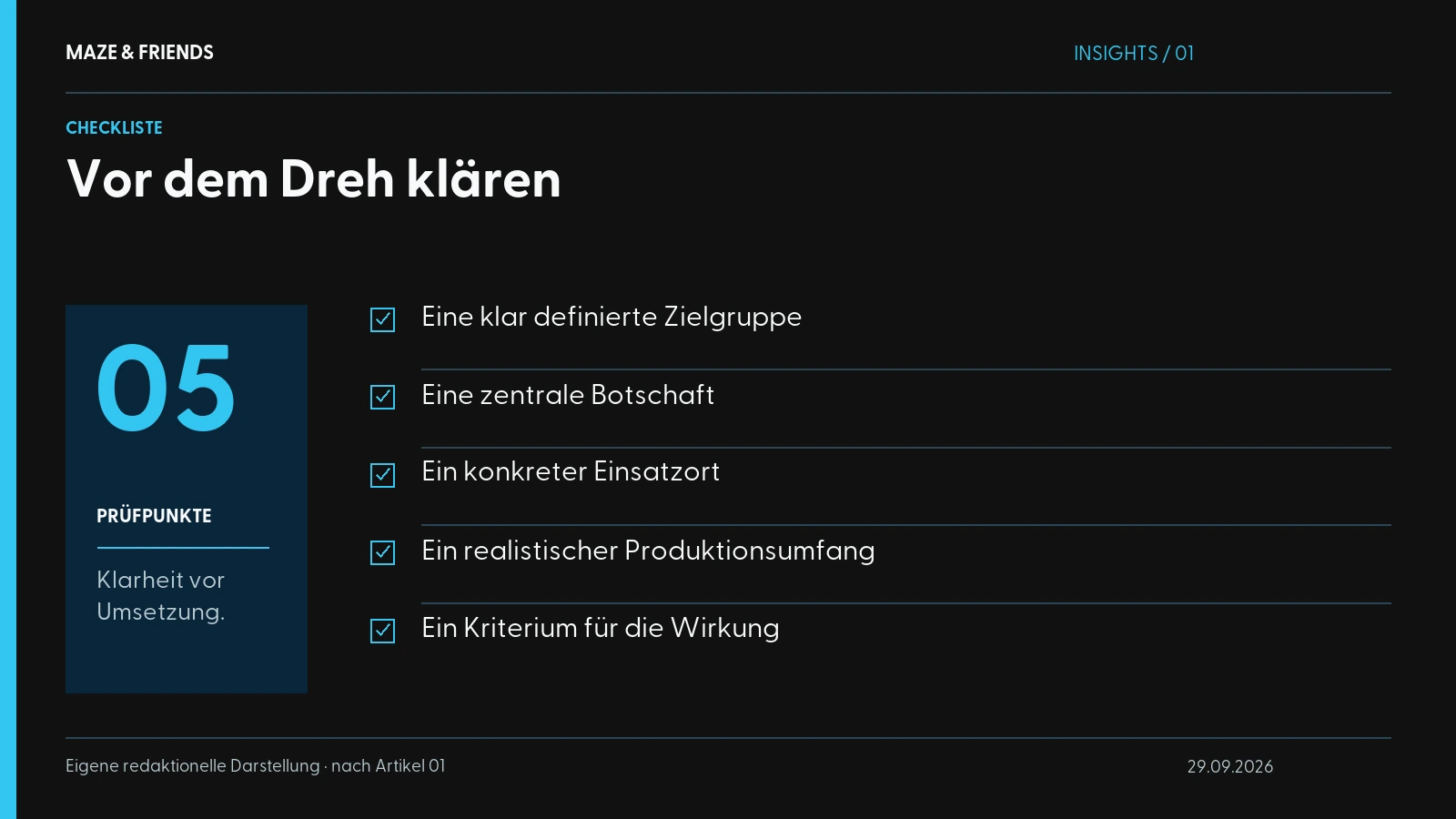
Before you call any agency, answer these five questions for yourself. They save you money and awkward misunderstandings:
- Goal: What exactly should the film achieve: trust, recruiting, sales? The format depends on it.
- Audience: Who is the film for? A film for investors looks different from one for applicants.
- Channels: Where will it run: homepage, trade fair, LinkedIn, sales meeting? That determines length and formats.
- Core message: If viewers remember only one sentence after the film, which one should it be? If you can’t say it in one sentence, the film isn’t ready yet.
- Budget & lifespan: What can it cost and how long should it last? A film meant to run for three years justifies more effort than a series of social clips for one quarter.
If you go into the initial call with clear answers to these five points, you get better quotes, more honest advice and, in the end, a film that moves something. What else to look for when choosing a production company is covered in our guide How to find a brand film agency. The projects directly below this section show how different good films can look.
The next steps towards your own brand film
A brand film makes sense for you, but the what, how and how much are still open? Start with brand film costs in 2026, then look at what to look for in an agency. If you first understand which video you really need, you will spend your budget far more wisely. Maze & Friends clarifies these questions with you in the initial call and then presents a fixed-price quote.
From the studio: Autohaus Willander: brand film featuring the managing director · iSi Group: brand film “iSi World”.
Frequently asked questions
What is meant by a brand film?
A brand film is a short corporate film that shows who a company is, what it stands for and why you can trust it.
At its centre are identity, values, people and attitude. A brand film therefore pays into soft, long-term goals: trust, recognition and loyalty. Its guiding question is “Who are you, and why should I care?”. That makes it work differently from an ad built for a click or a purchase.
What is the English term for “Imagefilm”?
In English, an “Imagefilm” is usually called a “corporate film” or “corporate video”, or a “brand film”, depending on its focus.
The term “Imagefilm” sounds English but is mainly used in German-speaking countries. “Image” refers to the picture others have of a company, in other words its reputation and standing. If you produce internationally or approach English-speaking providers, don’t just translate the word in your brief. Describe what you mean: a short film that portrays the company as a whole and builds trust rather than promoting a product.
What are some examples of brand films?
Typical brand film examples are the interview-style company portrait, the documentary film about real processes, the scripted film with a staged story and the animated brand film.
In the interview style, management, team or customers tell the story, complemented by footage from everyday work. Documentary films show real processes instead of a staged advertising world, which makes them particularly credible. Scripted films work with a narrative plot, often with actors. Animated films use graphics to make abstract services visible. There are also related forms with their own goal, such as the recruiting film or the location portrait. Your goal decides which form fits.
What makes a good brand film?
A good brand film carries one clear core message through real people, a story with a common thread and a visual language that suits the brand.
- Guiding idea: one sentence everything revolves around.
- People instead of logos: founder, team and customers as credible faces.
- Story: beginning, tension and resolution instead of a list of benefits.
- Visual language: colours, music, pace and tone that are recognisable.
Add to that discipline about length, because every second that tells nothing costs viewers.
Where do you use a brand film?
You use a brand film wherever people consciously form a picture of you: on your homepage, in pitches, at trade fairs and in recruiting.
Add sales meetings, LinkedIn and other social media channels, usually in shortened versions there. Plan where it will be used before the shoot, because that determines length and formats. On the homepage and on social media, the first few seconds decide whether someone keeps watching. In pitches, at trade fairs or in recruiting conversations, the film can be longer, because the audience already brings interest.
Is a corporate film the same as a brand film?
Corporate film is the umbrella term for any video a company produces about itself; the brand film is its best-known subtype.
The brand film deliberately relies on emotion and identity and aims to build trust in the company as a whole. Other corporate films pursue other goals, such as a recruiting film that speaks to applicants or a location portrait. In everyday use the terms are still often treated as equivalent, as are company film and company video. For your project, the term matters less than the question of what goal the film should serve.
What is the difference between a brand film and an explainer video?
A brand film shows who a company is and what it stands for; an explainer video makes a product, a feature or a process easy to understand.
The brand film works emotionally through identity, people and attitude and builds trust. The explainer video is more matter-of-fact, goes step by step and builds understanding. It therefore belongs where someone has a specific question, for example on product pages or in sales. The two formats complement each other well: the brand film gives people a reason to take a closer look at you, and the explainer video then answers the detailed questions.
What distinguishes a brand film from an aftermovie?
An aftermovie sums up a past event on film; a brand film portrays the company itself.
The aftermovie shows the atmosphere, highlights and scale of a conference, trade fair or festival and typically runs from 60 seconds to 2 minutes. Its job is to use the energy of the past event for the next one, for example on social media and in ticket sales. The brand film, by contrast, is meant to convey trust and identity over several years. For event organisers, both formats can make sense: one aftermovie per event and a brand film that shows what the event stands for as a whole.
How do I create a brand film?
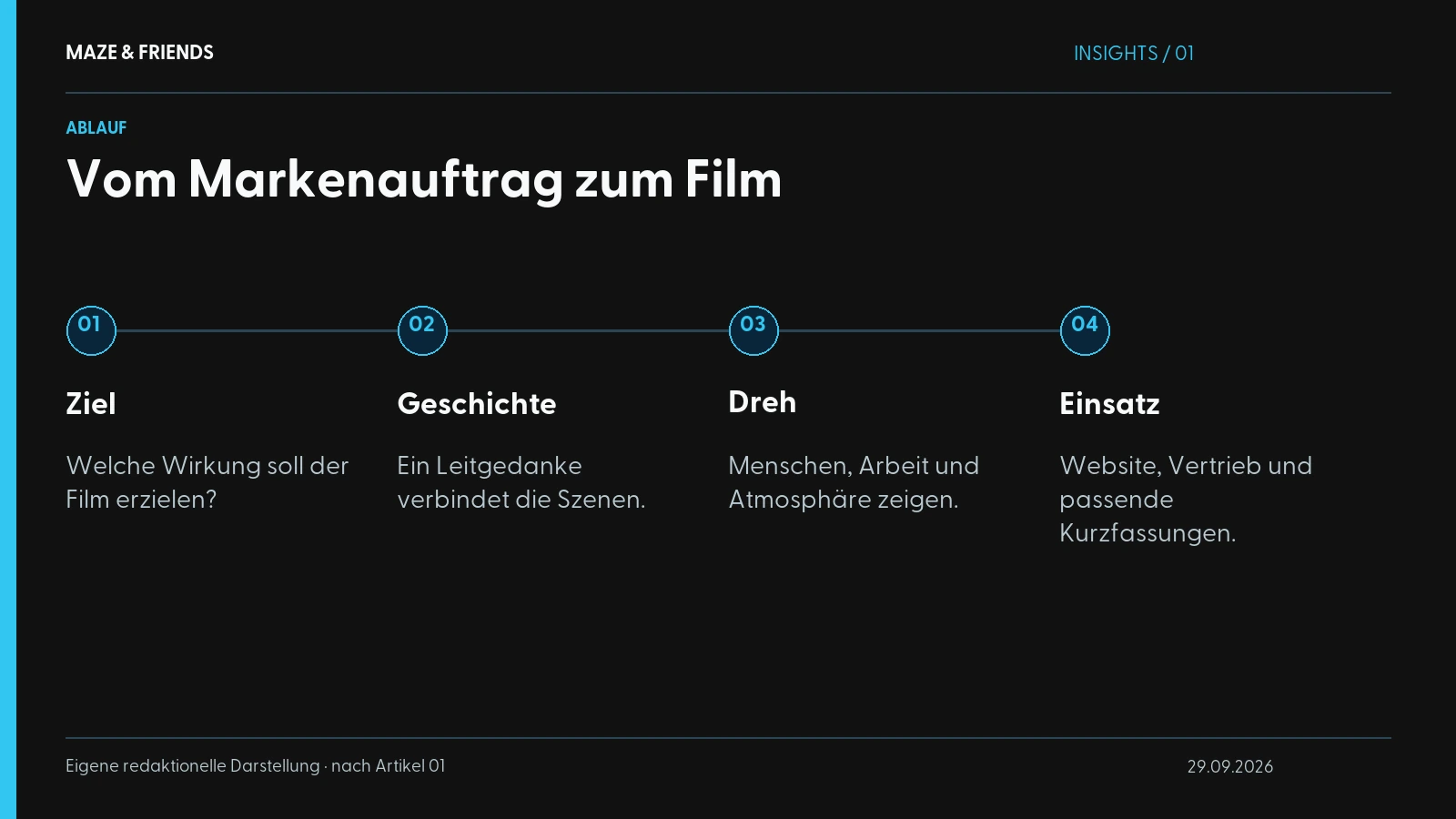
You create a brand film in two steps: first you clarify goal, audience, channels, core message and budget, then come concept, shoot and edit.
- Goal: trust, recruiting or sales decides the format.
- Audience: a film for investors looks different from one for applicants.
- Channels: homepage, trade fair or LinkedIn determine length and formats.
- Core message: the one sentence viewers should remember.
- Budget and lifespan: a film meant to run for three years justifies more effort.
Only then is it worth moving on to script and camera, whether with your own team or a production partner.
Do I need a brand film as a small company?
A small company does not automatically need a brand film. What tips the balance is whether trust is a central buying factor and your offer needs explaining; size hardly matters.
Small, owner-led businesses in particular often benefit a great deal, because their people are the real difference from the competition. This applies, for example, to consulting, products that need explaining, or services with long sales cycles and large investments. The prerequisite is that your positioning is settled and the budget is enough for a careful production. The film should also work in several places: on the website, in sales and in recruiting, where a good film about your culture often achieves more than a job ad.
When should you hold off on a brand film?
You should hold off on a brand film if your positioning is still shaky, what you really need is short-term sales, or the budget only stretches to a half-hearted production.
A film sets your message in concrete. If you don’t know what you stand for, you produce expensive fog. If the real goal is revenue, performance commercials with clean measurement are usually the better lever, because they are designed for clicks or purchases. With a very tight budget, waiting is often wiser than a half-hearted film. As a tool, a brand film only works when strategy and message come before it.
Can I shoot a brand film myself on a smartphone?
Technically you can shoot a brand film on a smartphone, but for the central film on your homepage or in a pitch it is rarely enough.
Image, sound and dramatic structure decide the effect: light, clean audio, a story with a common thread and a professional edit. Exactly that is hard to achieve without experience. For quick social media snippets or behind-the-scenes glimpses, on the other hand, a smartphone often makes sense, and free editing apps help. They do not replace a concept, though. A badly made brand film damages your image more than having none at all. Shooting it yourself is therefore only worthwhile if your standards are honestly low.
What are the most common mistakes with brand films?
The most common mistake with brand films is a film that runs too long, followed by advertising messages in the wrong format, an unclear core message and one-off use.
A tight 80-second film with a clear message almost always beats the four-minute film that tries to fit everything in. If you pack discounts and product benefits into a brand film, you get a bad commercial that runs too long. Without a core message in one sentence, it is still too early to shoot. And a film that only sits on one page wastes its value, so plan several cut lengths from one shoot right away, such as a 60-second version and short 15-second cuts for social media.
Next step
Want to know which of this fits your company? We will work it out together in 30 minutes. Free and without obligation.
Pick a time