


Brand video vs advertising video
Brand video, brand film or advertising video? The differences across five criteria, plus a simple logic for which video your company needs first.
In short: A brand video, also called a brand film, is a film that builds trust in your company as a whole. An advertising video, by contrast, sells something specific, such as a product, an offer or a promotion, and is optimised for quick action. The rule of thumb: brand film = “Why us?”, advertising video = “Why this, now?”. Most companies need both, but almost never in the same film. Vienna-based Maze & Friends produces both formats.
Anyone commissioning moving images for the first time trips over a lot of terms: brand video, brand film, advertising video, commercial, corporate film, company video, product video, recruiting video. Providers use the words differently, and depending on the search term you get completely different offers. Order an advertising video when you actually need a brand film (or the other way round), and you spend money on the wrong tool. Here we sort out the terms, show the differences across five criteria and give you a simple decision logic.

What brand video, brand film and advertising video mean
| Term | What it means | Typical length | Lifespan |
|---|---|---|---|
| Brand video / brand film | Portrait of the company: attitude, people, performance | 90–180 sec. | 2–4 years |
| Corporate film / company video | Umbrella term for all films in which a company shows itself; often used interchangeably with brand film | 90–180 sec. | 2–4 years |
| Advertising video / commercial | Sells a specific product, offer or promotion | 15–60 sec. | Length of the campaign |
| Product video | Shows a product in detail: function, benefit, use | 30–120 sec. | Product life cycle |
| Recruiting video | Shows the company as an employer | 60–120 sec. | 2–3 years |
In practice, two clarifications clear up most of the confusion.
“Brand video” and “brand film” essentially mean the same thing. In German, “Imagefilm” is the older term, well established in the DACH region (Germany, Austria, Switzerland), while “Imagevideo” is the younger, digitally shaped variant; English has the same pair in brand film and brand video. Some people understand a brand video to be the shorter web version, but there is no fixed standard for it. Anyone trying to sell you something fundamentally different for a “brand video” than for a “brand film” is selling words. Everything about the content is covered in our basic article “What is a brand film?”
The real difference runs between brand and advertising. It concerns goal, tone, length, distribution and how success is measured.

The difference between brand video and advertising video in five criteria
1. The goal. The brand film builds trust. It answers “Who are you, and why should I believe you?”. The advertising video triggers action: “Buy this, book this, click here, now”. Trust needs time and substance; action needs focus and an occasion.
2. The time horizon. A good brand film works for years, on the website, in sales, at trade fairs, in pitches. An advertising video lives as long as the campaign, meaning weeks to a few months, and is then replaced by the next one. That’s why a brand film justifies a higher production effort per film. With advertising videos, what counts is the ability to work in series: many variants, produced quickly, tested continuously.
3. The narrative stance. The brand film shows and proves, with people, work and results. Viewers reach the conclusion themselves that they are dealing with experts. The advertising video claims and demands. It may sharpen, shorten and call for action directly. In a brand film, that tone ruins everything: a company portrait that sounds like an offer comes across like a salesperson who pulls out the order form on first meeting.
4. Distribution. The brand film lives where people deliberately look for information: website, YouTube, sales meetings, trade fairs. The advertising video lives in the ad system, in social ads, YouTube pre-rolls and performance campaigns. There it has to win attention in seconds, usually without sound and always against competition in the feed. How narrow the time window is can be seen in the overview of video ad formats in Google Ads Help (in German): skippable ads on YouTube can be skipped after 5 seconds, and non-skippable ones are at most 60 seconds long.
5. Measuring success. With an advertising video, it’s direct. Every campaign delivers clicks, cost per enquiry and closed deals. With a brand film, it’s indirect, but real: time spent on the website, the quality of sales conversations (“they already knew who we were”), close rates over time. Anyone who demands campaign metrics from a brand film is measuring the wrong tool against the wrong yardstick. And anyone who measures nothing for an advertising video is burning budget.

Which video do you need first?
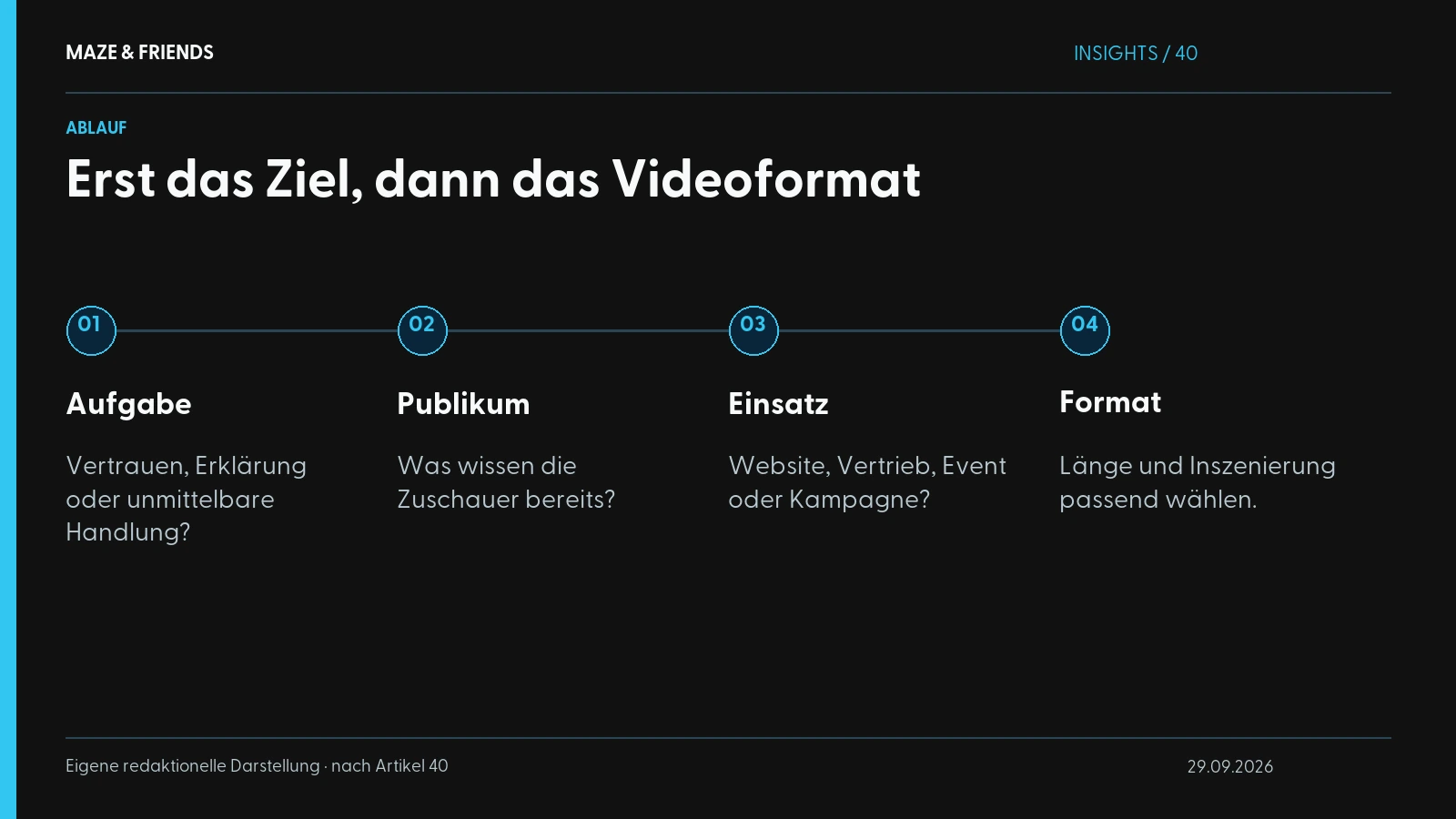
Three questions are almost always enough:
1. Does your audience already know you?
If prospects regularly ask who you actually are and whether they can trust you → brand film first. Advertising videos from a sender without a basis of trust convert poorly, because the click leads to a brand that proves nothing.
2. Do you have a specific, time-critical offer?
Product launch, promotion, event tickets, seasonal business → advertising video(s), produced lean, in several variants for testing. A brand film is too slow for this and too expensive per message.
3. Do you want to reach employees rather than customers?
Then you need a recruiting video. Applicants are an audience of their own with questions of their own, and re-edited customer footage doesn’t answer them.
In practice, this usually results in a sequence rather than an either-or: first the foundation (brand film), then the series (advertising videos) that builds on this trust. On the production side, the two can be interlinked. A well-planned brand film shoot delivers material from which advertising and social cuts can be pulled later, provided this is planned in from the start. This is exactly where requests made after the fact most often fail, because a film that wasn’t shot for variants can’t be meaningfully broken down into ads.
What do brand videos and advertising videos cost?
The pricing logic follows the time horizon. The brand film is the larger one-off investment (more concept work, more shooting effort, higher standards for every shot); the advertising video is the smaller but recurring one (series production for campaigns). For both, the same items drive the price: shoot days, edited versions, music rights and the share of animation. Maze & Friends produces both formats as part of its video production and presents a fixed-price quote after the initial call.
A cost signal from the market for context: for the German search term “Werbevideo” (advertising video), advertisers in Google Ads pay around €13 per click, and around €8 for “Imagefilm” (brand film) (Austria, as of 2026). Real budgets stand behind both terms, so the competition for these searches is just as real. All the more important to know which of the two tools you need before you send an enquiry. Otherwise you’ll be comparing quotes that can’t be compared.

First work out what’s missing
Brand video and brand film are the same tool for trust; the advertising video is the tool for a specific action. Before every enquiry, work out whether you’re short of trust or of demand. And plan the shoot so that advertising and social cuts can be made from the brand film later.
From the studio: Exclusive Home: cinema commercial · Sumetzberger: commercials.
Frequently asked questions
What is a brand video?
A brand video is a film that portrays your company as a whole and builds trust. It doesn’t sell a single offer.
It answers the question “Who are you, and why should I believe you?” and shows attitude, people, work and results to do so. 90 to 180 seconds is typical. A brand video runs where people deliberately look for information: on the website, on YouTube, in sales meetings, at trade fairs and in pitches. Technically, it is the same as a brand film.
Is a brand video the same as a brand film?
Yes. Technically, both terms describe a film that portrays the company as a whole and builds trust.
In German, “Imagefilm” is the older term, well established in the DACH region, and “Imagevideo” the younger, digitally shaped variant; brand film and brand video mirror that pair. Some providers mean a more compact version when they say brand video, but there is no standard for it. Anyone trying to sell you something fundamentally different for a brand video than for a brand film is selling words. Clarify length, where it will be used, formats and budget rather than the word. The real difference runs between brand and advertising anyway.
What is an advertising video?
An advertising video, also called a commercial, sells something specific, such as a product, an offer or a promotion, and is optimised for quick action.
It calls for action directly: buy, book, click, now. 15 to 60 seconds is typical, played out in the ad system, meaning in social ads, as an ad clip before YouTube videos or in performance campaigns. There it has to win attention in seconds, usually without sound and always against competition in the feed. After the campaign, it is replaced by the next one. That’s why the ability to work in series counts: many variants, produced quickly, tested continuously.
What is the difference between a brand video and an advertising video?
A brand video builds trust in your company over years; an advertising video triggers a specific action during a campaign.
The difference shows across five criteria:
- Goal: trust for the brand video, immediate action for the advertising video.
- Time horizon: several years versus the length of a campaign.
- Narrative stance: show and prove versus sharpen and call to action.
- Distribution: website, sales and trade fairs versus the ad system.
- Measuring success: indirectly over time versus directly via clicks and enquiries.
Mix up the two tools and you spend money on the wrong effect.
What is the difference between an advertising video and a product video?
A product video explains a product, with its function, use and benefit. An advertising video sells it in a sharpened form and for the length of a campaign.
Product videos often run on product pages and in sales, are usually 30 to 120 seconds long and stay in use as long as the product itself. Advertising videos are built around a single action and are replaced after the campaign. A good product video can yield many short, sharpened advertising cuts. It doesn’t work the other way round. A short commercial doesn’t make an understandable product explanation.
Can a video be a brand film and an advertising video at the same time?
Practically never, because the goals contradict each other.
Building trust needs calm and proof; selling needs focus and a call to action. What does work very well is a brand film shoot that is planned from the outset so that short advertising and social cuts can be made from it as well. One pool of material thus becomes several tools, and each stays true to itself. The “from the outset” is what matters, because a film that wasn’t shot for variants can hardly be broken down into ads meaningfully later. So name the advertising formats you need in the briefing.
Can a brand video include offers, prices or calls to buy?
Better not. That tone undermines the trust the film is meant to build.
A company portrait that sounds like an offer comes across like a salesperson who pulls out the order form on first meeting. The brand film shows and proves with people, work and results and lets viewers reach the conclusion themselves that they are dealing with experts. Discounts, promotions and prices belong in advertising videos that build on that trust. For a specific offer, you produce a separate advertising video.
When is an advertising video the better choice than a brand film?
For a product launch, a promotion, event tickets or seasonal business, in other words whenever a specific offer needs demand quickly.
For occasions like these, a brand film is too slow and too expensive per message. Leanly produced advertising videos in several variants, tested against each other in ads, are the better choice. They do, however, require a certain basis of trust. Advertising videos from a sender that proves nothing about itself bring few enquiries or purchases, because the click leads to a brand that leaves questions open. If prospects regularly ask who your company actually is, the brand film comes first.
Where should we start on a small budget?
Usually with a leanly produced, honest brand film, because it works for years and makes every later advertising video more effective.
The decision hinges on one question: are you short of trust, or short of demand for a specific offer? If trust is missing, the foundation comes first. If only demand for a clear occasion is missing, advertising videos come first. The most expensive option is almost always trying to do both at once on half a budget. The result can easily be a film that neither builds trust convincingly nor sells.
How long should an advertising video be?
As short as the message allows: 15 to 30 seconds for social ads, up to 60 seconds for offers that need explaining.
Whether someone keeps watching is decided in the first second. The key message therefore belongs at the start. For ads, the vertical format and being understandable without sound are also a must, because advertising videos usually play muted in the feed. Plan several short variants with different openings rather than one long version. Then you can test which version works best.
How long can you use a brand video?
A well-made brand video two to four years, an advertising video usually only for the length of a campaign.
Because of this long time horizon, a higher production effort per film is justified for a brand film. It works for years on the website, in sales, at trade fairs and in pitches. An advertising video is replaced by the next one after weeks to a few months, which is why speed and variants count for more than perfection there. You should renew a brand video at the latest when the team, location, offer or brand presence has visibly changed.
How do you measure the success of an advertising video?
Directly, via clicks, cost per enquiry and closed deals, because every campaign delivers these figures.
Anyone who doesn’t evaluate metrics for advertising videos is burning budget, because they can’t see which variant works. With a brand video, measurement is indirect, but real: time spent on the website, sales conversations in which prospects already know who your company is, and close rates over a longer period. Campaign metrics don’t suit a brand film. Define before production which yardstick applies to which video.
How much does an advertising video cost compared with a brand video?
A single advertising video usually costs less than a brand video. But it is produced in series, which makes it a smaller but recurring investment.
The brand video is the larger one-off investment, with more concept work, more shooting effort and higher standards for every shot, because it works for years. With advertising videos, what counts is variants that are produced quickly and tested continuously. For both, the price is driven by shoot days, the number of edited versions, music rights and the share of animation. Only compare quotes that describe the same tool; otherwise you’re putting prices for different services side by side.
What should I look out for when I want to have a brand video made?
First clarify the task, audience, where it will be used and the yardstick for success. Then compare only quotes with the same scope of services.
Providers use the terms differently, so depending on the search term you get very different quotes for what seems to be the same video. Describe concretely what you need: length, where it will be used, lifespan and formats. Say straight away whether advertising and social cuts should be made from the shoot later, because that has to be planned in during the shoot. Also make sure the concept shows and proves. People, work and results are more convincing than claims.
Can you create a brand video with AI?
AI tools generate short clips from photos or text. They don’t replace a credible brand video, because it lives on real people and real work.
A brand video is supposed to prove that skilled people stand behind your company. Generated scenes show nobody from your team and no real place. AI makes sense as support in production, for example for transcripts, subtitles or format adjustments. If you use AI-generated images that look realistic, label them openly. The transparency rules of the EU AI Act (in German) have applied since August 2026 and explicitly require this for deepfakes.
Next step
Want to know which of this fits your company? We will work it out together in 30 minutes. Free and without obligation.
Pick a time