


Eight questions for any brand film agency
Finding a brand film agency: 8 questions for the initial call that reveal a good partner. With warning signs, a quote check and tips on budget and rights.
In short: You don’t recognise a good brand film agency by its showreel. You recognise it by its questions. It first wants to know what the film should achieve, such as applications, sales meetings or trust, and derives the concept and budget from that. Eight test questions in the initial call show you whether an agency plans for impact or simply delivers pictures. Vienna-based Maze & Friends asks these questions itself before the camera rolls.
You want to have a brand film produced for your company, and there are three quotes on your desk. One dazzles with a 4K drone showreel, one is suspiciously cheap, and the third feels solid without you being able to say exactly why. When choosing a brand film agency, most decision-makers judge the wrong things: beautiful pictures instead of the question of whether the film achieves a business goal.
That gets expensive. A brand film is not a small item in the marketing budget, and a film that looks pretty but moves nobody to act is money down the drain. Maze & Friends produces brand films for mid-sized B2B companies and sees again and again in initial calls where projects fail. Rarely at the camera, mostly at the missing goal.
You can ask the eight questions in this article in any initial call. You’ll quickly notice whether a production company has your success in mind or just its next pretty portfolio piece.
How do I recognise a good brand film agency?
You recognise a good brand film agency by three things: it asks better questions than you do, it talks about impact rather than technology, and it is honest with you, even when that means advising you against something. That is the difference between consulting that also delivers and a mere producer of pictures.
The term “brand film” (in German “Imagefilm”) is often used loosely, so here is a quick definition: a brand film is a short corporate film that conveys your company’s attitude, expertise and personality. It builds trust instead of selling a single product. If you’re unsure which format suits your goal, clarify beforehand what a brand film can do and where its limits lie. That saves you a lot of confusion in the briefing.
Serious brand film production starts with the question “What should the film achieve for you?”. The look comes later. The eight test questions hinge on exactly this question.

What should I look for when choosing a brand film agency? The 8 questions
The eight questions work like a filter, and you don’t have to be a film professional to ask them. What an agency answers reveals more about how it works than any showreel.
1. “What exactly should the film achieve?” And who asks this question first?
At a good agency, this question comes up unprompted. If the person opposite you in the initial call first wants to know whether the film should attract applicants, prepare sales meetings or build trust with new customers, that’s a good sign. If, on the other hand, they immediately talk about camera set-ups, drones and editing software, walk away.
A brand film for companies always has a job: recruiting, winning new customers, building trust with existing leads, location marketing. That job determines tone, length, message and distribution. An agency that doesn’t clarify this first is producing blind.
2. “How do you measure whether the film has worked?”
This question reliably exposes people. Many providers vanish once the file has been delivered. An agency that thinks in data talks about goals that can be measured: time spent on the landing page, applications received after the recruiting film, click-through rate of ads using the film as a creative.
No brand film gives you clean revenue attribution down to the last euro. Anyone who promises that is promising too much. A good agency names realistic indicators and builds the film so that it can be played out measurably, for example with clean tracking on the website where the film is embedded. This is where consulting parts ways with pure production.
3. “Please show me a project that isn’t your showpiece.”
Ask, and every agency will show you its three glossy references. It gets interesting when you ask for an average project, ideally with a budget similar to yours. Your film will, after all, be produced with your budget, and that’s rarely the showcase client’s.
Look for industry proximity: a provider that has already filmed mid-sized industrial companies understands that a factory floor is staged differently from a start-up loft. Ask about your sector, for example: “Have you already shot for mechanical engineering firms or suppliers?” Experience in the right context is worth more than a cinematic showreel from another world.
4. “Who will actually be on site with us on the shoot day?”
A common trick in the industry: the charming creative director wins you over in the pitch, and on the shoot day a freelancer you’ve never seen turns up. Ask about the team that will deliver your project: direction, camera, sound, editing. Are these people permanent members of the agency, or are they brought in project by project?
Both can work. But you should know who bears responsibility and who you can reach if in doubt. An honest agency tells you openly who is permanent and who is a partner. If it dodges the question, that’s a warning sign.
5. “What does a brand film cost with you, and what makes up the price?”
The price question is not taboo; it is a touchstone. Serious brand film production explains what drives the price: shoot days, team size, location, actors or real employees, animations, number of edited versions. After the briefing, it presents a fixed-price quote. Anyone who throws a flat fee at you without any briefing has either not listened or is counting on hidden extras.
For orientation: professional brand films for mid-sized companies cover a wide range, depending on effort, from a simple one-day shoot to a multi-day production with concept, voice-over and post-production. So that you don’t look at the wrong figure when comparing quotes, we have broken down the cost factors of a brand film for 2026 in detail, including the items agencies like to keep quiet about.
6. “What happens after the shoot? Do we get edits for approval?”
The edit is where raw footage becomes a film, and it’s where most conflicts arise. Clarify in advance: how many correction rounds are included in the price? Do you get interim versions for approval, or only the finished result? Who owns the raw footage at the end?
Good agencies work in approval stages: first a rough cut to sign off the structure, then the fine cut, then colour and sound. That lets you step in early, before expensive changes arise. Anyone who tells you “Trust us, it’ll be fine” shifts the entire risk onto you.
7. “Are you planning the film for every format, or just for YouTube?”
A brand film that only exists as a one-minute version for the homepage gives away half its value. A well-planned shoot yields several versions: the long version for the website, short cuts for LinkedIn and social, vertical versions for stories and reels, individual clips for ads.
Ask whether the agency already thinks about this chain of uses at the concept stage. It saves money: the same shoot days, many times the usable material. Which formats make sense for which channel belongs in the concept. After the shoot, it’s too late.
8. “What would you advise us against?”
The most revealing question comes last. A brand film advertising agency that can do everything and says yes to everything is a warning sign. Ask directly: “Given our goal and budget, what would you advise us against?” An honest agency has an answer straight away, for example: “With your budget, I wouldn’t do an elaborate animation. I’d rather invest in a second shoot day.”
Anyone without a clear opinion on this question has either no experience or no stance. You want neither on a larger project. That’s why this honest answer is part of every initial call at Maze & Friends.

The 8 questions at a glance
| # | Question | What it tells you |
|---|---|---|
| 1 | What should the film achieve? | Goal-driven thinking instead of a love affair with technology |
| 2 | How do you measure success? | Data-driven work instead of “file sent, goodbye” |
| 3 | Show a project that isn’t a showpiece | Realistic quality for your budget |
| 4 | Who is there on the shoot day? | A reliable team instead of a pitch bluff |
| 5 | What makes up the price? | Transparency instead of hidden extras |
| 6 | Approval stages in the edit? | Control instead of a black box |
| 7 | Do you plan for multiple formats? | Efficiency instead of a single-use video |
| 8 | What would you advise us against? | Stance and honesty |
If an agency answers six of the eight questions confidently and honestly, you have found a good partner. If it flounders on questions 1, 2 and 8, save your money.

What does brand film production cost?
What brand film production costs depends on the scope. Anyone who gives you an exact figure without a briefing is doing marketing, not consulting. The price comes from very concrete factors: number of shoot days, team size, number of locations, whether real employees or actors appear on camera, whether animated graphics are added and how many edited versions you need.
Roughly speaking, a simple, well-made brand film with one shoot day is considerably cheaper than a multi-day production with a concept phase, voice-over recording and elaborate post-production. More important than the absolute figure is the ratio of effort to impact. An expensive film that moves nobody to act costs more than an inexpensive one that triggers applications or enquiries.
The most honest way to handle the budget: tell the agency your rough range openly. A good agency plans the most effective film from it and presents a fixed-price quote, instead of luring you in with a tight quote and renegotiating later. The full cost logic, including typical price drivers, is in our detailed article on brand film costs in 2026.

What is the most common mistake when choosing an agency?
The most common mistake in practice: decision-makers compare quotes on paper by price and showreel, but never test the way of thinking in a conversation. A brand film is a project built on trust. For weeks you work with strangers and let them into your company, onto your factory floor and close to your employees.
That’s why your gut feeling from the initial call counts as a hard selection criterion. Ask the eight questions and pay less attention to perfect answers than to whether the person opposite you talks to you honestly, concretely and as an equal, or buries you in jargon. That is how you recognise the partner for a brand film that really moves something.
Goal first, camera second
With the eight questions, you quickly see whether a brand film agency understands your goal first and only then unpacks the camera. Maze & Friends works exactly like this: understand, build, prove.
In the initial call, we clarify together what your film should achieve, which format and budget are realistic and whether we’re a good fit. Afterwards you receive a fixed-price quote. Consulting that also delivers. Book a discovery call with Maze & Friends now.
From the studio: Dr. Bohrer Lasertec: portrait film · Pregenerate: brand film and reels.
Frequently asked questions
Where can I have a brand film made?
You can have a brand film made by freelancers, by specialised film production companies or by agencies that combine strategy and production.
- Freelancers: usually affordable and flexible; you often supply the concept and strategy yourself.
- Film production company: brings direction, camera, sound and editing, but not always the strategic context.
- Advertising agency: thinks in campaigns, but doesn’t always have film production in-house.
The ideal is a partner that combines both: clarifying what the film should achieve and then producing it themselves. Which type suits you depends on your goal. The prettiest showreel doesn’t help much with that.
Which questions should I ask a brand film agency in the initial call?
The three most revealing questions for a brand film agency are: what should the film achieve, how do you measure success and what would you advise us against?
Before it talks about cameras or drones, a good agency raises the question of the goal unprompted. When it comes to measuring success, it names realistic indicators rather than a revenue calculation accurate to the euro. Asked what it would advise against, it has an honest answer straight away, such as a second shoot day rather than an expensive animation. It’s also worth asking about an average project with a similar budget, about the team on the shoot day and about the approval stages in the edit. Anyone who flounders on goal, measurement and advising against is the wrong partner.
What are the warning signs with brand film agencies?
Warning signs with brand film agencies are a flat fee without a briefing, technology instead of goals in the conversation, dodging the team question and agreeing to everything.
Anyone who names a price without a briefing has either not listened or is counting on extras later. Anyone who talks about camera set-ups and drones first in the initial call is producing blind. A “Trust us, it’ll be fine” instead of clear approval stages in the edit shifts the risk entirely onto you. And an agency that says yes to every idea has either no experience or no stance. You want neither on a project that takes place inside your company for weeks.
What should a brand film agency’s quote include?
A serious brand film quote lists concept, production and post-production separately and specifies shoot days, team, locations, versions, correction rounds and usage rights.
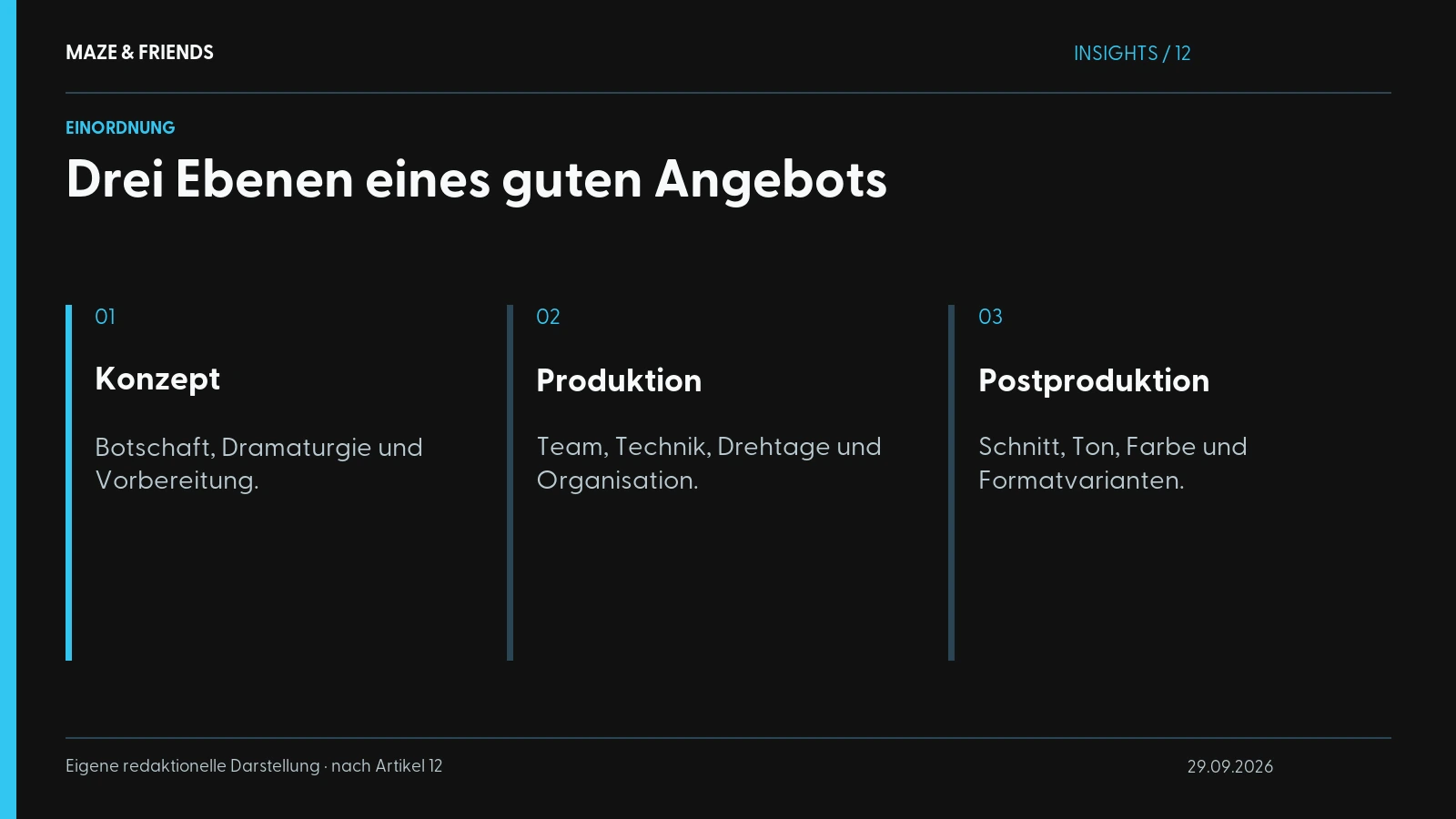
For the concept, what counts is message, dramaturgy and preparation. For production, the team, equipment, shoot days and organisation should be clear, including whether your own employees or actors will appear on camera. Post-production covers editing, sound, colour, any animations and the agreed format variants, such as vertical versions for reels. Only when two quotes describe the same scope of services can you compare them fairly. If one of these layers is missing, ask before you sign.
Should I tell the agency my budget for the brand film?
Yes, tell the agency your rough budget range openly, because that’s the only way it can plan the most effective film for exactly that frame.
Without a frame, every agency calculates a different project, and in the end you compare quotes that can’t be compared. A good agency tells you honestly what makes sense with your budget and what you’d better do without. A bad one lures you in with a tight quote and renegotiates later. What counts in the end is the ratio of effort to impact, and an expensive film that gets no reaction costs more than an inexpensive one that triggers applications or enquiries.
How does producing a brand film with an agency work?
Producing a brand film with an agency runs in phases: briefing, concept, shoot planning, shoot and editing in several approval stages.
- Briefing: clarify goal, audience and where the film will be used.
- Concept: define and sign off message and dramaturgy.
- Shoot: one or more shoot days according to the shooting schedule.
- Rough cut: sign off the structure before the details are worked out.
- Fine cut, colour and sound: final corrections and all formats.
The approval stages let you step in early, before changes become expensive.
How long does it take to have a brand film made?
From the initial call to the finished brand film, you should allow several weeks; a good agency sets the exact schedule before shooting begins.
The time is split between briefing and concept, shoot planning, one or more shoot days and editing with approval loops. Tight deadlines are possible, but usually come at the expense of the concept phase, and that is exactly where quality is decided. Also allow time for your own approvals: if feedback comes quickly and bundled, the editing phase gets noticeably shorter. Several locations, aerial shots that depend on weather windows or many people involved in the company can extend the schedule.
What do I need to contribute to a brand film as the client?
As the client, you provide a clear briefing, a contact person on the shoot day and timely approvals; a good agency takes care of the rest.
The briefing should cover goal, audience, where the film will be used and your budget range. On the shoot day, the team needs someone who opens rooms, coordinates interviewees and makes quick decisions. Also let your team know in advance who will be filmed and what for, and obtain consent from everyone taking part. With an experienced agency, your business keeps running on the shoot day, because the shoot is planned accordingly.
Who owns the raw footage and usage rights to the finished brand film?
Who owns the raw footage and usage rights to a brand film is governed by the contract, so you should clarify both in writing before production starts. Under section 38 of the Austrian Copyright Act (UrhG) (in German), the rights to a commercially produced film lie, in case of doubt, with the film producer, meaning the production company.
Three points matter: on which channels and for how long you may use the film, whether the music licence also covers paid advertising, and whether you receive the raw footage. Raw footage becomes valuable when you later want to pull new cuts, reels or ads from it. Arrangements differ from provider to provider, so ask specifically. At Maze & Friends, you own the usage rights to all delivered formats, and the raw footage is available on request.
How do you measure whether a brand film works?
You measure whether a brand film works using indicators such as time spent on the website, applications received or the click-through rate of ads featuring the film.
No brand film delivers revenue attribution accurate to the euro, and anyone who promises it is exaggerating. For measurement to be possible, the film has to be played out measurably, for example with clean tracking, meaning correct measurement on the website where it is embedded. Define the metrics before the shoot and later compare them with the situation before the film. A good agency raises the topic unprompted instead of simply delivering the finished file.
Does a brand film agency need experience in my industry?
Industry experience is not a must, but it is a clear advantage, because an agency with relevant projects knows how to show your environment credibly.
A factory floor is staged differently from a start-up loft, and a supplier needs different images from a consultancy. So ask whether the agency has already shot in your industry or a related one, for example in mechanical engineering or with suppliers. Watch these films in full and check whether they were made with a budget like yours. A showreel from another world, however cinematic, does little for you.
Is it bad if an agency works with freelancers on the shoot day?
Freelancers on the shoot day aren’t automatically bad, as long as it’s clear who is responsible for the project and who you can reach if in doubt.
A permanent core with partners brought in per project for camera, sound or editing can work just as well as a completely permanent team. It becomes a problem when a charming creative director wins you over in the pitch and on the shoot day people turn up whom you’ve never seen. So ask specifically about the team for your project: who directs, who operates the camera, who edits, and which of them are permanent members of the agency? An honest agency answers that openly.
Why isn’t a good showreel enough to choose a brand film agency?
A showreel shows an agency’s best images, but not whether it will build a film with your budget that achieves your business goal.
Showreels consist of glossy excerpts from showcase clients with their own budgets; your film is made with yours. The most common mistake when choosing is therefore comparing quotes on paper by price and showreel instead of testing the way of thinking in a conversation. Pay attention to whether the person opposite you talks honestly, concretely and as an equal, or buries you in jargon. On a project for which you let an outside team into your company, your gut feeling from the initial call is a hard selection criterion.
Next step
Want to know which of this fits your company? We will work it out together in 30 minutes. Free and without obligation.
Pick a time