



B2B social media that actually wins leads
B2B social media: which channels bring leads for DACH mid-sized companies, which only cost time, and how to build a focused channel strategy.
In short: B2B social media brings leads when you focus on a few channels instead of trying to be everywhere. In 2026, the company presence of mid-sized firms in the DACH region (Germany, Austria and Switzerland) rests mainly on LinkedIn and, for products that need explaining, YouTube. For most industrial companies, TikTok, X and Xing cost more time than they bring in enquiries. Maze & Friends from Vienna chooses channels based on where your decision-makers really are.
Someone in the meeting says it: “We really ought to do something on social media again.” Shortly afterwards, the to-do list says that someone will now also run Instagram, TikTok and the company’s LinkedIn account. Three months later, the results are sobering: a lot of effort, a few likes from employees and suppliers, zero enquiries. This is how mid-sized industrial companies in the DACH region burn time week after week on channels where their customers don’t buy at all.
The problem is rarely that too little gets posted. Usually the channel is wrong, the role is unclear and sales isn’t connected. This article sorts out which social media channels genuinely drive B2B leads in 2026 and which you can drop with a clear conscience. The focus is on your company’s presence. The visibility of individual people is a separate topic, more on that shortly.
What does “social media for B2B” mean, and what doesn’t it mean?
B2B social media means your company is present on social platforms to reach business customers, in other words other companies and their decision-makers rather than consumers. The difference from B2C is fundamental: you sell services that need explaining, often expensive ones, to a small number of very specific people who make considered decisions. There is no anonymous mass audience here.
That is why social media is not a sales channel in the narrow sense. Nobody buys a special-purpose machine because they saw a post. In B2B, social media is a channel for visibility and trust: the place where your company comes across as present and competent long before a concrete need arises.
A company presence is not a personal brand
This is where most of the confusion comes from, so let’s settle it first: B2B social media works on two levels.
- The company presence: how your company shows up, from the LinkedIn company page and the company’s YouTube channel to the Instagram profile. That is what this article is about.
- The personal brand: the visibility of individual people in your company, such as the managing directors. A separate and very effective field, but a different one. If that interests you, read Personal branding for B2B decision-makers.
Why this distinction matters becomes clear with the very first channel. In B2B, reach and trust almost always come from people, while the company presence provides the frame.

Why do most B2B company profiles bring no leads?
First, the honest diagnosis: if your company profile brings no enquiries, it is usually down to one of four reasons.
- Company pages have little organic reach by nature. Platforms such as LinkedIn favour posts by people over posts by companies. A post on the company page often reaches only a fraction of its own followers organically.
- The “we have to be everywhere” reflex. Running five channels half-heartedly ties up all your capacity and convinces nobody on any of them. Presence without focus is expensive busywork.
- The wrong expectation. In B2B, a “lead from social media” is almost never the direct click from a post to the contact form. Social pays into the early phase, meaning awareness, trust and “I know them”, and often works in a supporting role in the background. If you only measure the last click, you will wrongly conclude the channel does nothing.
- No connection to sales. Visibility that nobody picks up fizzles out. Without a path from content to conversation, all you get is applause.
Remember the third point in particular. B2B social media is a long-distance run in the upper part of the funnel (TOFU, top of funnel). If you expect instant revenue from it, you often shut down exactly the channel that would have built impact over months.
Which social media channels really bring B2B leads in 2026?
For a typical industrial or mid-sized company in the DACH region, the honest assessment looks like this, first as an overview, then in detail.
| Channel | B2B suitability | What it is good for | Effort |
|---|---|---|---|
| High | Reach among decision-makers, credibility, recruiting, ads | Medium to high | |
| YouTube | High (for products that need explaining) | Application videos, demos, know-how, SEO effect | High |
| Instagram/Meta | Medium | Employer branding, retargeting ads | Medium |
| TikTok | Low (exception: recruiting) | Reaching young talent | High |
| X (Twitter) | Low | Niche topics, PR | Medium |
| Low | Hardly any content reach left | Low |
LinkedIn is a must, with one caveat
For practically every B2B company in the DACH region, there is no way around LinkedIn. Your decision-makers spend their working time there, the context is right, and expertise can be shown credibly.
On its own, though, the LinkedIn company page rarely carries much weight. It matters as a business card, as proof that you exist, for job ads and as the destination for ads, but its organic reach stays limited. The real reach comes from the personal profiles of your team and your leadership: a post by the managing director is usually seen far more often than the same content on the company page. The company page is the anchor, the people are the engine. We show how this works methodically in Thought leadership on LinkedIn.
In practice, this means: maintain the company page properly, but put your energy into the visibility of the people behind it. Use LinkedIn Ads when you want to reach specific industries, job functions or regions. For precise B2B targeting, the platform is hard to beat.
YouTube is underrated among industrial mid-sized companies
Many people think of YouTube as B2C entertainment, and that is a mistake. For products that need explaining in particular, it is one of the strongest B2B channels there is. Application videos, machines in action, assembly instructions, answers to typical technical questions: this is exactly what an engineer or technical buyer actively searches for, often in the middle of the selection process.
The double advantage: YouTube is considered the second-largest search engine in the world and belongs to Google. A good application video works for you for years and also turns up in classic search. Instead of fleeting feed content, you build a knowledge archive that prepares the ground for enquiries. The catch: video takes more effort to produce. In return, the competition in German-language B2B is limited.
Instagram and Meta for employer branding and retargeting
In classic B2B, Instagram rarely brings direct enquiries. Where it can still pay off: employer branding. If you are fighting for talent amid the skills shortage, an authentic look behind the scenes gives your employer brand a face.
Then there is the advertising side: with Meta Ads Manager, you can reach website visitors again very cost-effectively (retargeting). As a standalone lead channel for industry, Meta is weak; as an amplifier with a clean website and proper tracking, it can pay off.

Which channels usually just cost time in B2B?
Knowing what you can leave out matters just as much as knowing where you should be present. For the typical B2B industrial company:
- TikTok: almost always the wrong place for lead generation in industrial B2B. The one serious exception is recruiting: if you specifically want to reach young skilled workers or apprentices, TikTok can work. Otherwise, the effort is out of all proportion to the return.
- X (formerly Twitter): reach and relevance have dropped markedly in German-language B2B. Fine for individual PR or niche topics, rarely sensible as a core channel for mid-sized companies.
- Xing: the emotionally obvious choice as the DACH network, but in practice hardly a content channel any more. It is more of an address and job directory than a place to build reach with posts.
- Pinterest, Facebook (organic) and the like: irrelevant for the vast majority of industrial and mid-sized cases. Facebook still works as an ad platform, but organically it has run out of steam.
As a rule of thumb: where your decision-makers don’t spend their working time, even good content won’t bring in leads. Better to cut such channels than to drag them along half-heartedly.
How do you build a B2B social media strategy that fits your company?
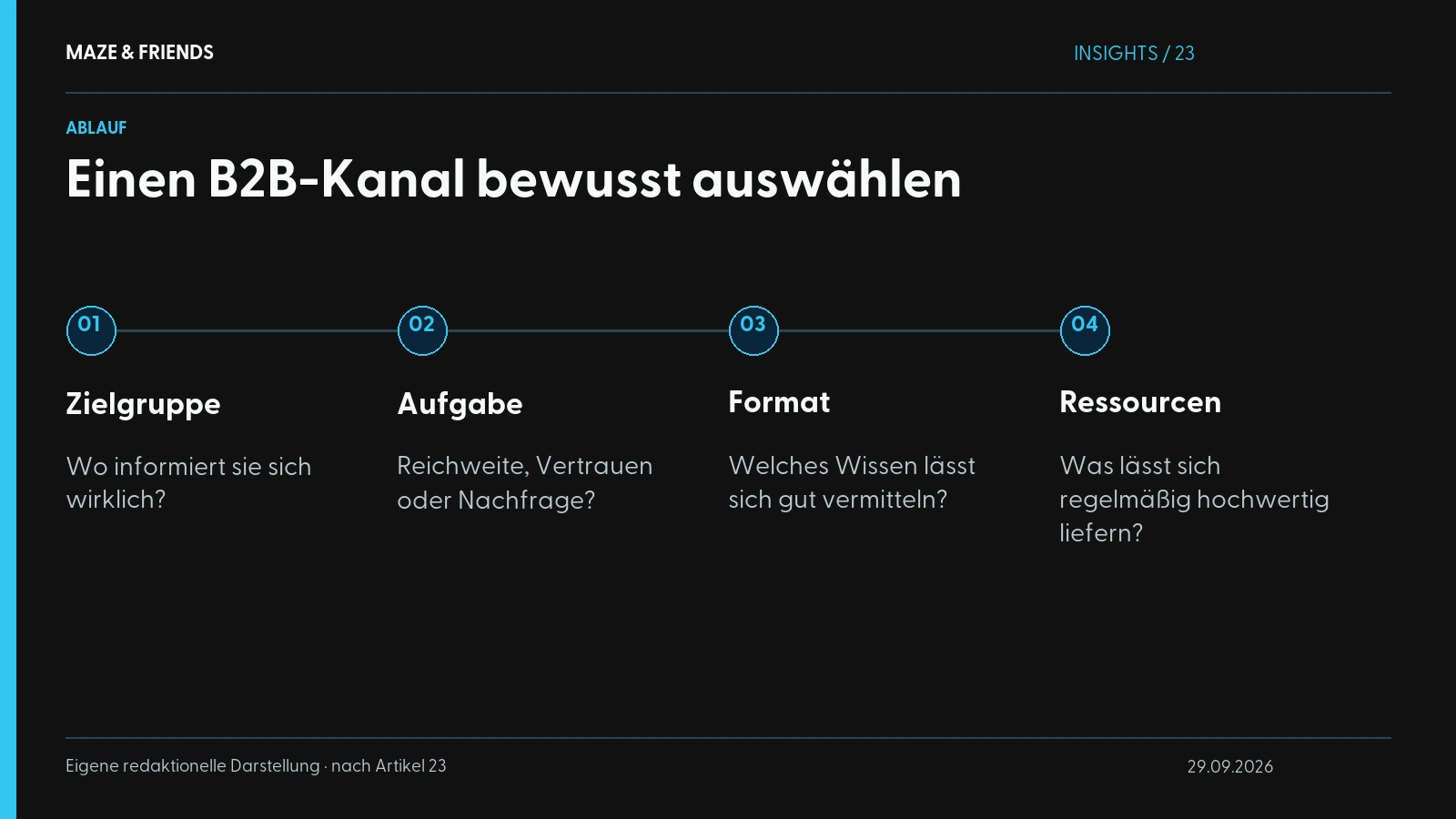
Channel choice follows clear criteria, and taste has nothing to do with it. A sound B2B social media strategy answers five questions at company level, in this order:
- Where are your decision-makers really? This means the place where your target group spends its working time, even if you would rather be somewhere else yourself. For industrial buyers and technical decision-makers, that is almost always LinkedIn, often YouTube and rarely TikTok.
- What can you deliver? Be honest about your resources. If you can produce video regularly, YouTube is a lever. If not, don’t force yourself. Better one channel you run well than three you neglect.
- One channel as home, the rest as amplifiers. Choose one main channel where you are genuinely present. Other platforms may complement it, but they must not splinter your effort.
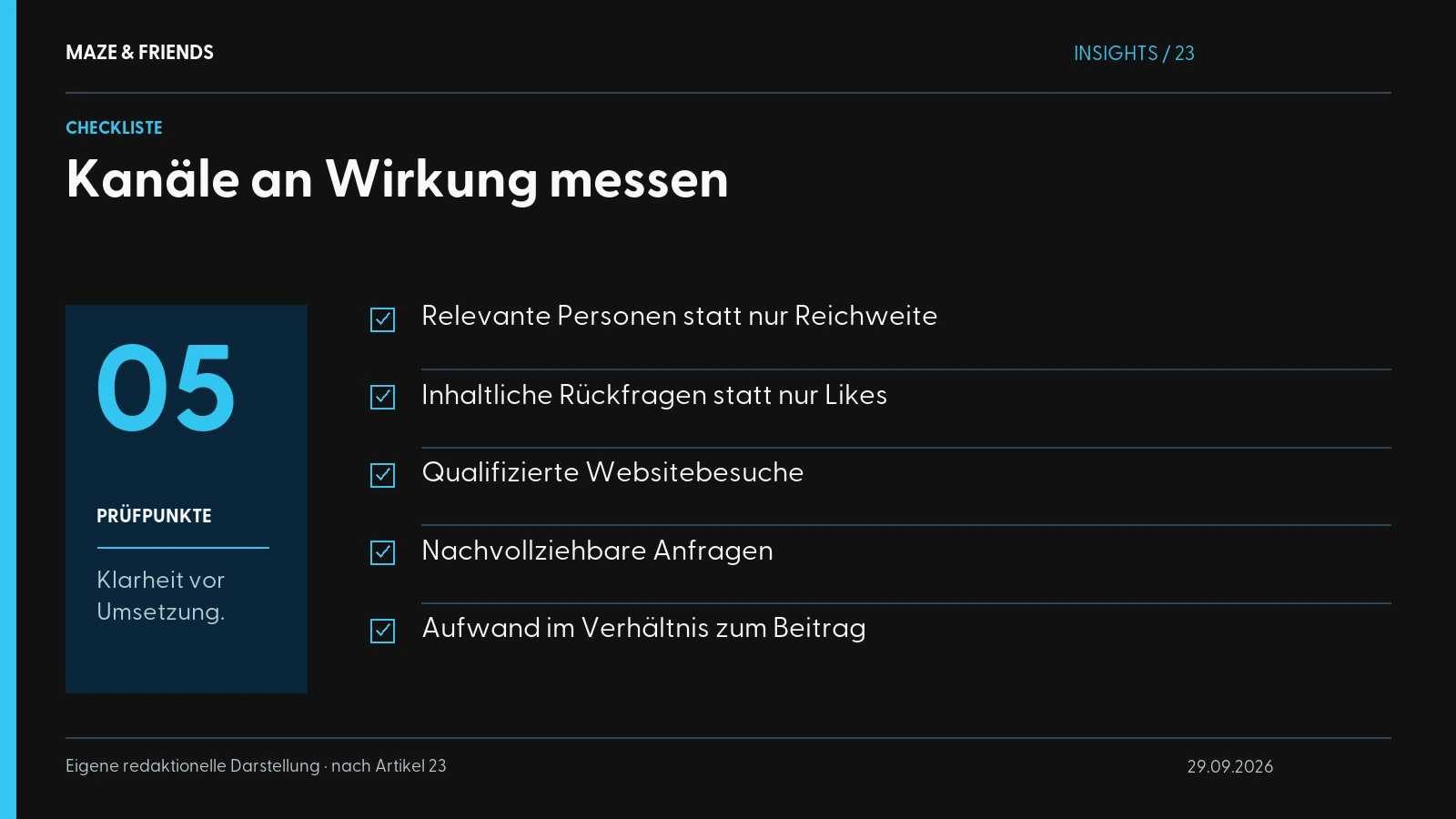
- Set realistic goals. Top of funnel is about awareness and trust; instant sales are the exception there. Measure meaningful signals such as qualified profile visits and enquiries that refer to your content, rather than vanity metrics (figures that look good but say nothing about enquiries) such as raw follower counts.
- Build the bridge to sales. Agree in advance what happens when someone gets in touch. Visibility without proper follow-up is wasted time.
Answer these five questions honestly and the channel question almost settles itself. What usually remains is a very focused picture, and that is exactly the point.
What does social media marketing cost in Austria, and who does the work?
There are roughly three ways to get it done, each with honest pros and cons:
- In-house: full control and close to the expertise, but it takes time and skills that are often missing in day-to-day business. Only realistic if someone genuinely owns the role.
- Freelancers: flexible and usually cheaper, good for individual disciplines such as video editing or graphic design. Strategy and the link to sales, however, often stay with you.
- Agency: more structure and strategy from a single source, at a higher cost. Worthwhile if, beyond individual posts, you want a well-thought-out channel mix connected to real leads.
Flat-rate prices would not be serious, because costs depend heavily on scope: from “one post a month” to a fully managed channel mix including advertising. At Maze & Friends, you receive a fixed quote after the initial call. What matters more than the hourly rate is whether enquiries come out of it in the end. For social media marketing in Austria, one more thing applies: the market is smaller and more personal than in Germany. If you know Vienna’s and Austria’s mid-sized companies, you understand the decision-makers and the tone faster.
Maze & Friends connects social media with strategy and sales. If you want to know which channels pay off for your company, you will find more on our page about our social media agency in Vienna.

Few channels, run consistently
B2B social media almost always fails because effort is spread too thin, hardly ever because there is too little of it. Try to be everywhere and you convince nowhere. Choose the one or two channels where your decision-makers really are, which for most mid-sized DACH companies means LinkedIn and YouTube. Run them consistently and connect them to your sales team. You may ignore the rest.
If you don’t want to guess which channels pay off for your company: Maze & Friends delivers strategy and execution from a single source. Book a no-obligation discovery call: in the conversation, we will tell you honestly which social media channels bring you leads and which you can skip.
From the studio: iSi Group: brand film “iSi World” · Aviation Academy Austria: brand film, Reels and performance marketing.
What “professional” means on social media today and how the algorithm and content relate to each other is something Manuel Zellnig explained in an interview with Ghezzo (in German).
Frequently asked questions
What is B2B social media marketing?
B2B social media marketing means a company uses social platforms to reach business customers and their decision-makers, with the aim of visibility and trust rather than quick sales.
Unlike B2C, you sell services that need explaining, often expensive ones, to a small number of very specific people who make considered decisions. Nobody buys a special-purpose machine because they saw a post. In B2B, social media is therefore a channel for visibility and trust: your company comes across as present and competent there long before a concrete need arises. It is worth distinguishing between the company presence and the personal brands of individual people.
Which social media channels matter most for B2B?
For most B2B companies in the DACH region, LinkedIn and, for products that need explaining, YouTube are the most important channels; everything else is a complement or can be dropped.
LinkedIn reaches decision-makers in a professional context and offers precise targeting for ads. YouTube delivers application know-how with a long shelf life. Instagram and Meta are moderately suitable, mainly for employer branding and retargeting. For most industrial companies, TikTok, X and Xing cost more time than they bring in enquiries, with the exception of TikTok for recruiting. The deciding factor is whether your decision-makers spend their working time there.
Is a LinkedIn company page worth having at all?
Yes, as a business card and an anchor. The real organic reach, however, comes from the personal profiles of your team and leadership.
Platforms such as LinkedIn favour posts by people; a post on the company page often reaches only a fraction of its own followers organically. You still need the page as proof that you are a serious business, for job ads and as the sender of ads. With LinkedIn Ads, you reach specific industries, job functions or regions; for precise B2B targeting, the platform is hard to beat. Maintain the page properly, but put your energy into the visibility of the people behind it.
Does YouTube make sense for B2B companies?
Yes, for products that need explaining in particular, YouTube is one of the strongest B2B channels, because engineers and technical buyers actively search there for applications, demos and answers.
Application videos, machines in action, assembly instructions and answers to typical technical questions are often watched in the middle of the selection process. Then there is the search effect: YouTube is considered the second-largest search engine in the world and belongs to Google, so good videos also turn up in classic search and work for you for years. The catch is the higher production effort. In return, the competition in German-language B2B is limited.
Is Instagram worth it for B2B companies?
Rarely for direct enquiries, but often for employer branding and retargeting: Instagram shows your employer brand, and Meta’s advertising platform reaches website visitors again.
If you are fighting for talent amid the skills shortage, an authentic look behind the scenes gives your employer brand a face. With Meta Ads Manager, you can reach people who have already visited your website again very cost-effectively. As a standalone lead channel, Meta is weak for industry; as an amplifier with a clean website and proper tracking, it can pay off. Organic Facebook, on the other hand, is hardly relevant any more for most industrial cases.
Does my industrial company need TikTok?
For winning business customers, in the vast majority of cases no; the one serious exception is recruiting young skilled workers and apprentices.
For lead generation in industrial B2B, TikTok is almost always the wrong place; the high production effort is out of all proportion to the return. Things look different if you specifically want to win young people for an apprenticeship or a skilled career: then an honest look into the workshop, the team and everyday work can succeed. In that case, plan TikTok as a recruiting channel with its own goals and metrics, and don’t expect orders from it. Without clear resources, you are better off leaving it out.
Is Xing still relevant for B2B in the DACH region?
Hardly as a content channel: in practice, Xing is more of an address and job directory than a place where posts achieve reach.
Emotionally, Xing is the obvious choice as the DACH network, and a well-kept profile does no harm. But you should not invest energy in regular posts there. It is a similar story with X, formerly Twitter: reach and relevance have dropped markedly in German-language B2B. The channel is usable for individual PR or niche topics, but rarely sensible as a core channel for mid-sized companies. The capacity you save here usually achieves more on LinkedIn or YouTube.
How many social media channels should a B2B company run?
Better one or two channels done properly than five done half-heartedly: choose one main channel where your decision-makers really are, and only add others for a clear reason.
The most common cause of unsuccessful B2B presences is fragmentation. Running five channels half-heartedly ties up all your capacity and convinces nobody on any of them. One channel as home, the rest as amplifiers: that keeps your effort concentrated. For most mid-sized DACH companies, this means LinkedIn as the base and YouTube if you can produce video regularly. A channel you can’t maintain is better cut than dragged along.
Which questions should a B2B social media strategy answer?
A sound B2B social media strategy answers five questions in a fixed order, from the target group to the handover to sales.
- Where do your decision-makers really spend their working time?
- What can you deliver regularly with your resources?
- Which channel is home, and which ones only amplify?
- Which realistic goals and signals do you measure?
- What happens when someone gets in touch?
Answered honestly, they almost always lead to a few clearly chosen channels.
How do you measure the success of B2B social media?
Measure B2B social media by qualified profile visits and enquiries that refer to your content. Raw follower counts or likes are vanity metrics.
The right expectation is key: in B2B, a lead from social media is almost never the direct click from a post to the contact form. The channel pays into the early phase, into awareness and trust, and often works in a supporting role in the background. If you only measure the last click, you will wrongly conclude it does nothing. When new enquiries come in, ask how people found you, and make sure tracking on your website is set up properly.
How quickly does B2B social media bring leads?
Realistically, it takes months: first awareness and trust build up, then enquiries follow. Early signals such as profile visits and comments, however, appear soon.
B2B social media is a long-distance run in the upper part of the funnel, in other words where prospects are only just getting to know you. With long buying cycles and several people involved, concrete enquiries take time. If you give up after four weeks, you never see the result and often shut down exactly the channel that would have built impact over months. Agree internally on a realistic test period and interim goals before you decide on success or failure.
How much does social media cost for B2B companies in Austria?
Costs depend on scope, from one post a month to a fully managed channel mix including advertising; the only serious basis is a fixed quote after a briefing.
The main cost drivers are the number of channels, the frequency and format of the content (video above all), the share of strategy work, any advertising budget and how much your team handles itself. What matters more than the hourly rate is whether enquiries come out of it in the end. For Austria, one more thing applies: the market is smaller and more personal than in Germany. If you know Vienna’s and Austria’s mid-sized companies, you understand the decision-makers and the tone faster.
Should we handle social media in-house or hand it to an agency?
That depends on your resources and ambitions; a middle way often works best: sharpen the strategy externally and keep parts of the execution in-house.
In-house offers full control and closeness to the expertise, but it needs time, skills and someone who genuinely owns the role. Freelancers are flexible and usually cheaper, good for individual disciplines such as video editing or graphic design, but strategy and the link to sales often stay with you. An agency brings strategy and structure from a single source, but costs more. As an agency in Vienna, Maze & Friends covers strategy and execution under one roof.
What are some examples of B2B social media?
Typical B2B examples are application videos on YouTube, expert posts by the managing director on LinkedIn, insights for applicants on Instagram and LinkedIn ads for selected industries and job functions.
A machine builder, for instance, shows its equipment in action and answers typical technical questions on video, which prospects find in the middle of the selection process. The managing director puts industry developments into context on LinkedIn, while the company page serves as the anchor. For the employer brand, the team shows its everyday work, and retargeting reaches website visitors again. What all good examples have in common is that each channel has a clear role and is connected to sales.
Should employees post on LinkedIn for the company?
Yes, voluntarily and with clear guardrails: on LinkedIn, posts by people usually reach far more people than the same content on the company page.
In B2B, reach and trust almost always come from people; the company page only provides the frame. It works best when the managing director leads the way and specialists talk about their own field instead of just sharing company posts. A shared line of topics, simple approval rules and support with wording or images all help. Compulsion, on the other hand, quickly feels fake. How this turns into genuine personal brands is a separate field with its own strategy.
Next step
Want to know which of this fits your company? We will work it out together in 30 minutes. Free and without obligation.
Pick a time
Manuel Zellnig has been building visibility for companies since 2018: brand film, personal branding, performance marketing and AI visibility. Qualified advertising specialist (Werbeakademie Wien), Bachelor in Business Management (Carinthia University of Applied Sciences), author of the book ‘Mobile Apps zur Messung der Kundenzufriedenheit’ (2017, in German) and creative expert for the Austrian Economic Chamber (WKO) in two transformation guides. He measures before he recommends and writes here about what actually works in projects.
Publications and interviews: WKO transformation guide for printers (in German) · WKO transformation guide for florists (in German) · Interview with Ghezzo (in German) · ‘Heute’ on Viennese start-ups (in German)