


Trade fair ROI: formula and worked example
Calculate trade fair ROI: full costs, formula, a fictitious worked example and KPIs for mid-sized B2B firms. Find out whether your stand pays off.
In short: Trade fair ROI is the return from your trade fair presence minus all costs, divided by those costs. The calculation only becomes reliable once you capture every cost, not just the stand rental, and measure the return through contribution margin and pipeline value, over months. That is why Maze & Friends from Vienna only calculates trade fairs with a baseline and clean lead tracking; otherwise every figure remains a guess.
It is September. The budget round for next year is under way, and at some point management asks: “So what did the trade fair in the spring actually bring us?” And all there is to show is a pile of business cards, a good gut feeling and not a single reliable figure.
Few channels in mid-sized B2B companies are booked as routinely, and recalculated properly as rarely, as the trade fair presence. In the end, a gut feeling often decides whether it gets booked again next year.
This article gives you the calculation you need to determine your trade fair ROI reliably, without dressing it up and without talking it down. Afterwards you will have a figure you can take into the budget round.
What is the ROI of a trade fair presence, and why is it so hard to measure?
ROI stands for “return on investment”, the return on the money you put in. The basic formula is simple:
ROI (%) = (Return − Total costs) / Total costs × 100
For a Google Ads campaign, that is quickly calculated: spend, clicks, enquiries, revenue. A trade fair is trickier, for three reasons:
- Long sales cycles. In industrial B2B, many months often pass between the first stand conversation and the signed order, quite often more than a year. If you take stock two weeks after the fair, you are measuring nothing.
- Many touchpoints. The prospect had already visited your website, seen an ad, stopped by the stand and was later visited by your field sales team. Which channel do you credit with the deal?
- Soft effects. Brand awareness, well-tended existing customers, keeping an eye on competitors: all of this has value, but none of it shows up in a revenue line.
That is exactly why most trade fair calculations fail: they either do not capture all the costs or they capture the return too early. Both lead to a figure that nobody trusts.
What does a trade fair presence really cost?
An incomplete cost side is usually to blame for a wrong ROI calculation. The stand rental is only the tip of the iceberg. If you add up your trade fair costs in full, these blocks belong in the calculation:
| Cost block | What it includes | Often forgotten |
|---|---|---|
| Stand space | Rent per m², registration fee, catalogue entry | – |
| Stand construction | Build/hire, furniture, graphics, technology, build-up and dismantling, storage | Transport & storage for the following year |
| Stand services | Electricity, water, internet, cleaning, waste | Additional bookings on site |
| Travel & staff | Travel, hotel, meals, expenses, external stand hosts where needed | Several people over several days |
| Internal staff costs | Working days × day rate for planning, stand duty, follow-up | Almost always ignored completely |
| Marketing around the fair | Invitations, pre-show campaign, landing page, giveaways, print | Half the campaign runs “on the side” |
| Follow-up | Lead capture, follow-up campaign, CRM maintenance | Costs time = money |
The item most often left out is internal staff costs. If four people invest three days at the fair plus two days each of preparation and follow-up, that quickly adds up to 20 person-days. Multiply that by a realistic day rate and you have a five-figure sum that appears in no calculation, but is real. In that time, these people could have done other things; that is your opportunity cost.
Only once this total is in place do you have the complete investment side.

How do you calculate trade fair ROI in practice?
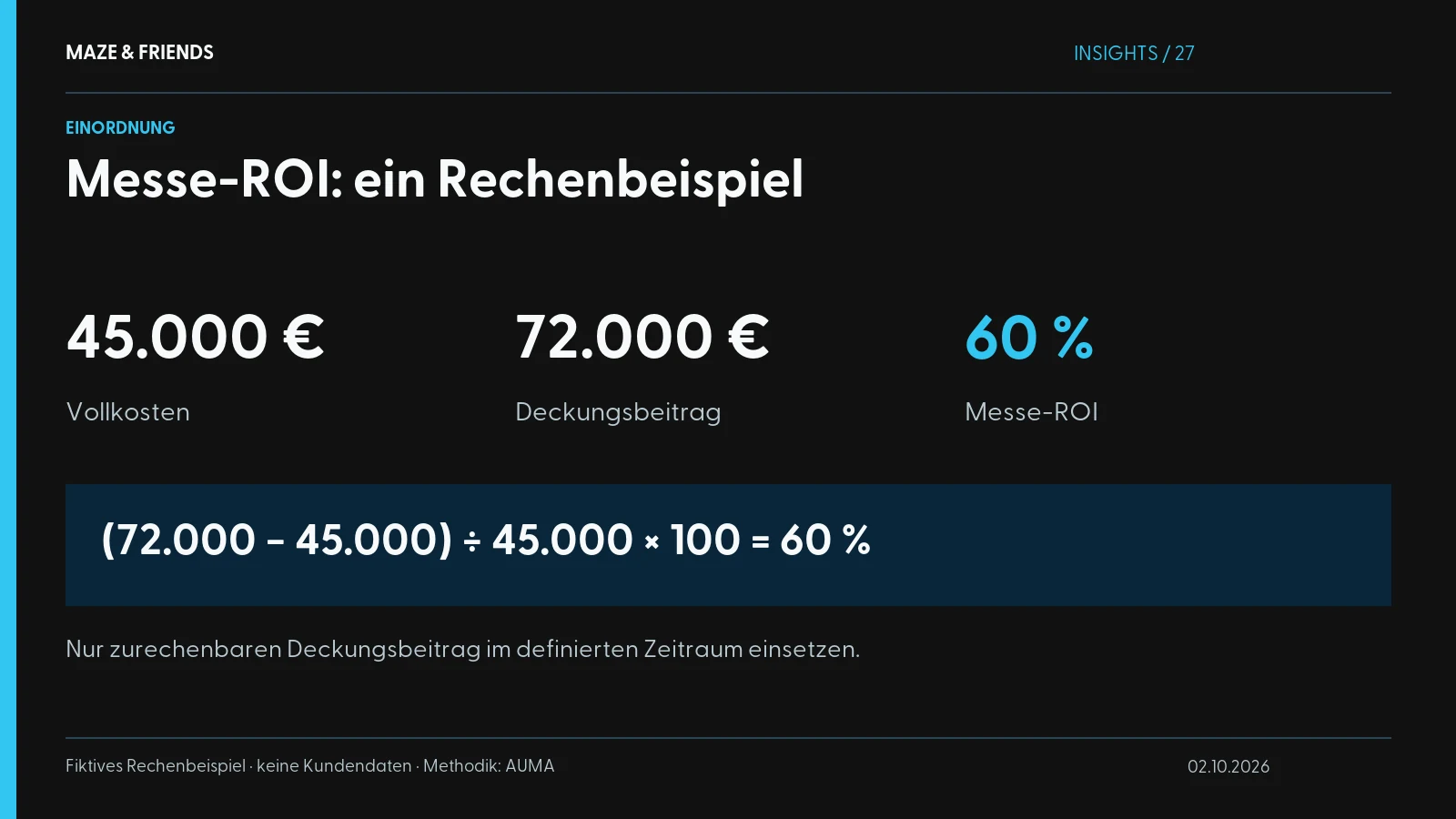
Let us take a fictitious, simplified worked example for a mid-sized industrial supplier. The figures are invented and deliberately rounded so that the logic becomes visible; they are neither market prices nor customer data. You put your own figures in their place:
- Total trade fair costs: €45,000
- Result: 6 new customers over the following nine months
- Average contribution margin per new customer in the first year: €12,000
Return = 6 × €12,000 = €72,000
ROI = (€72,000 − €45,000) / €45,000 × 100 = 60%
Important: calculate with contribution margin or profit margin, not with revenue. If you bring in €300,000 in revenue from the fair, but €260,000 of that is material and production costs, the fair is no golden goose: it contributed €40,000 to the bottom line. If you calculate with gross revenue, you are fooling yourself.
One more point: the example only counts the first year. In B2B, customers you win often keep buying for years. If you calculate with customer lifetime value instead of the first-year contribution margin, a “just about” ROI quickly turns clearly positive. Both figures are legitimate; you just have to say which one you are showing.
What counts as “return”, and how do you measure trade fair success?
To measure trade fair success, you need KPIs that you capture during and immediately after the fair. Keep hard effects separate from soft ones.
Hard KPIs (feed directly into the ROI):
- Total number of leads and, of those, qualified leads
- Cost per lead = total costs / number of leads
- The same calculation per qualified lead (the more meaningful figure)
- Pipeline value: the sum of all sales opportunities that came out of the fair
- Closed deals and the resulting contribution margin
- Meetings with existing customers with concrete upsell or cross-sell value
Soft effects (report separately, do not mix into the ROI):
- Brand awareness and visibility in the industry
- Well-tended relationships with existing customers
- Competitor watch: what are the others showing?
- Recruiting and employer branding
- Press and trade media contacts
- Direct market feedback on new products
Soft effects are not worthless, just harder to pin down. With a substitute value you can still make them tangible: an engineer recruited on the stand might save you a recruitment consultancy’s fee. A trade article that comes out of a stand conversation has an advertising value equivalent. Put a figure on it wherever possible, but keep it separate from the hard ROI figure so that nobody can accuse you of creative accounting.

Is a trade fair worth it for you? The break-even question
Whether a trade fair is worth it comes down to a sober question asked in advance; past ROI only helps to a limited extent: how many deals do you need to cover the costs?
Break-even = total costs / contribution margin per deal
In the example above: €45,000 / €12,000 = 3.75, so 4 customers won just to break even. Now comes the most important part: look at your CRM. How many trade fair leads have you actually turned into customers in the past? If experience shows you get 6 deals from 60 leads, the fair is economically viable. If it is only 2, you either have to work on your follow-up or drop the fair.
This calculation is also your best argument in the budget round, because it forces clarity. Instead of “the fair was nice”, it becomes: “We need 4 deals, historically we manage 6, so we are booking again.”
A smaller regional or niche trade fair often clearly beats a major flagship fair on ROI, if your target customers are more densely represented there. A lot is impressive at a major flagship fair, but you might meet your 20 relevant buyers more cheaply at a focused specialist fair. Size is not a mark of quality. Target audience density is.
How do you measure trade fair success properly over time?
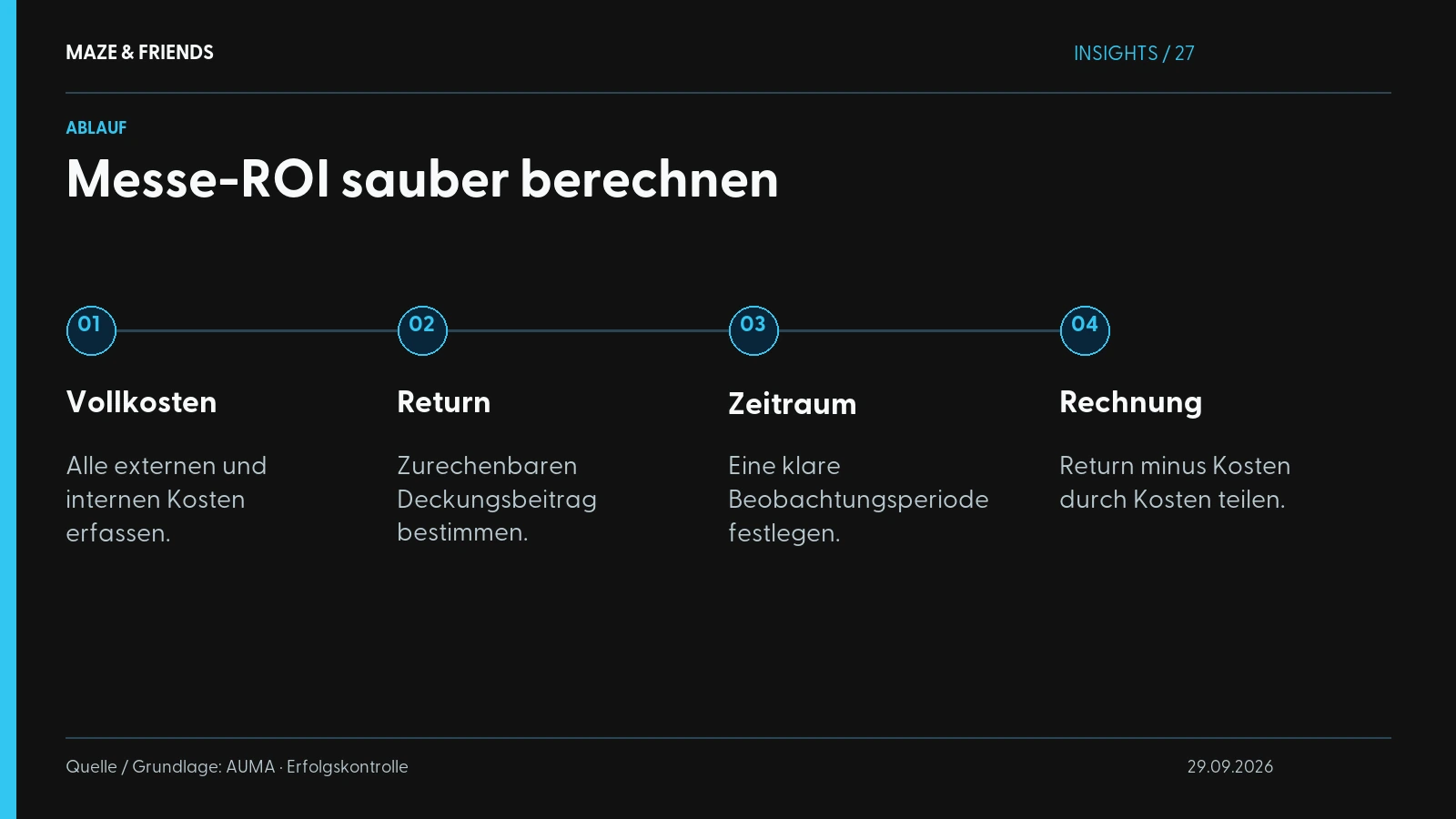
The most common reason trade fair ROI stays in the fog: there is no baseline and no tracking. Four steps make it clean:
- Set goals in advance. Without a defined lead or revenue goal, you cannot measure success afterwards. This belongs in the planning, long before the stand is up.
- Tag the lead source in the CRM. Every trade fair contact gets a unique source tag. Only then can you trace what became of it months later.
- Lay trade-fair-specific trails. A dedicated landing page, a QR code on the stand, an individual promotional code: anything that later assigns a contact clearly to the fair.
- Evaluate in stages. Check the position after 3, 6 and 12 months. Only after a full sales cycle do you have the real figure.
This is exactly where ROI depends on two other topics: thorough preparation and a follow-up that works. How to design your presence for profitability from the outset is covered in our guide to planning your trade fair presence. And how to turn stand contacts systematically into orders rather than business cards in a drawer is shown in the article on the trade fair funnel and follow-up. The best ROI formula is useless if nobody follows up afterwards.
How reliable is your trade fair calculation?
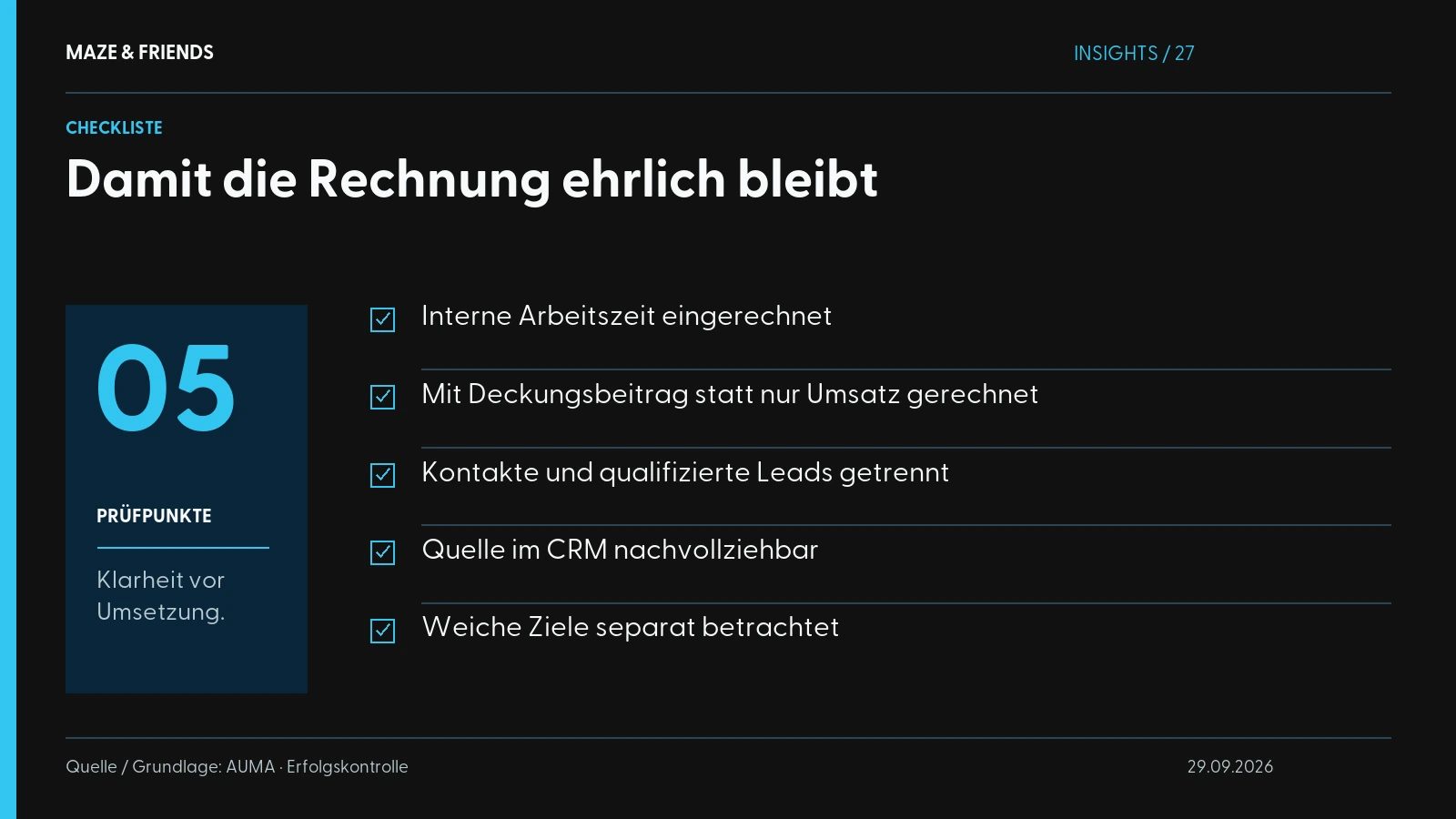
- All seven cost blocks captured, including internal staff costs
- Return calculated with contribution margin, not revenue
- Goal set in writing before the fair
- Every lead given a source tag in the CRM
- Qualified leads separated from mere contacts
- Break-even calculated in deals and compared with CRM history
- Soft effects quantified separately, not mixed into the ROI
- Evaluation after 3, 6 and 12 months scheduled
If you can tick off these eight points, you have a figure instead of a gut decision.
A figure instead of a gut feeling
You calculate trade fair ROI reliably when you capture all seven cost blocks, calculate with contribution margin instead of revenue, tag every lead in the CRM and evaluate in stages over a full sales cycle. Before you approve the next stand budget, this is exactly the check worth doing: which trade fair pays off for you, and which one can you skip?
Maze & Friends looks at your actual costs, your CRM history and your follow-up rate with you. How we combine strategy, stand concept and follow-up process into one economically sound whole is explained on our page on trade fair marketing. We take the first step together in an initial call.
From the studio: Kazakhstan export project: market trip and event · Vienna Region: RIZ UP GENIUS 2026.
Frequently asked questions
What is trade fair ROI, explained simply?
Trade fair ROI, short for return on investment, shows how much your trade fair presence brought back after deducting all costs, expressed as a percentage of those costs. If it is above zero, the fair paid off; if it is below, it cost more than it brought in.
The formula itself is easy; the inputs are the hard part: you really have to capture all costs, not just the stand rental, and measure the return through hard KPIs such as contribution margin or pipeline value. The figure only becomes reliable over months, not two weeks after the fair.
How do you calculate the ROI of a trade fair?
You calculate trade fair ROI by subtracting total costs from the return, dividing the result by total costs and multiplying by 100. A fictitious, simplified worked example: a trade fair costs €45,000 in total and leads to 6 new customers over the following nine months, each with a contribution margin of €12,000 in the first year, so €72,000 in return.
The ROI is then €72,000 minus €45,000, divided by €45,000, times 100, which is 60%. Use contribution margin for the return rather than revenue, and say whether you are calculating only the first year or the full customer value.
What is a good ROI for a trade fair?
There is no universal benchmark for a good trade fair ROI; the sound approach is to compare it with the ROI of your other sales and marketing channels. If a qualified lead at the fair costs you less than one from ads or field sales, that speaks for the fair.
In B2B in particular, a fair may only break even in the first year and pay off through the customer value of the following years. The ROI is positive as soon as the contribution margin from the fair exceeds its full costs. Always state the basis of your calculation, first year or full customer value.
Which costs are often forgotten in the trade fair calculation?
The most commonly missing item is internal staff costs, meaning your team’s working days for planning, stand duty and follow-up, multiplied by a realistic day rate. Other items that often get lost:
- Transport and storage of the stand for the following year
- Additional bookings on site, for example for electricity, internet or cleaning
- Travel and expenses for several people over several days
- Marketing around the fair, from invitations to the landing page
- Lead capture, follow-up campaign and customer data maintenance
If four people invest three days at the fair plus two days each of preparation and follow-up, that quickly adds up to 20 person-days and a five-figure sum that is real but appears in no calculation.
How much does a trade fair stand cost?
What a trade fair stand costs depends on the space, the stand type and the fit-out; only the costing for your specific fair gives you a reliable figure. The biggest cost drivers are space and position, building or hiring the stand including furniture, graphics and technology, and build-up and dismantling.
With a modular system that lasts for several fairs, you spread the construction costs across several appearances. For your ROI calculation, however, the stand is only one block of several: stand services, travel and staff, marketing around the fair and follow-up are added on top. If you only count the stand rental, you are dressing up the numbers.
How do I calculate the cost per lead at a trade fair?
Divide the total cost of your trade fair presence by the number of leads; the same calculation using only qualified leads is more meaningful. Qualified means genuine need, budget and decision-making authority.
200 dog-eared business cards are worth less than 30 serious conversations, even if the price per contact looks worse as a result. What matters is that the total costs really include everything, including internal working time. You can compare the cost per qualified lead directly with other channels such as ads or field sales.
Should I calculate trade fair ROI with revenue or contribution margin?
Calculate trade fair ROI with contribution margin or profit margin rather than revenue, because revenue includes your material and production costs and makes the fair look artificially successful. A fictitious example: €300,000 in revenue from the fair with €260,000 in material and production costs means only €40,000 contributed to the bottom line.
If you calculate with customer lifetime value, the value of a customer over the entire business relationship, instead of the first-year contribution margin, a tight ROI often turns positive. Both versions are legitimate, as long as you say which one you are showing.
How many orders does a trade fair need to pay off?
How many orders you need is shown by the break-even: total costs divided by the contribution margin per deal. The result is the number of deals at which the fair covers its costs. In the fictitious example with €45,000 in costs and €12,000 contribution margin per customer, that is 3.75, so 4 customers won just to break even.
Compare this figure with your sales history: if experience shows you get 6 deals from 60 trade fair leads, the fair is economically viable. If it is only 2, you have to work on your follow-up or drop the fair. This calculation is also your best argument in the budget round.
How long does it take for a trade fair presence to pay off?
How long it takes depends on your sales cycle: in industrial B2B, many months often pass between the stand conversation and the order, quite often more than a year. An ROI figure two weeks after the fair is therefore worthless.
Schedule evaluations after 3, 6 and 12 months and treat the early values as interim results. For this to work, every trade fair contact needs a unique source tag in the CRM, your customer relationship management system; otherwise, months later, nobody will know which order came from which fair. The final evaluation only comes after a complete sales cycle.
Which KPIs show whether a trade fair was successful?
Whether a trade fair was successful is shown by qualified leads, pipeline value and the contribution margin of closed deals, measured against the goal set in advance. These figures belong in the evaluation:
- Total leads and, of those, qualified leads
- Cost per lead and per qualified lead
- Pipeline value of all sales opportunities from the fair
- Closed deals and their contribution margin
- Meetings with existing customers that lead to concrete additional business
Report soft effects such as brand awareness separately, so that the hard figure stays clean.
How do I measure soft effects such as brand awareness?
Soft effects can be measured through substitute values and counts; report them separately from the hard ROI figure so that your calculation cannot be picked apart. For goals like these, the term return on objectives, ROO for short, is also common.
Examples are the reach of trade articles that come out of stand conversations, the number of relevant first contacts, a fee saved because you recruited a specialist on the stand, or documented product feedback. Put a figure on what can be quantified, but do not mix it into the ROI. Then nobody can accuse you of creative accounting.
Is a small specialist trade fair worth more than a major flagship fair?
A small specialist trade fair is often worth more than a major flagship fair, because what counts is the density of your target customers rather than the number of visitors. At a focused regional or niche fair, you sometimes meet your relevant buyers more cheaply and in a calmer atmosphere than in the bustle of a flagship fair.
Size is not a mark of quality; target audience density is. Run both options through the same logic: full costs, expected qualified leads, your historical closing rate and the break-even in deals. The fair with the better ratio wins, not the one with the bigger name.
Why is trade fair ROI harder to measure than online advertising?
Trade fair ROI is harder to measure because sales cycles are long, customers have many touchpoints and part of the benefit appears in no revenue line. With a Google Ads campaign, by contrast, you see spend, clicks, enquiries and revenue fairly quickly.
The trade fair contact may already have visited your website, seen an ad, come to the stand and later been visited by field sales. That is why it is best to decide in advance which channel you credit with the order. Most trade fair calculations fail because they capture costs incompletely or the return too early.
What is trade fair marketing?
Trade fair marketing covers everything a company does to use a trade fair as a sales and communication channel, from setting goals through the stand and content to the follow-up. This includes choosing the right fair, invitations and meetings in advance, the stand concept, materials such as video or exhibits, lead capture and follow-up in sales.
Trade fair marketing only becomes economical when every part contributes to a measurable goal and measuring success is planned in from the start. Otherwise the trade fair remains a channel that gets booked every year and is never properly recalculated.
Which mistakes make a trade fair ROI calculation worthless?
The most common mistakes in a trade fair ROI calculation are incomplete costs, evaluating too early and using revenue instead of contribution margin as the return. Each of them produces a figure that nobody in the budget round will trust.
On top of that come soft effects mixed into the hard ROI, and missing tracking: without a goal set in advance and a source tag in the CRM, an order can no longer be attributed to the fair months later. Lumping contacts and qualified leads together is just as misleading. If you keep these points cleanly apart, you have a reliable figure instead of a gut decision.
Next step
Want to know which of this fits your company? We will work it out together in 30 minutes. Free and without obligation.
Pick a time
Manuel Zellnig has been building visibility for companies since 2018: brand film, personal branding, performance marketing and AI visibility. Qualified advertising specialist (Werbeakademie Wien), Bachelor in Business Management (Carinthia University of Applied Sciences), author of the book ‘Mobile Apps zur Messung der Kundenzufriedenheit’ (2017, in German) and creative expert for the Austrian Economic Chamber (WKO) in two transformation guides. He measures before he recommends and writes here about what actually works in projects.
Publications and interviews: WKO transformation guide for printers (in German) · WKO transformation guide for florists (in German) · Interview with Ghezzo (in German) · ‘Heute’ on Viennese start-ups (in German)