



Trade fair planning in seven steps
Trade fair planning in seven steps: a measurable goal, a timeline, budget allocation and follow-up, so your trade fair builds pipeline, not just costs.
In short: Planning a trade fair presence means thinking backwards from the fair: for a serious stand, you need six to nine months of lead time. It starts with a measurable goal in leads rather than “visibility”, followed by budget, stand concept, content and a follow-up plan that is ready before the fair. Maze & Friends from Vienna plans trade fair appearances for mid-sized industrial companies in this order, because without follow-up the budget evaporates on the exhibition floor.
Sales says “We need to be at the trade fair”, management nods, and then for months the project doesn’t really belong to anyone. Eight weeks before the fair, panic breaks out: the stand builders are fully booked, the roll-up banners arrive too late, and nobody knows what is actually supposed to be shown on the stand. In the end, four people in polo shirts stand next to an expensive piece of furniture and hope someone stops by.
Among mid-sized industrial companies, this is the norm, and it explains why so many firms say after the fair: “It wasn’t worth it.” Usually the planning was to blame, rarely the fair.
This guide shows you how to plan a trade fair presence so that it generates pipeline, meaning concrete enquiries and projects for your sales team. That includes a timeline, the budget allocation and the places where money typically evaporates.
How do I plan a successful trade fair presence?
A successful trade fair presence takes shape in the months before the fair. The order in which you plan carries more weight than the stand design. Most companies start with the stand and therefore at the wrong end.
For your trade fair preparation, that means:
- Define the goal: what should come out of it? Concretely, in figures.
- Sharpen the target audience: who do you want to talk to on the stand, and who not?
- Set the budget: the overall frame, split into stand construction, content, staff and follow-up.
- Derive the stand concept: only now, from the goal and the target audience.
- Content & exhibits: what do you show, what story do you tell?
- Brief the team: who does what on the stand?
- Plan the follow-up: finished before the fair starts.
In practice, it often runs the other way round: step 4 comes first, step 7 is forgotten. That is where most trade fair appearances fail.
A sober view of the stand helps here. It is a tool for holding many relevant conversations in a short time and processing them properly afterwards. Anything that does not contribute to that goal is decoration.
First comes a measurable goal
“Visibility” is not a goal, and neither is “showing presence”. Both are excuses for not having to measure anything afterwards.
A usable trade fair goal looks something like this: “120 qualified conversations, of which 40 leads with a concrete project need, of which 8 in the sales process within four weeks of the fair.” You set the figures yourself. What matters is that you can break them down beforehand and check them afterwards. Every further decision depends on them, from stand size and number of staff to content and the conversation guide.
If your goal is leads, every visitor to the stand needs a reason to leave their details: an exhibit, a demo, a live example or a conversation with a real expert. A bowl of pens will not do it. How trade fair contacts turn into pipeline afterwards belongs in the planning. We have taken the follow-up apart in a separate guide: Trade fair funnel: from leads to follow-up.
Who you want to talk to on the stand
Among mid-sized industrial companies, what counts is less how many people walk past than how many of the right ones are among them. A trade visitor with a budget and a project is worth more than a handful of students who take a pen.
Clarify beforehand which roles you want to meet (purchasing, engineering, management) and from which industries. That includes how your stand staff can recognise these people in conversation in under a minute. This goes into the briefing and is not improvised on the stand.

How much lead time do I need for a trade fair?
For a serious, booked stand presence, you should realistically plan six to nine months of lead time. For small row stands or joint stands, three to four months are often enough. It can be done in less than eight weeks, but it will be more expensive, more rushed and rarely good.
The lead time is not red tape; it follows from hard dependencies: the good stand positions go early, stand builders and good photo and film crews have lead times, and content needs time to mature. The timeline as a checklist:
| Time before the fair | What happens |
|---|---|
| 9–6 months | Fix goal & budget, book the space, secure a good position, rough stand concept |
| 6–4 months | Commission the stand builder, content concept, start brand film/video production, clarify exhibits |
| 4–2 months | Finalise stand design, print & roll-ups, invitations to existing customers, book meetings in advance |
| 8–4 weeks | Team briefing, conversation guide, test lead capture, build the follow-up process |
| 2 weeks | Logistics, technical check, confirm final meetings, prepare social content |
| Trade fair week | Deliver, capture leads properly, keep track daily |
| 1–4 weeks afterwards | Start the follow-up: fast, personalised, consistent |
The lead time for content and brand film is almost always underestimated. A good brand film that runs on the stand and lives on afterwards in the follow-up email needs a concept, a shoot, an edit and approval rounds. That takes weeks, not days. If you want to produce the film “somehow, quickly”, that is exactly what you get: somehow, quickly.
What if time is short?
In mid-sized companies, it is often already July when the autumn trade fair in September comes up. Then radical focus helps more than doing “everything by halves”. A small, clear stand with one strong message and a follow-up that works beats a large, unfinished presence every time. Better to do one thing properly than five things by halves.
In Austria and the DACH region (Germany, Austria, Switzerland), the relevant autumn trade fairs are booked up early, and the good stand positions even earlier. For a presence in September, July is the last sensible starting line for the actual preparation, even if the space is already booked.
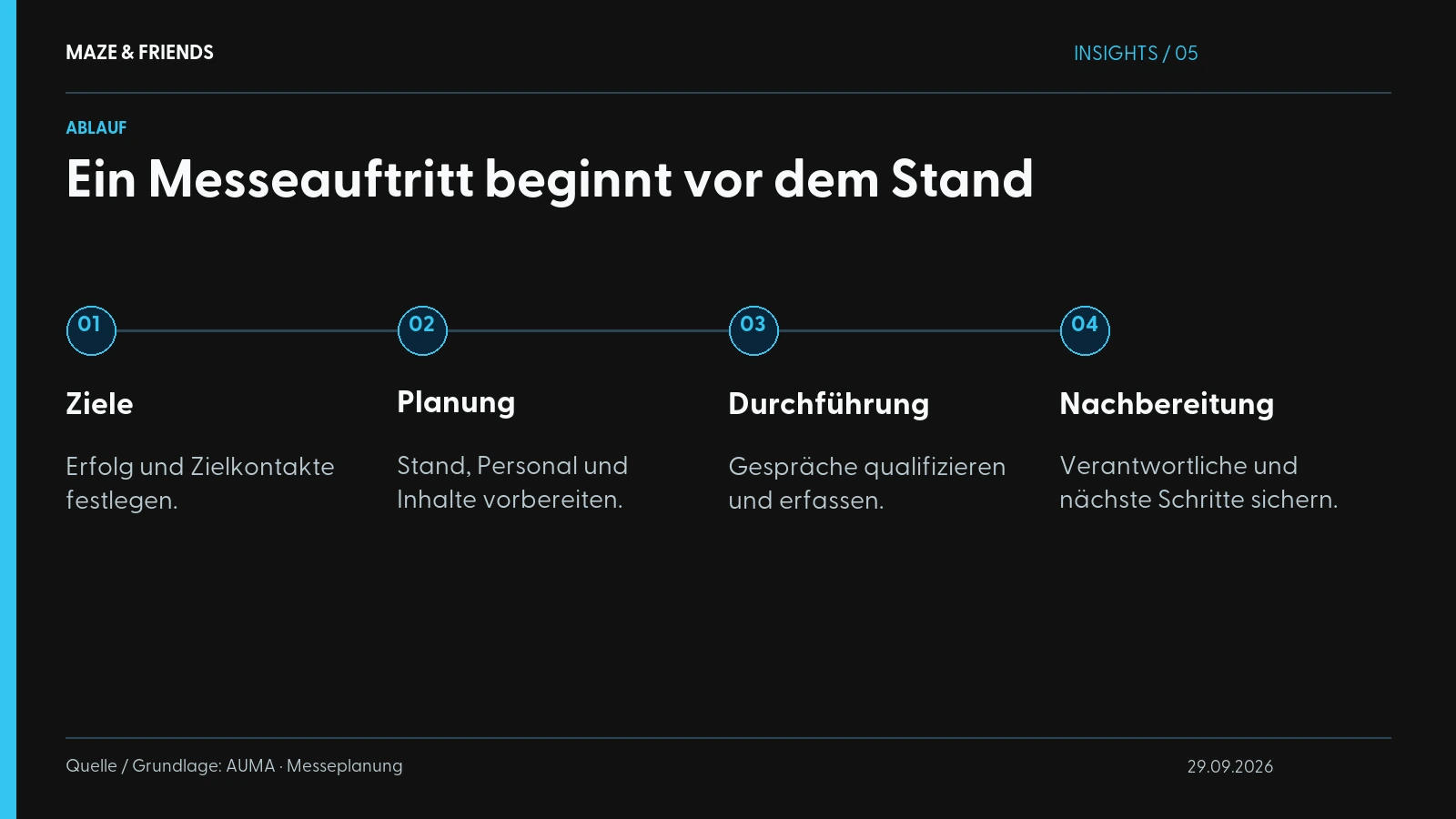
What goals should a trade fair presence have?
A trade fair presence should always have a business goal that can be expressed in figures: usually leads and projects initiated, less often pure brand awareness. The goal determines everything else: size, budget, content and how success is measured. Without a goal, you end up measuring gut feeling.
Typical, usable types of goal:
- Lead generation: new qualified contacts with a project need. The most common and usually most sensible case for mid-sized B2B companies.
- Existing customer care: meeting current customers, initiating cross-selling and upselling, maintaining relationships. Underestimated, and often the part that delivers the ROI.
- Recruiting: skilled workers see you at the fair. For many industrial companies, this is now just as important as sales.
- Product or market launch: testing a new product with the trade public and collecting reactions.
- Brand awareness: legitimate, but only if you can honestly measure softer KPIs too and do not use them as a fig leaf.
Hardly any company needs an “everything” goal. Most do well with one main goal and at most one secondary goal. If you want everything at once, you prioritise nothing, and the stand becomes arbitrary.
Why the follow-up is your real goal
Uncomfortable but true: the value of a trade fair only emerges in the weeks afterwards. A contact that nobody follows up remains a business card in the bin.
That is why the toughest question in the planning is: Who does what with the contacts from day one after the fair, and with which message? If that is still open by the time of the fair, the problem lies in sales, and the fair only makes it visible at great expense.
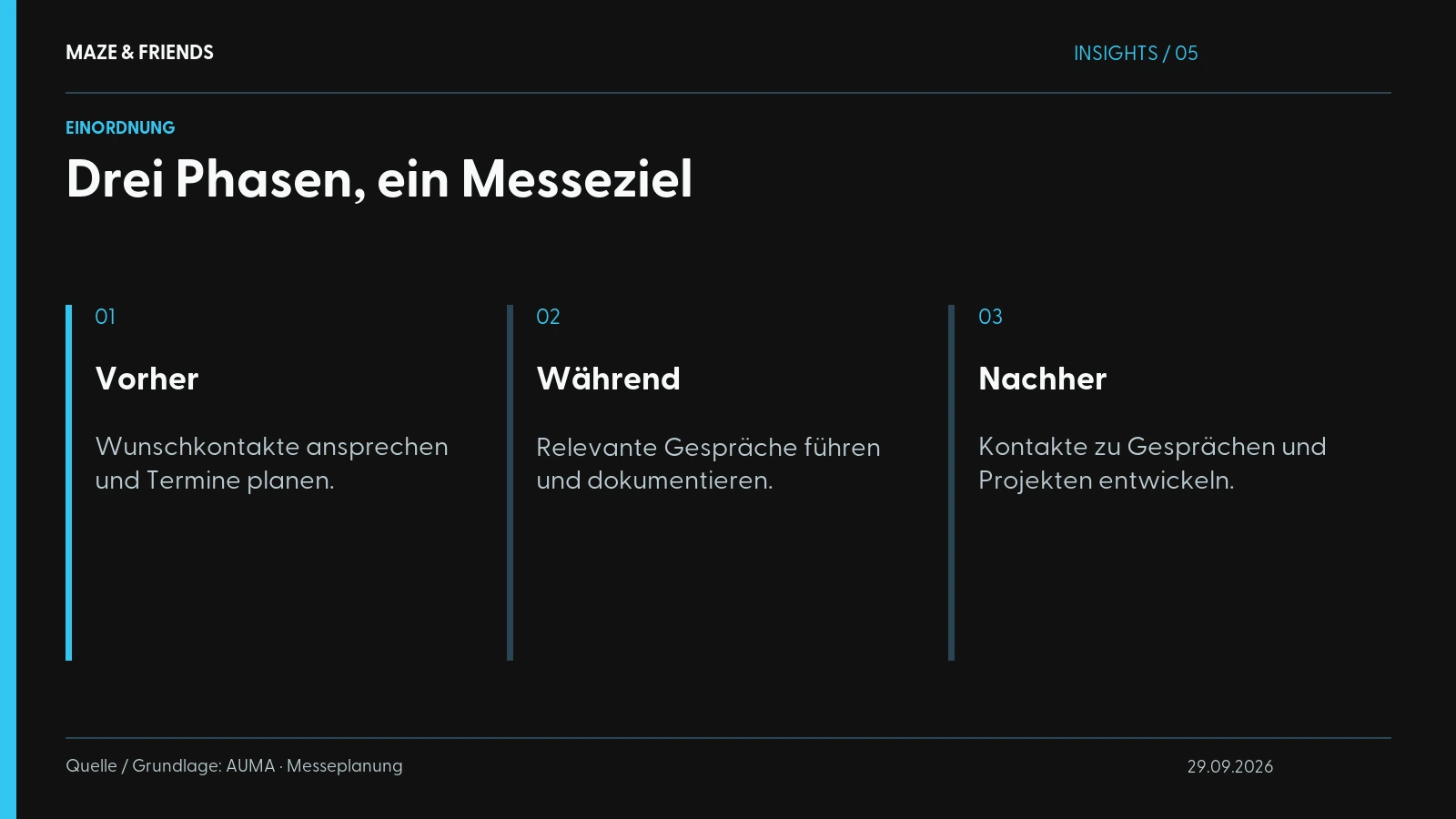
What does a trade fair stand cost, and where does budget burn?
The answer to “What does a trade fair stand cost?” depends on space, stand type and level of fit-out: a small row stand and a large custom-built stand are many times apart. A rough costing logic for how the budget is distributed:
| Cost block | What it includes | Share (rough guide) |
|---|---|---|
| Stand space | Rent per m², position, ancillary costs | 20–30% |
| Stand construction & equipment | Build, furniture, technology, electricity, cleaning | 25–35% |
| Content & communication | Brand film, graphics, print, exhibits, digital | 10–20% |
| Staff & travel | Stand staff, travel, hotel, expenses | 15–25% |
| Follow-up & marketing | Invitations, lead tool, follow-up campaign | 5–15% |
The shares are empirical values for a first costing, not a fixed formula; depending on the fair and stand type, they shift considerably. More important than the exact figure is the distribution. If you put almost everything into stand design and nothing into follow-up, you get a nice photo and no pipeline.
This is where budget burns most often:
- Too much space for prestige. Double the square metres means double the cost in almost every block, without double the leads. Space follows the goal.
- Stand construction without reuse. A modular system that lasts for several fairs beats the throwaway stand that shines once and then gathers dust in storage.
- Content that only lives on the stand. A brand film that you only show on a screen for three days is wasted. The same film in the follow-up email, on LinkedIn and on the website keeps working afterwards.
- No digital lead capture. With a paper system, some of the contacts are illegible or gone by Monday.
- Staff without a briefing. Expensive people stand on the stand and don’t know whom to approach. That costs nothing extra, and ruins the ROI all the same.
If you have to choose between “bigger” and “better prepared”, always choose better prepared. A small stand with clear stand planning, good content and a follow-up that works beats a large presence without a plan on every relevant KPI.
What content does a trade fair presence need?
A trade fair presence is also a content project. What stands on the stand is only the stage; the content decides whether someone stops. In B2B, three things almost always pay off:
- A brand film or explainer video that makes clear in 60 to 90 seconds what you solve, not what you are. It runs on the stand and lives on afterwards in emails and on social media.
- An exhibit or a live demo where people can touch or see something. That creates conversations that no roll-up banner creates.
- A clear conversation guide for the team: the three questions everyone on the stand uses to open a conversation and qualify a contact.
The mistake is almost always the same: content is done last, under time pressure, without a concept. Yet it is what turns a stand into a reason to stop. Plan it in early, in the lead-time window six to four months beforehand.

Plan your trade fair presence before the stand is up
Whether your trade fair presence generates pipeline or just costs hardly depends on the size of the stand. What counts is a measurable goal, enough lead time for stand and content, and a follow-up that is ready before the fair. If you are in the middle of planning, clarity on these three points gets you further than extra square metres.
At Maze & Friends, a trade fair presence is a content and sales project, from the brand film and the stand message to the follow-up. Send us your trade fair and your rough goal, and we will work out in an initial call where your biggest lever lies.
From the studio: Kazakhstan export project: market trip and event · Wirtschaftsagentur Burgenland: event photography. More about the service: Event content.
Frequently asked questions
What is a trade fair presence?
A trade fair presence is your company’s participation as an exhibitor at a trade fair in order to hold many relevant conversations in a short time. Business is supposed to come out of it, and that takes far more than the stand: a goal, a budget, a stand concept, content and exhibits, a briefed team and the follow-up process after the fair.
The stand itself is a tool for conversations. Whether the presence pays off is therefore decided above all in the preparation and in the weeks afterwards.
How can I plan my trade fair stand?
Plan your trade fair stand backwards from the fair: first goal, target audience and budget, only then stand concept, content and exhibits, team briefing and the follow-up plan. Many companies start with the stand and forget the follow-up; that is where many appearances fail.
Decide early who in the company is responsible for the presence. Otherwise the project sits untouched until panic breaks out a few weeks before the fair and good stand builders have long been booked up. Derive every decision, from stand size to conversation guide, from the measurable goal.
When should I start planning a trade fair presence?
Start planning a serious stand presence six to nine months before the fair; for small row or joint stands, three to four months are often enough. Under eight weeks, a presence is feasible, but more expensive, more rushed and full of compromises.
The lead time follows from hard dependencies: good stand positions go early, stand builders and photo and film crews have lead times, and content needs time. In Austria and the DACH region, the relevant autumn trade fairs are booked up early. For a fair in September, July is the last sensible starting line for the actual preparation, even if the space is already booked.
What does a trade fair presence cost?
What a trade fair presence with your own stand costs depends on space, stand type and level of fit-out. A small row stand and a large custom-built stand are many times apart; only the costing for your specific fair gives you a reliable figure.
Besides stand space and stand construction, content, staff and travel, and the follow-up belong in the calculation. More important than the absolute figure is the distribution: if you put almost everything into stand design and nothing into follow-up, you get a nice photo but no pipeline. Double the square metres also means double the cost in almost every block, without double the leads.
How do I split the budget for a trade fair presence?
Split a trade fair budget roughly into five blocks: stand space, stand construction and equipment, content and communication, staff and travel, and follow-up and marketing. As a guide for a first costing, these shares apply:
- Stand space: 20–30%
- Stand construction and equipment: 25–35%
- Content and communication: 10–20%
- Staff and travel: 15–25%
- Follow-up and marketing: 5–15%
These are empirical values, not a fixed formula; depending on the fair and stand type, they shift considerably. Above all, make sure content and follow-up are not left empty-handed. A brand film that keeps working after the fair in follow-up emails, on LinkedIn and on the website is a better investment than extra square metres.
Is there funding for a trade fair presence?
Funding is sometimes available for trade fair appearances; whether yours qualifies depends on your location, the fair and the programmes currently running. Programmes and conditions change regularly, so there is no blanket answer.
Ask the relevant body early, ideally before booking the stand: in Austria, for example, the Austrian Economic Chamber (WKO) or your federal state’s funding agency; in Germany, the trade fair association AUMA offers an overview. A common way of sharing costs and organisation is a joint stand with other exhibitors. Only factor funding into your plan once you have the approval in writing.
How do I formulate a measurable trade fair goal?
A measurable trade fair goal names concrete figures that you can break down beforehand and check afterwards: conversations, qualified leads and projects in sales. An example: 120 qualified conversations, of which 40 leads with a concrete project need, of which 8 in the sales process within four weeks of the fair.
“Visibility” or “showing presence” are not goals, because they cannot be checked. Set yourself one main goal and at most one secondary goal, such as lead generation plus existing customer care. The goal determines stand size, staff, content and the conversation guide.
What are the benefits of a trade fair presence for companies?
The biggest benefit of a trade fair presence is personal contact: at a specialist trade fair, purchasing, engineering and management are within reach on a single day. For mid-sized industrial companies, the specialist trade fair is one of the few places where many relevant conversations are possible in a short time.
A trade fair also lends itself to caring for existing customers, to recruiting, because skilled workers see you there, and to a product launch with direct feedback from the trade public. These benefits only pay off if you plan the presence with a goal and a follow-up. As a prestige appointment, it achieves little.
How do you design a trade fair stand?
Design your trade fair stand only once the goal and target audience are fixed, because the stand concept should generate conversations with the right visitors, not merely look good. Three things almost always pay off: a clear message that shows which problem you solve, an exhibit or a live demo, and a short film that makes your offer clear in 60 to 90 seconds.
Plan space for conversations instead of expensive furniture for prestige. A modular system that lasts for several fairs is usually more economical than a stand that shines once and then gathers dust in storage.
Which ideas work for small trade fair stands?
Small trade fair stands work with a strong message, a real reason to stop and meetings arranged in advance, rather than with as much equipment as possible. An exhibit or a live demo creates conversations that no roll-up banner creates.
Creative here mainly means showing something visitors can touch, see or try out, plus a short film that lives on after the fair in emails and on LinkedIn. Invite existing customers in a targeted way so that your stand does not depend on passing trade. A small, clear stand with a follow-up that works beats a large, unfinished presence on every relevant KPI.
What do I need for a trade fair presence?
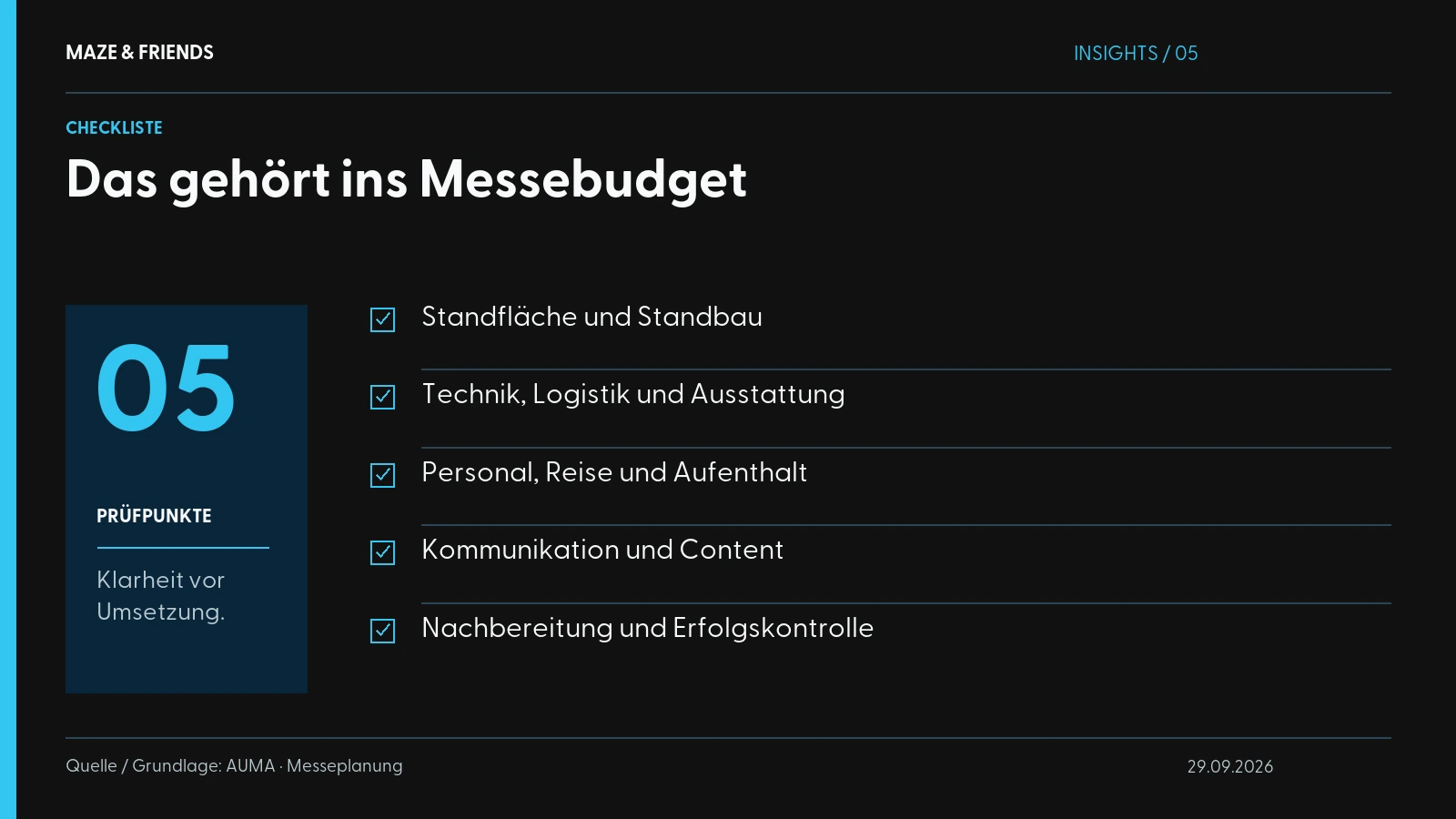
For a trade fair presence, besides stand space and stand construction, you need a measurable goal, convincing content, a briefed team, digital lead capture and a finished follow-up plan. As a checklist:
- Goal, budget and booked stand space
- Stand concept, stand construction, technology and logistics
- Brand film or explainer video, exhibit or live demo, print
- Team briefing with conversation guide and tested lead capture
- Invitations to existing customers and a follow-up plan from day one
Each item has its own time window, from booking the space nine to six months beforehand to the follow-up in the weeks after the fair.
What tips are there for trade fair exhibitors?
The most important tip for trade fair exhibitors: plan the follow-up before the fair, because the value of a trade fair presence emerges in the weeks afterwards. Add to that a few ground rules from practice:
- Arrange meetings in advance and invite existing customers in a targeted way
- Describe target contacts so that the team can recognise them in conversation in under a minute
- Open conversations with three fixed questions and qualify contacts as you go
- Capture leads digitally and keep track daily
And if you have to choose between bigger and better prepared, always choose better prepared.
What is the most common mistake in trade fair preparation?
The most common mistake is a missing follow-up: companies invest in space, stand construction and staff, but nobody is responsible for the contacts after the fair. Then many conversations turn into no pipeline at all.
Just as typical is the wrong order, starting with the stand instead of the goal and target audience. Other expensive patterns are too much space for prestige, content that only lives on the stand for three days, a paper system instead of digital lead capture, and stand staff without a briefing.
How do I measure whether a trade fair presence was worth it?
You measure whether a trade fair presence was worth it against the goal set in advance, in other words against qualified conversations, leads and projects that then go into sales. Without a goal in figures, all you measure afterwards is gut feeling.
Capture every contact with role, need and next step, so that you can later trace what became of it. In B2B, you often only know the final return on investment after months, because orders take time. Evaluate in stages rather than passing judgement two weeks after the fair.
Do I need an agency for my trade fair presence, or is a stand builder enough?
For the stand, technology and graphics, a stand builder is enough; goal, message, content and follow-up, however, are your responsibility or something you hand to a marketing partner. Many appearances fail because nobody takes care of these parts.
If you have someone in-house with time and close ties to sales, you can steer this yourself. If not, a partner who thinks of the presence as a content and funnel project pays off. Maze & Friends plans trade fair appearances for mid-sized industrial companies in exactly this way, from the brand film and the stand message to the follow-up.
Next step
Want to know which of this fits your company? We will work it out together in 30 minutes. Free and without obligation.
Pick a time
Manuel Zellnig has been building visibility for companies since 2018: brand film, personal branding, performance marketing and AI visibility. Qualified advertising specialist (Werbeakademie Wien), Bachelor in Business Management (Carinthia University of Applied Sciences), author of the book ‘Mobile Apps zur Messung der Kundenzufriedenheit’ (2017, in German) and creative expert for the Austrian Economic Chamber (WKO) in two transformation guides. He measures before he recommends and writes here about what actually works in projects.
Publications and interviews: WKO transformation guide for printers (in German) · WKO transformation guide for florists (in German) · Interview with Ghezzo (in German) · ‘Heute’ on Viennese start-ups (in German)