


Real estate Facebook ads to win listings
Real estate Facebook ads for winning listings: which setup brings in seller leads, how to protect lead quality and what quietly burns your budget.
In short: Real estate Facebook ads are paid ads on Facebook and Instagram, both of which run through Meta. For winning new listings, the goal is not the buyer but the seller lead: an owner who is thinking about selling. In the experience of Maze & Friends from Vienna, what works is a local angle in image and copy, an opening hook about value and fast follow-up. Budget burns when you boost posts and fail to qualify leads.
You boosted a post or ran a “Leads” campaign. Sign-ups even came in, a few dozen forms for little money. Then you picked up the phone: half were wrong numbers, and the rest only wanted to know what their own flat might theoretically be worth, with zero intention to sell. Result: budget gone, not a single sole agency agreement. What remains is the suspicion that “this Facebook thing” simply does not work for estate agents.
The suspicion is understandable, but wrong. It almost always comes down to the setup: the wrong campaign objective, an audience that is too broad, a form without a filter and nobody following up systematically. This article shows you what an acquisition setup looks like that brings in seller leads predictably, and what burns your money. Sober, and without a miracle framework.
What are real estate Facebook ads, and why is winning listings a different game?
A few terms first, because a lot gets mixed up here. Facebook and Instagram both belong to Meta and run on the same advertising system, Meta Ads Manager. Whether people talk about “real estate Facebook ads”, “Facebook advertising for estate agents” or “property leads via Meta ads”, they essentially mean the same thing: targeted ads shown to people who are not actively searching right now but fit the profile.
Unlike on Google, where someone actively types “house value [town]”, on Meta you interrupt the feed of someone who is actually looking at holiday photos. That sounds like a disadvantage, but for winning listings it is the lever: you reach the passive seller, the owner for whom “selling one day” has so far been no more than a vague thought.
Now for the most important distinction in the whole article. As an estate agent, you have two engines:
- Listing acquisition (buying in): you win the mandate, ideally a sole agency agreement. Your target person is the owner, and your goal is the seller lead.
- Marketing (selling): you find the buyer for a property you already have on your books.
This article is exclusively about engine one, because that is where the margin is. A mandate usually brings a high commission, so the price you can afford per lead is high, as long as the leads have a genuine intention to sell. Winning listings online pays off precisely when you put quality before quantity. Buyer and seller advertising never belong in the same campaign: two messages, two different people.

What works when you win listings with Meta ads?
What works is a handful of building blocks that have to mesh, with no secret trick involved. If one is missing, the chain breaks, usually at the follow-up.
Open with value instead of the sale
The most common mistake in ad copy is the hard hook “Do you want to sell your property?”, a question heavy with decision that almost nobody clicks. A soft opening driven by curiosity performs much better:
“What is your flat in the 18th district worth today? Free valuation in 3 minutes.”
The strongest hook is the free, no-obligation online valuation. That is hardly down to the tool, since almost everyone has an automated valuation (AVM, automated valuation model) these days. It is down to the question “What is mine worth?”, which taps a latent need without forcing a decision. One aside for German-speaking markets: owner ads in the DACH region (Germany, Austria and Switzerland) usually use the formal form of address, “Sie”.
The second strong hook is neighbourhood proof, which triggers the herd instinct:
“Just sold: 4-room period flat in Währing, at full market price within a few weeks. What is your property in the neighbourhood worth?”
And the strongest change of perspective, if you can back it up: “We already have the buyers”, with the number of registered buyers searching in the area. That turns the seller’s core fear (“Will I find a good buyer?”) into reassurance. But only advertise with real numbers. Invented buyers will come back to bite you at the very first appointment.
Deliver regionally, speak locally
On Meta, the neighbourhood effect comes mainly from the message, because fine-tuning the audience is barely possible. According to Meta’s help pages, ads for property and related services such as valuations belong in the special ad category “Housing”, which you declare when creating the campaign. For audiences in Austria, that means no selection by age, gender or postcode, restricted detailed targeting, and if you choose a city, an address or a pin, Meta automatically widens the radius to around 16 kilometres. Tight radii around individual districts and targeting by age are therefore not possible, and you cannot rely on life-stage signals. You get the “just round the corner” effect from real reference properties, concrete place and district names such as Währing, Döbling, Mödling or Klosterneuburg, and cases from the area in image and copy. Check the current rules for your country in Ads Manager before you launch, because Meta can change them.
Choose the right campaign objective
This is where most people fail before spending their first euro. If you optimise for “Reach” or “Traffic” in Ads Manager, Meta delivers exactly that: clickers who rarely fill in a form. For winning listings you need the Leads objective, so the algorithm optimises for people who are likely to convert. You have two ways to collect the lead:
- Meta lead ad (instant form): the form opens directly in the app, with contact details pre-filled. Frictionless and cheap per lead, but intent tends to be lower because it is so easy.
- Your own landing page: the click leads to your branded valuation page. More friction, therefore fewer but better leads, and you own the page and the data yourself.
For a quick start, a lead ad is fine, provided you qualify it. For serious, long-term listing acquisition, your own landing page is superior. How to build a page that really turns the click into an enquiry is explained in Conversion optimisation without the buzzwords.
Qualify in the form
This is the building block that separates curiosity from intent, and almost everyone lacks it. A form with only name, email and phone delivers the maximum number of the worst possible leads. Deliberately build in one or two filtering questions:
- Do you own the property? (Yes/No)
- When could you imagine selling? (in the next few months / this year / just curious)
Yes, this lowers the number of leads, and that is exactly the point. Every “just curious” clicker the form filters out is sales time your team does not burn on the phone. In listing acquisition, expensive sales time is almost always scarcer than lead costs.
Follow up fast and keep at it
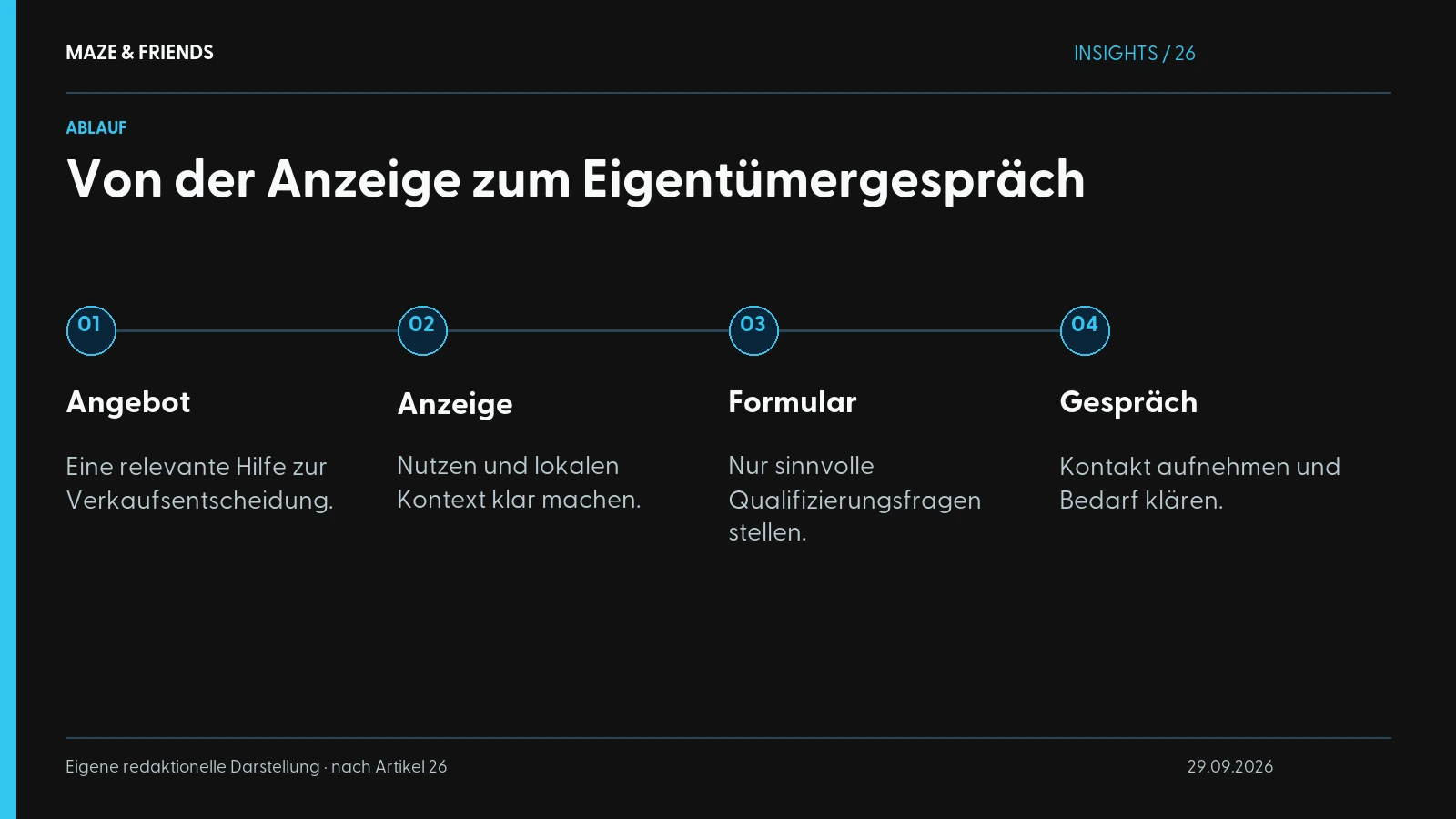
A lead is warmest in the first few minutes and cools down rapidly after that. Set up two things: an immediate automated signal (confirmation, WhatsApp, SMS) and automated nurturing that carries your three value promises: best price, speed, peace of mind. “You don’t have to worry about a thing” often weighs as heavily with sellers as the price.
What burns the budget in real estate Facebook ads?
On the other side are the budget eaters. They are always the same patterns; here are the most common ones and what to do instead.
| Budget eater | Why it costs you | What to do instead |
|---|---|---|
| The “Boost post” button | Optimises for engagement, not leads: you are buying likes | Create a campaign with the “Leads” objective in Ads Manager |
| Targeting that is too broad | Wasted reach, no neighbourhood effect | Regional delivery within the “Housing” category, a local angle in image and copy, one market per ad set |
| A form without a filter | Curiosity clicks eat up sales time | Build in 1–2 qualifying questions |
| The wrong campaign objective | Reach/traffic brings clickers, not sellers | Optimise for conversions/leads |
| No follow-up system | Leads cool down before you call | Automate instant confirmation and nurturing |
| Stock photos, generic copy | Looks like every other ad and gets scrolled past | Real local properties, real names, real cases |
| Looking only at the lead price | Cheap leads can be expensive if none of them becomes a mandate | Measure cost per mandate, not just cost per lead |
The most expensive mistake is in the last row. A lead for €8 sounds great until you notice that not one in a hundred such leads becomes a mandate. A lead for €60 that regularly turns into mandates is in a different league economically. The figure that counts is therefore what an actual mandate costs you. The lead price alone says little. To know it, you have to measure the whole path from click to contract; how that works is explained in Setting up conversion tracking properly.

What does a seller lead cost, and when does it pay off?
Fixed figures would be dubious, because every region is different. But we can give you the logic. Let us work through a funnel as a fictitious example, with no guarantee and no market values:
Suppose that in this example you pay €40 to €80 per qualified seller lead. Only some of these leads turn into a valuation appointment, and only some of the appointments into a sole agency agreement. Depending on the region and the quality of your follow-up, experience shows it takes a double-digit number of leads per mandate. That sounds like a lot, but do the maths: in the example, a single mandate brings a five-figure commission. Even if a mandate costs you a few thousand euros in ad budget, the contribution margin stays clearly positive.
That is exactly why winning listings via Meta is so attractive: the price you can afford per mandate is high. The mistake is simply giving that headroom away with unqualified leads and missing follow-up. Many accounts that “don’t work” fail because of the setup. That can be rebuilt, with realistic expectations instead of a fixation on the lead price.

Meta ads or Google Ads for winning listings?
Estate agents comparing channels ask this question first. It is not an either-or; the channels do different jobs.
| Google Ads | Meta ads (Facebook/Instagram) | |
|---|---|---|
| User state | actively searching (“house value Vienna”) | passively scrolling the feed |
| Intent | high, acute | latent, awakened |
| Lead price | tends to be higher | tends to be lower |
| Strength | harvests existing demand | creates demand, neighbourhood effect |
Google harvests the owners who are already thinking about it; Meta wakes up those who have not even started searching, which makes it the better channel for owning your region with local messages over the long term. If you have the budget, run both in parallel: Google for acute demand, Meta for the neighbourhood effect and reach.

What do you need to watch legally with Meta leads?
This is not legal advice, just guard rails you should not crash into. A GDPR mistake makes the cheapest lead expensive.
- Double opt-in is mandatory. Meta lead ads only deliver a single opt-in. For promotional follow-up emails, you need a subsequent, advertising-free confirmation email with a confirmation link, and you must log the opt-in.
- Legal notice (Impressum) and privacy notice belong visibly on every form and every landing page, including a note that data is passed on to your valuation tool and CRM.
- Respect the right of withdrawal. For an estate agency contract concluded at a distance with a consumer, a 14-day right of withdrawal applies in Austria and Germany. You must inform the consumer before the contract is concluded, otherwise you risk your claim to commission.
- Austrian context: sales are stable from a regulatory point of view in Austria: acting for both parties (dual agency) and sharing commission remain permitted. The “ordering party pays” principle (Bestellerprinzip) has applied to lettings since July 2023; sales are not affected. Sales acquisition is therefore the more lucrative and legally calmer field.
Cost per mandate instead of lead price
Real estate Facebook ads bring in seller leads when the setup is right: the Leads campaign objective, a local angle in image and copy, a form that filters, and follow-up in minutes rather than days. In the end, what you measure is what a mandate costs you. Check your current setup at exactly these points, because that is where the budget of many estate agency accounts seeps away.
If you want an outside view: Maze & Friends looks at your setup and tells you where your money is fizzling out and whether a clean valuation funnel pays off, in the spirit of “Consulting that also delivers”. You can read how we set up campaigns for estate agents on our pages on performance marketing and the real estate and construction industry. Drop us a short note on how you win listings today, and in the initial call we will work out where your biggest lever lies.
From the studio: Optik Küssenpfennig: ads and editorial calendar · Nachfolger: campaigns in five countries.
Frequently asked questions
What does listing acquisition mean?
Listing acquisition means an estate agent wins owners who entrust their property to them for sale, ideally with a sole agency agreement. Listing acquisition is the buying side of the estate agency business, because without a mandate there is no revenue.
It is separate from marketing, that is, finding buyers for properties already on your books. Winning listings is harder, because owners willing to sell are rare and courted by many, but that is where the margin lies. Online, it works best with a soft opening such as a free valuation, which makes contact before the owner starts searching actively.
What are Facebook ads for estate agents?
Facebook ads for estate agents are paid ads on Facebook and Instagram that reach people in your region in a targeted way. Both run on the same advertising system, Meta Ads Manager. Whether people talk about real estate Facebook ads, Facebook advertising for estate agents or Meta ads, they essentially mean the same thing.
Unlike on Google, where someone is actively searching, on Meta you interrupt the feed of people who are not searching right now. That is exactly the lever for winning listings: you reach the passive seller, for whom a sale has so far been no more than a vague thought. Buyer and seller advertising never belong in the same campaign.
Do Facebook ads make sense for estate agents?
For estate agents, Facebook ads make most sense for winning listings, because they reach owners who are not yet actively searching but are thinking about selling. If they seem not to work, it is almost always down to the setup.
Typical causes are the wrong campaign objective, ads without a local angle, no filter in the form and no follow-up system. Facebook ads make sense when you put quality before quantity and measure cost per mandate. Because a mandate usually brings a high commission, a lead with a genuine intention to sell can be allowed to cost something.
How much do Facebook ads cost for estate agents?
You decide how much Facebook ads cost through your own budget. As a rough guide for a test, a daily budget in the low double digits per campaign is enough. More important than the amount is testing for long enough and optimising for the Leads objective, instead of stopping after three days without an appointment.
Fixed lead prices would be dubious, because every region is different. A fictitious calculation with no guarantee and no market values: if a qualified seller lead costs €40 to €80 and it takes a double-digit number of leads per mandate, a mandate can cost a few thousand euros in ad budget. In the example, that is set against a five-figure commission, which is why cost per mandate is what counts.
What does a Facebook business account cost for estate agents?
A Facebook business page and an ad account in Meta Ads Manager cost nothing; you only pay the ad budget you spend on ads. Meta optionally offers a paid subscription for the blue verification badge, whose price and availability vary by country.
For winning listings, the badge hardly matters. More important are a fully set-up ad account, a page with real properties and references, and a landing page with a legal notice and privacy notice. The real money goes into campaigns optimised for the Leads objective.
Which rules apply to property ads on Facebook?
Meta assigns ads relating to residential property to a special Housing category, which you have to declare when creating the campaign and which restricts targeting. This affects age, gender, detailed targeting and very small-scale location selection, for example, and in certain European countries a minimum radius around the chosen location also applies.
Check the current rules for your country directly in Ads Manager, because they can change. You then create the neighbourhood effect mainly through the message: real reference properties, concrete place and district names and cases from the area. On top of that come legal guard rails such as double opt-in, a legal notice and a privacy notice.
Which ad copy works for winning listings?
For winning listings, ad copy works when it opens with value rather than the sale. The question about value sparks curiosity without demanding a decision. An example: “What is your flat in the 18th district worth today? Free valuation in 3 minutes.” The hard hook “Do you want to sell your property?”, on the other hand, barely pulls.
Neighbourhood proof also works well, such as a recently sold property in the same area, combined with the question about the value of the reader’s own property. And if you can back it up with real numbers: “We already have the buyers”, with the number of your registered buyers. Owner ads in the DACH region usually use the formal form of address, “Sie”.
Which campaign objective should I choose for winning listings?
For winning listings, choose the Leads campaign objective in Ads Manager, so Meta optimises for people who actually fill in a form. With the Reach or Traffic objectives, you get exactly that: clickers who rarely send an enquiry.
Even more expensive is the “Boost post” button, because it optimises for engagement and you are essentially buying likes. Create a dedicated campaign with the Leads objective and keep buyer and seller advertising strictly apart: two messages, two different people, two campaigns. Whether you collect the lead with an instant form or your own landing page is something you decide after that.
Are Meta lead ads or your own landing page better?
For serious, long-term listing acquisition, your own valuation landing page is usually better; for a quick start, a Meta lead ad is enough, provided you qualify it with questions. Lead ads open a form directly in the app, with pre-filled contact details.
That makes them frictionless and cheap per lead, but intent tends to be lower because submitting is so easy. Your own landing page creates more friction and therefore fewer but better leads. You also own the page and the data, and you can integrate your valuation tool, privacy notice and double opt-in properly.
How do I recognise a good seller lead?
A good seller lead owns the property, has a reasonably concrete time frame for the sale and leaves real contact details. What counts is the signal of an intention to sell; the number of enquiries is secondary.
That is why one or two filtering questions belong in the form: whether the person is the owner and when a sale is conceivable, such as in the next few months, this year or just out of curiosity. That lowers the number of leads, and that is exactly the point. Every person merely curious about their property’s value whom the form filters out is sales time your team does not burn on the phone. Better ten serious leads than a hundred curious ones.
How quickly do I need to follow up Meta leads?
Follow up Meta leads as quickly as possible, ideally within minutes rather than days. A lead is warmest right after submitting and cools down rapidly after that.
Set up two things: an immediate automated signal, such as a confirmation by email, SMS or WhatsApp, and automated nurturing that carries your value promises, namely best price, speed and peace of mind. Add a prompt personal call to clarify the valuation requested. “You don’t have to worry about a thing” often weighs as heavily with sellers as the price.
May I call and email Meta leads?
A call to clarify the valuation explicitly requested is usually justifiable as part of initiating business, but for promotional emails you need a confirmed double opt-in. Meta lead ads only deliver a single opt-in.
For follow-up emails with advertising, you therefore need an advertising-free confirmation email with a link and a logged opt-in. A legal notice and privacy notice belong on every form, including a note that data is passed on to your valuation tool and CRM. For an estate agency contract concluded at a distance with consumers, a 14-day right of withdrawal applies in Austria and Germany, and you must inform consumers about it before the contract is concluded. This does not replace legal advice; it is a guard rail.
Is Facebook advertising or Google Ads better for estate agents?
For winning listings, it is not an either-or: Google Ads harvests owners who are already actively searching, while Meta wakes up those who have not even started. On Google, intent is high and acute, and the lead price tends to be higher.
On Facebook and Instagram, intent is latent and has to be awakened first, but the lead price tends to be lower and you reach the passive seller. Meta is therefore better suited to being present in your region as the go-to contact over the long term. If you have the budget, run both in parallel: Google for acute demand, Meta for reach and the neighbourhood effect.
Does Instagram or Facebook work better for estate agents?
Facebook and Instagram run on the same Meta system, so you do not have to choose and can cover both platforms in one campaign. In practice, you tend to reach older owners in the Facebook feed, while Instagram and Reels are stronger for reach and younger audiences such as heirs.
For winning listings, Facebook often delivers the lion’s share of seller leads. Being present on Instagram as an estate agent is still worthwhile, for example with property videos and glimpses of real sales, because it builds trust before an owner wants to sell. What matters is that both platforms lead to the same valuation funnel.
What are the most common mistakes in real estate Facebook ads?
The most common mistakes in real estate Facebook ads are “Boost post”, the wrong campaign objective, forms without filters, missing follow-up and looking only at the lead price. What helps instead:
- A campaign with the Leads objective instead of a boosted post
- One or two qualifying questions in the form
- Instant confirmation and automated nurturing
- Real local properties and cases instead of stock photos and generic copy
- Measuring cost per mandate, not just cost per lead
A lead for €8 sounds good until not one in a hundred of them becomes a mandate. A lead for €60 that regularly turns into mandates is in a different league economically.
Next step
Want to know which of this fits your company? We will work it out together in 30 minutes. Free and without obligation.
Pick a time
Manuel Zellnig has been building visibility for companies since 2018: brand film, personal branding, performance marketing and AI visibility. Qualified advertising specialist (Werbeakademie Wien), Bachelor in Business Management (Carinthia University of Applied Sciences), author of the book ‘Mobile Apps zur Messung der Kundenzufriedenheit’ (2017, in German) and creative expert for the Austrian Economic Chamber (WKO) in two transformation guides. He measures before he recommends and writes here about what actually works in projects.
Publications and interviews: WKO transformation guide for printers (in German) · WKO transformation guide for florists (in German) · Interview with Ghezzo (in German) · ‘Heute’ on Viennese start-ups (in German)