


Local SEO in Graz for Maps and AI search
Local SEO in Graz: how to get into the Google Maps three-pack and be recommended by ChatGPT, Perplexity and Google AI. Practical steps for Graz SMEs.
In short: Local SEO in Graz makes sure people from your area find you: in the Google Maps three-pack, in classic search and increasingly in AI answers from ChatGPT, Perplexity or Google AI. The levers are almost the same in all three places: a well-kept Google Business Profile, genuine reviews and local signals across the web. That is why Maze & Friends from Vienna treats local SEO and AI visibility as one job.
You offer a good service in Graz, as a tax adviser in Geidorf, a plumber in Gösting or a physiotherapist in Jakomini. Even so, the phone rings less often than it should. That is rarely down to your work. Usually people simply cannot find you at the moment they are looking.
People search differently today than they did two years ago. Sometimes they type “tax adviser Graz” into Google and look at the map. Sometimes they ask their phone out loud for something “near me”. And more and more often they ask ChatGPT or Perplexity directly: “Who would you recommend for X in Graz?” In all three cases, it takes seconds to decide whether you are on the list or not. This article shows you how to turn up in all three places without having to study marketing first.
What is local SEO, and why is Graz different right now?
Local SEO is the work of getting your business to the top for searches with a local angle, in other words whenever someone looks for a service “nearby” or specifically “in Graz”. The most visible spot is the so-called local pack: the small map box with usually three entries that Google shows above the normal results. If you are in it, you get the lion’s share of calls and clicks. If you are in fourth place, you are practically invisible.
None of that is new. At its core, local SEO in Austria has followed the same rules for years. What is new is the second stage that has appeared next to it: AI search. When someone asks ChatGPT, Perplexity, Google Gemini or the AI Overviews for a local provider, they do not get a map list. They get a finished recommendation in full sentences. And that recommendation draws largely on exactly the same signals Google Maps evaluates. This is the good news of this article: you do not have to run two separate building sites. You build one foundation and get found in both places.

How do you get found on Google Maps in Graz?
To be found on Google Maps, you need to understand how Google decides who makes the top three. In its Business Profile Help (in German), Google names three factors itself:
- Relevance: does your profile match the search? Do you really offer what people are looking for, and does it say so clearly?
- Distance: how far are you from the person searching? In Graz, that means a business based in Lend has a natural advantage over one in Seiersberg when someone searches from Lend.
- Prominence: how established is your business? Google works this out from reviews, mentions across the web, links and your general presence.
You cannot change distance. Your location is where it is. Relevance and prominence, however, are in your own hands, and that is exactly where local SEO in Graz is decided. You build relevance with a complete, correctly filled-in profile and with content on your website that states clearly what you do, where and for whom. You build prominence through reviews and by making sure your business appears consistently across the Graz web: in industry directories, on local sites, in the company directory of the Austrian Economic Chamber (WKO). No single trick lifts you into the top three. It is the sum of clean basics.

How can you optimise your Google Business Profile?
Your Google Business Profile (formerly “Google My Business”) is the heart of it all. This listing appears in Maps and in local search, and it costs nothing. Even so, most Graz businesses leave half its potential untouched. If you want to optimise your Google Business Profile, work through these points in order:
- Completeness above all. Fill in every field: category or categories, opening hours, phone number, website, services, attributes. A half-empty profile tells Google that nobody is looking after it.
- The right primary category. The primary category is one of the strongest levers there is. Choose it as precisely as possible: “Tax adviser”, not “Consultant”. Add suitable secondary categories.
- NAP consistency. Name, address and phone number (NAP for short) must be exactly the same as on your website and in every directory. Even “Straße” versus “Str.” in an Austrian address can cause confusion.
- Real photos. Upload current pictures regularly: your team, your premises, your work. Google and users reward profiles that look alive.
- Posts. Use the posts feature for news. Do not rely on the questions-and-answers feature in the profile, though: Google now only offers it for selected industries and regions and is rebuilding it. You are better off answering typical customer questions on your website.
It does not sound like magic, and it is not. But exactly this thoroughness separates the three businesses in the local pack from everyone else.

How important are reviews for local SEO in Graz?
Very important, and twice over. First, reviews are a direct prominence signal for Google: their number, average and recency all feed into your local ranking. Second, they are the first thing a person looks at before picking up the phone. Four stars from thirty genuine reviews beat five stars from three.
You cannot buy or invent reviews. Sooner or later it blows up in your face, and Google is getting better at filtering out fakes. What works is unspectacular: ask every customer for an honest review, ideally straight after the appointment, with a short link. Do not pick in advance whom you ask, and do not offer anything in return, such as discounts. Reply to every review, including the critical ones, calmly, factually and constructively. The next prospect will see it, and it tells Google there is an active business here. For AI search, which we will come to in a moment, these review texts are gold, because a system often infers from them what you stand for in Graz.

What does AI search mean for local providers in Graz?
This is the part most people still overlook. More and more people no longer put their local question to Google but straight to an AI system: “Which dentist in Graz would you recommend?” or “I need a reliable electrician in Graz-Eggenberg.” ChatGPT with web search, Perplexity, Google Gemini and the AI Overviews answer with a short, concrete recommendation and name a handful of businesses. The question for you is whether you are one of them.
These systems have no knowledge of their own about the Graz market. What they answer, they derive from what the web says about you: your Google Business Profile, your reviews, mentions on local sites and in directories, and the text on your own website. Put differently, the same foundation that gets you into the Maps top three also makes you quotable for AI. On top of that, everything that applies to AI search in general helps: clear answers to real questions, unambiguous details about location and service, no marketing smoke screens. We have broken down how this works technically and how to become quotable on purpose here: Generative engine optimisation explained.
And because you should not have to guess whether it works, ask the systems yourself. Type your most important local search into ChatGPT and Perplexity and see who gets named. That is your baseline. We show you how to measure and keep track of this AI visibility systematically here: How to measure your AI visibility.
The 30-day checklist for local SEO in Graz
If your time is limited, work through this sequence. Every step pays into Google Maps and AI search at the same time:
| Week | What you do | Why it matters |
|---|---|---|
| 1 | Complete your Google Business Profile, choose the right primary category, check your NAP | The basis for Maps and AI recommendations |
| 2 | Align your NAP on your website and in the main directories (WKO, Herold, industry listings) | Consistency as a trust signal |
| 3 | Set up a review process: ask every customer for an honest review, reply to existing reviews | A ranking and decision signal |
| 4 | Write one clear location and service page per core service, answer real questions | Relevance and quotability for AI |
None of this needs a big budget. It needs thoroughness and staying power. What we see most often in Graz businesses is standstill: out of uncertainty nothing happens at all, and everyone waits for “that Google thing” to sort itself out. It will not.
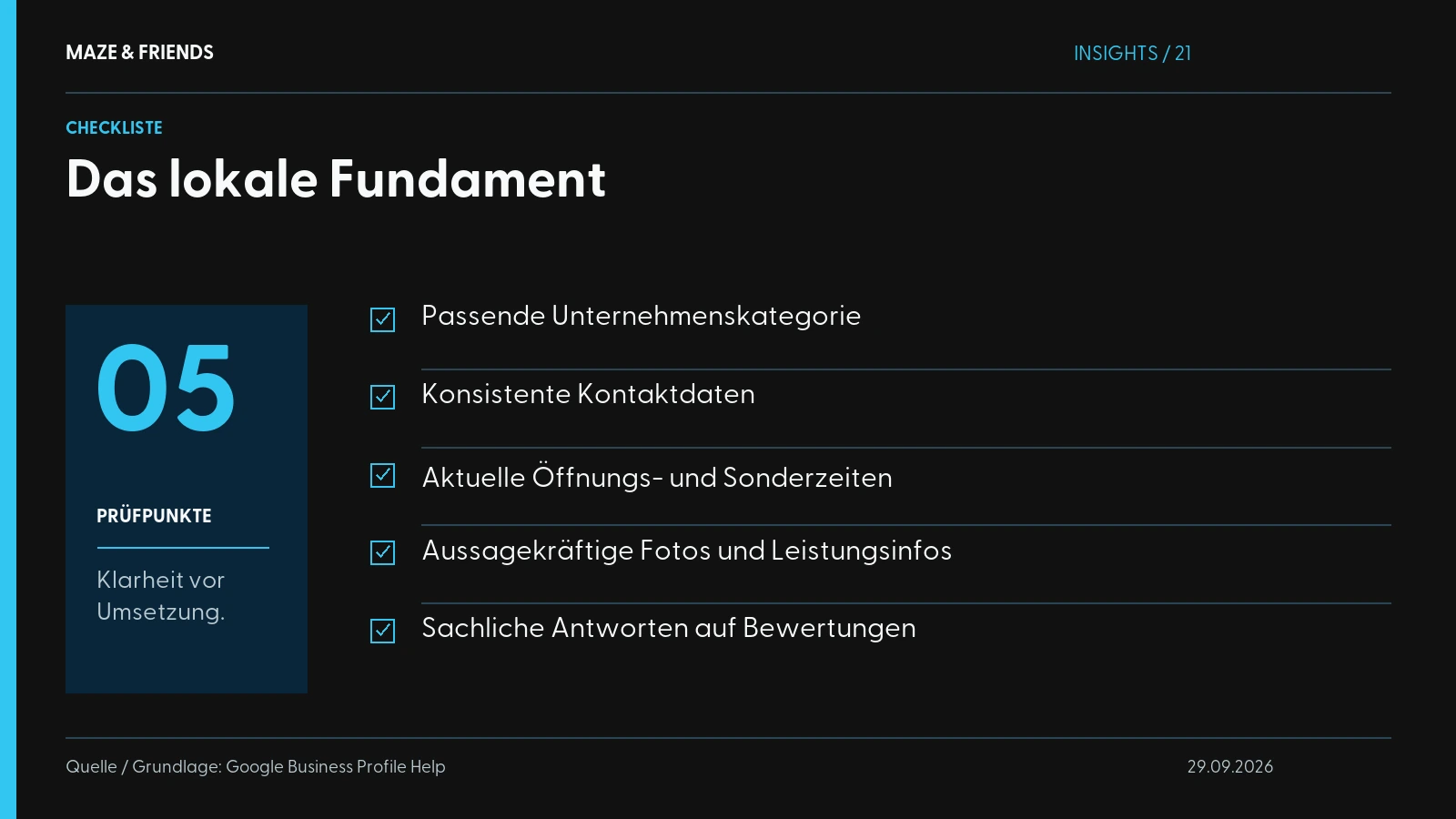
One foundation for Maps and AI search
Local SEO in Graz comes down to a few basics, done thoroughly: a complete Google Business Profile, consistent company details, genuine reviews and clear service pages. The same foundation makes you visible on Google Maps and in AI answers. Start with the profile, ask your customers for an honest review after your next appointment and type your most important search into ChatGPT yourself once.
If you then want to know where your biggest lever lies: Maze & Friends treats local visibility and AI search as one job and shows you where you stand first. Have a look at our page on search engine optimisation. The first step is an initial call, in the spirit of “Consulting that also delivers”.
From the studio: car.acho: website, photos and videos · Bowl Kuchl: food photography and content strategy.
Frequently asked questions
What does SEO stand for, and what is local SEO?
SEO stands for search engine optimisation. For searches with a local angle, such as “tax adviser Graz” or “plumber near me”, local SEO makes you visible. It is most visible in the local pack, the map box with usually three entries above the normal Google results. Unlike nationwide SEO, what counts most here is your Google Business Profile, your reviews and your distance from the person searching. The same signals increasingly feed into the answers of ChatGPT, Perplexity and Google AI as well.
How do I get into the Google Maps top 3 in Graz?
You get into the Google Maps top 3 through relevance, distance and prominence, the three criteria Google itself names for local results. You cannot change your distance from the person searching: a business in Lend has a natural advantage when someone searches from Lend. You build relevance with a complete profile, a precise primary category and website content that says clearly what you do, where and for whom. Prominence comes from genuine reviews and mentions of your business across the Graz web. There is no single trick.
What belongs in a complete Google Business Profile?
A complete Google Business Profile, formerly Google My Business, contains every available detail about your business. Half-empty profiles tell Google that nobody is looking after them. The profile itself is free. Pay particular attention to:
- the most precise primary category possible, such as “Tax adviser” rather than “Consultant”, plus suitable secondary categories
- opening hours, phone number, website, services and attributes
- regular new, real photos of your team, premises and work
- your actual business name without extra search terms, as Google’s guidelines require
Posts about current news keep the profile alive as well.
What does NAP consistency mean in local SEO?
NAP consistency means your business name, address and phone number are written exactly the same everywhere: on your website, in your Google Business Profile and in every directory. The abbreviation stands for name, address and phone. Even small differences such as “Straße” and “Str.”, an old phone number or an address from before a move can leave Google and AI systems unsure whether they are looking at the same business. Consistent details, on the other hand, act as a trust signal and strengthen your local prominence.
How do I get more Google reviews without breaking the guidelines?
You get more Google reviews by asking customers for an honest review with a short link straight after the appointment. Google’s guidelines do not allow incentives such as discounts or free services in exchange for a review, nor asking selectively for positive reviews only. Bought or fake reviews come to light sooner or later, because Google is getting better at filtering out fakes. Reply to every review, including critical ones, calmly and constructively, because the next prospect reads along. Four stars from thirty genuine reviews are more convincing than five stars from three.
Is local SEO still relevant when many people ask ChatGPT?
Local SEO is relevant precisely because of ChatGPT and similar tools, since AI systems largely derive local recommendations from the same signals that decide Google Maps rankings. These include business profiles, reviews, mentions on local sites and in directories, and the text on your website. So you do not have to run two separate building sites: if you build your local foundation properly, you become more visible in map search and in AI answers at the same time. And many people still search Google and Maps directly for businesses near them.
How do I get recommended by ChatGPT, Perplexity or Google AI in Graz?
As a Graz business, you are more likely to be recommended by ChatGPT, Perplexity or Google AI when the web shows clearly what you offer, where and for whom. These systems have no knowledge of their own about the Graz market; they derive their answer from profiles, reviews, local mentions and your website. What helps are pages that state your service, location and catchment area unambiguously and answer real customer questions, plus review texts that show what customers value you for. To check whether it works, type your most important local search into ChatGPT and Perplexity yourself.
How long does it take for local SEO in Graz to work?
A properly completed Google Business Profile can make itself felt on Google Maps within a few weeks, while building prominence through reviews and mentions tends to take months. How fast it goes depends on the competition in your industry and your area: in a district with few competitors it is usually quicker than in a fiercely contested industry in the city centre. Local SEO works like a foundation that becomes more stable and harder to attack over time. If you keep at it, you build a lead others cannot close in the short term.
Do I need business premises in Graz for local SEO?
No, you do not need business premises for local SEO, because tradespeople, consultants and mobile service providers can run a Google Business Profile with a service area instead of a visible address. According to Google, the requirement is that customers can visit you at a location or that you serve them in person. If you work from home, you hide the address. In your service area you can list places such as Seiersberg or Leibnitz alongside Graz; the mechanics are the same everywhere in Styria. What matters is that your services and area are clearly described, so Google and AI systems associate you with the region.
How much does local SEO in Graz cost per month?
The basics of local SEO cost mainly time, because the Google Business Profile is free and you can set up the profile, listings and review process yourself. It only costs money once you outsource work or step up your content, review management and AI visibility. The monthly cost then depends on the competition in your industry, the number of your locations and services, the state of your website and whether you build things once or want ongoing support. A serious provider shows you where you stand first instead of selling you a standard package.
Can I do local SEO myself, or do I need an agency?
You can implement the most important basics of local SEO yourself: complete your profile, align your company details everywhere, collect reviews and write one clear page per core service. That takes thoroughness and staying power, not a big budget. An agency typically takes on the baseline analysis, the clean-up of directory listings, location and service pages, building local mentions and ongoing measurement. That pays off if you lack the time, your industry is fiercely contested or you also want to become visible in AI answers on purpose.
How do I recognise a reputable SEO agency in Graz?
A reputable SEO agency in Graz shows you where you stand before offering a package and does not promise guaranteed top positions. Nobody can guarantee first place on Google, as Google itself makes clear. Make sure the agency explains its work in plain terms, shows references with traceable results and that your business profile, website and all logins are in your name. It is a plus if the agency treats local visibility and AI search as one job instead of just selling rankings. Many providers promise the same thing; the baseline analysis tells them apart.
How do I measure whether local SEO is working?
The performance statistics in your Google Business Profile are the first place to see whether local SEO is working: views, calls, direction requests and website clicks over time. These also help:
- Google Search Console for searches with a local angle
- spot checks of your most important search terms from different districts, because distance changes the result
- the number and average of your reviews, compared month on month
- your most important local question, asked regularly in ChatGPT and Perplexity
In the end, enquiries count, not positions.
Which mistakes cost the most visibility in local SEO?
The most expensive mistakes in local SEO are a half-completed business profile, a primary category that is too general and inconsistent company details across the web. Add to that missing or unanswered reviews, and bought reviews that come to light sooner or later. Near-identical pages for every district that differ only in the place name do not help either and can count as doorway pages under Google’s spam policies. The most common mistake, though, is doing nothing at all out of uncertainty and waiting for “that Google thing” to sort itself out.
Which directories matter for local SEO in Austria?
For local SEO in Austria, the company directory of the Austrian Economic Chamber (WKO Firmen A–Z), Herold, the Austrian business directory, and the directories of your industry count most. Bing Places and Apple Business Connect are also worthwhile. What matters is less the number of listings than their quality: name, address and phone number must match your Google Business Profile exactly everywhere. Mentions and links from Graz partners, associations or regional media strengthen your local prominence further. Before creating new listings, clean up the old ones first, for example after a move or a change of number.
Next step
Want to know which of this fits your company? We will work it out together in 30 minutes. Free and without obligation.
Pick a time
Manuel Zellnig has been building visibility for companies since 2018: brand film, personal branding, performance marketing and AI visibility. Qualified advertising specialist (Werbeakademie Wien), Bachelor in Business Management (Carinthia University of Applied Sciences), author of the book ‘Mobile Apps zur Messung der Kundenzufriedenheit’ (2017, in German) and creative expert for the Austrian Economic Chamber (WKO) in two transformation guides. He measures before he recommends and writes here about what actually works in projects.
Publications and interviews: WKO transformation guide for printers (in German) · WKO transformation guide for florists (in German) · Interview with Ghezzo (in German) · ‘Heute’ on Viennese start-ups (in German)