



Generative engine optimisation explained
Generative engine optimisation (GEO) explained simply: how ChatGPT and co. choose their sources and how to make your content citable in AI answers.
In short: Generative engine optimisation (GEO) is the practice of preparing your content so that generative AI systems such as ChatGPT, Perplexity or Google AI Overviews draw on it as a source and cite it. Instead of fighting for a spot in a list of results, the aim is to become part of the answer the AI delivers directly. Vienna-based Maze & Friends measures this AI visibility and builds the content, technology and brand data it needs.
A potential customer no longer types “brand film production Vienna” into Google. They ask ChatGPT directly: “Which agency makes reputable industrial films in the DACH region?” If your company doesn’t appear in that answer, it’s rarely because of a bad website. It was simply never built to be read, understood and recommended by a machine. What GEO is, how it works and what you can do about it is covered here.

What is generative engine optimisation (GEO)?
Generative engine optimisation (roughly: optimising for generative search engines) is the discipline of structuring and wording content so that AI answer systems pick it up as a trustworthy source. The term was coined in a research paper by Pranjal Aggarwal and colleagues from November 2023. Your goal is more than a blue link in a list of results: your statement should end up in the generated answer itself, ideally with your brand named or a link to your site.
That is a fundamental difference from classic search. With Google in the classic sense, you get a list of links and decide for yourself what to click. A generative engine such as ChatGPT, Perplexity, Google AI Overviews, Google Gemini or Microsoft Copilot gives you a finished answer written as continuous text. The system has already made the selection. If your content isn’t in it, you don’t exist for the user in that moment.
You’ll come across three abbreviations in this field all the time:
| Term | What it stands for | What it optimises for |
|---|---|---|
| SEO | Search engine optimisation | Rankings in classic search results (Google, Bing) |
| AEO | Answer engine optimisation | Direct answer boxes, featured snippets, voice assistants |
| GEO | Generative engine optimisation | Citability in AI-generated answers (ChatGPT, Perplexity, AI Overviews) |
The three are not mutually exclusive; they build on one another. If you want to understand how they fit together in detail, you’ll find it in our overview of GEO, AEO and SEO. For a start, one sentence is enough: GEO extends SEO, and that extension is becoming necessary because a growing share of your audience no longer enters search through a list of results at all.
How does generative engine optimisation work?
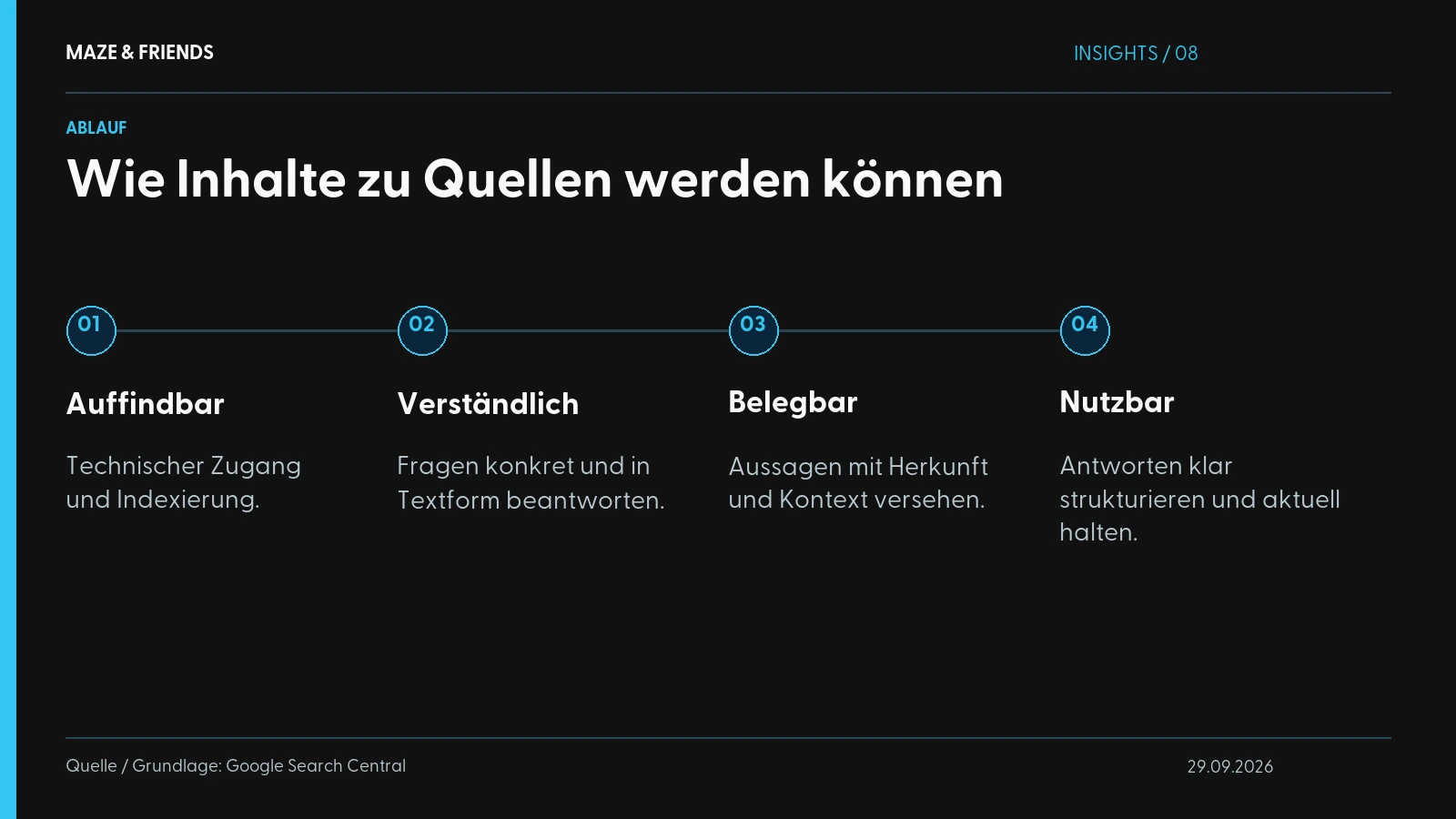
Generative engine optimisation starts where a generative engine forms its answer. Put simply, three steps take place:
- Understanding the question. The AI system breaks the user’s query down into its components and interprets the actual intent behind it.
- Gathering sources. Many systems access the web live (this is called retrieval) or use their trained knowledge. They draw on several sources that match the question.
- Composing the answer. From these sources the model writes a new, coherent answer, deciding which statements to adopt and which sources to name.
With GEO you want to be found as a source in step 2 and judged worth citing in step 3. The old SEO tricks won’t get you there. An engine doesn’t reward keyword density; it does reward clarity, unambiguity and traceable authority. These points in particular add to your citability:
- Clear, self-contained statements. An AI prefers to adopt passages it can use without context. A sentence that answers a question completely and unambiguously is worth a lot to a model.
- Structure that machines can read. Headings that mirror real questions. Short definitions early in the text. Lists and tables instead of walls of text. That way the system finds the relevant passage quickly.
- Entity and authority. The engine has to know who you are and why it should believe you. This authority is built by a consistent presentation of your company across your own website, publicly accessible reference sources, industry directories and expert articles. In the jargon this is called “entity authority”.
- Verifiability. Concrete figures, named methods, real examples and comprehensible reasoning are more likely to be adopted than vague advertising claims. “We are the market leader” gets ignored. A sentence that names the client, industry, region and a proven result is citable, provided it’s true.
- Currency and consistency. If your details contradict each other across different pages, trust drops. A system that finds two contradictory statements would rather use neither.
In practice this ongoing work is often simply called GEO optimisation: refining these points until your content is as unambiguous for machines as it is for people. How Maze & Friends implements and measures this for companies is shown on the service page AI visibility (GEO).
How do you get cited by ChatGPT?
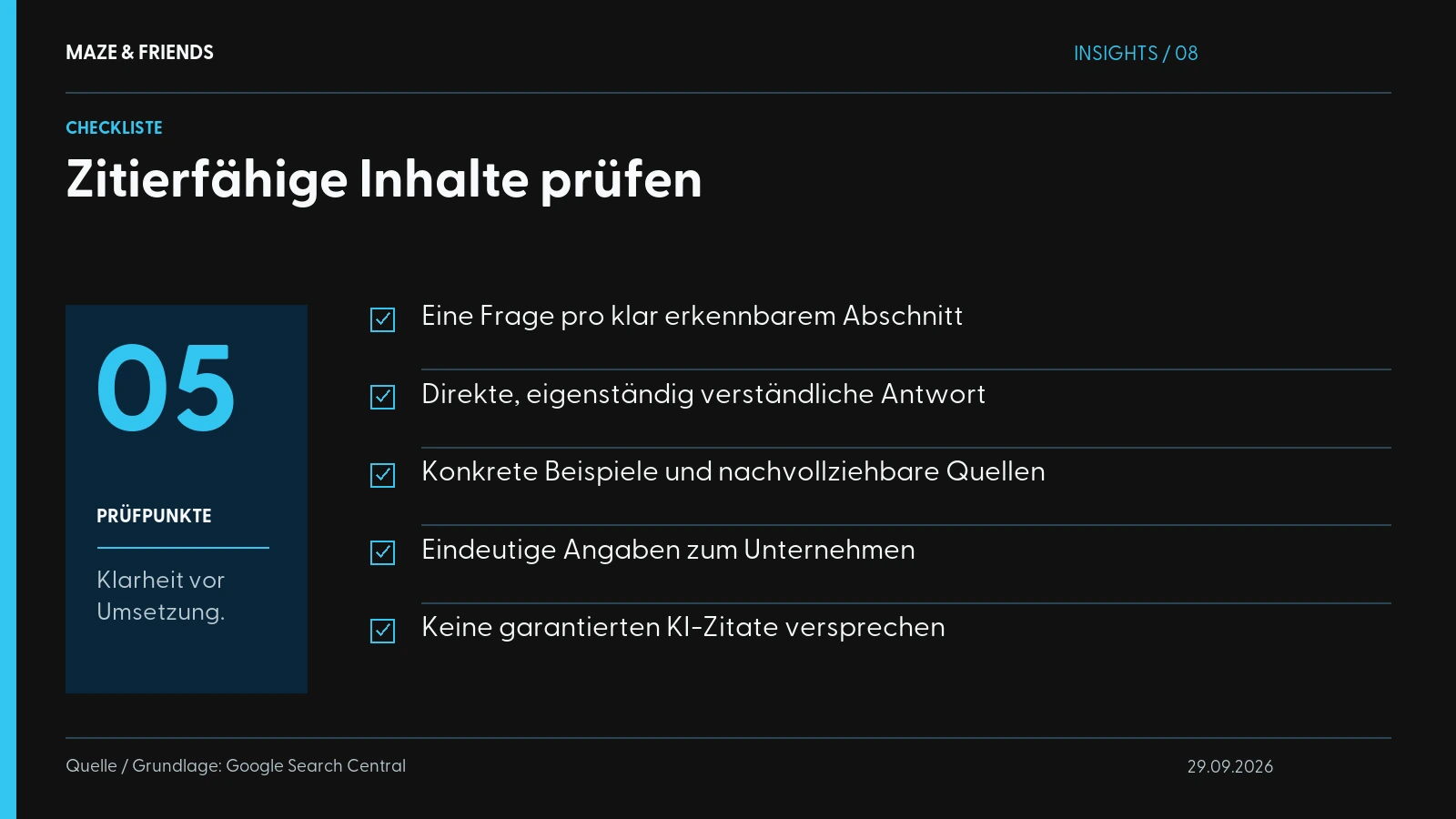
There is no button that guarantees ChatGPT will name you. But you can systematically increase the likelihood. Maze & Friends applies this checklist itself, and you can put it into practice straight away:
1. Answer real questions word for word. Research which questions your audience really asks, meaning which sentences a person types or speaks. What a keyword tool spits out is only a starting point. Build these questions in as headings and answer them completely in the first sentence underneath. This article is structured exactly like that.
2. Include the “In short” paragraph. A short, self-contained section at the beginning that answers the core question in two or three sentences is ideal quotation material for generative engines. It can be adopted without rewording, like the paragraph this article starts with.
3. Show real experience, not claims. Google and the models behind it increasingly assess content according to the E-E-A-T principle: experience, expertise, authoritativeness and trust. In its guidance on AI-generated content from February 2023, Google writes that its systems reward high-quality content with these qualities, however it was produced. Practical examples, named methods and honest assessments (including of what doesn’t work) beat any superlative.

4. Make yourself unambiguous as an entity. Make sure your company is presented the same way everywhere: the same name, the same description, the same core statements across your website, LinkedIn, industry directories and expert articles. Structured data (Schema.org markup) helps machines capture these connections cleanly.
5. Be technically accessible. If your site loads slowly, hides behind cookie banners or only delivers important content via JavaScript, a crawler may not be able to read it at all. For Google’s AI Overviews, Google names exactly this basic requirement in its documentation on AI features: a page must be indexed and eligible to appear in Search with a snippet. The technical foundation is unspectacular, but without it the rest achieves nothing. That’s why we check it first in technical search engine optimisation.
6. Build topical depth. A single article rarely makes you an authority. Substance is signalled by a coherent cluster of several articles that cover a topic from every angle and link to each other sensibly. This foundational article, too, belongs to a larger GEO cluster.
7. Check whether it works. Ask the systems yourself. Put exactly the questions you want to be found for to ChatGPT, Perplexity and Google AI Overviews, and see who gets cited. It isn’t exact, because answers fluctuate. But you can see whether you show up in the relevant range at all and who your real competition for a place in the answer is.
This matters especially for the DACH market, because many German-speaking B2B providers don’t have GEO on their radar yet. Whoever works cleanly now claims their place in AI answers before it gets crowded. Early SEO adopters had the same advantage in the early years of search engines, except that the field moves considerably faster today.
What can GEO achieve, and what can’t it?
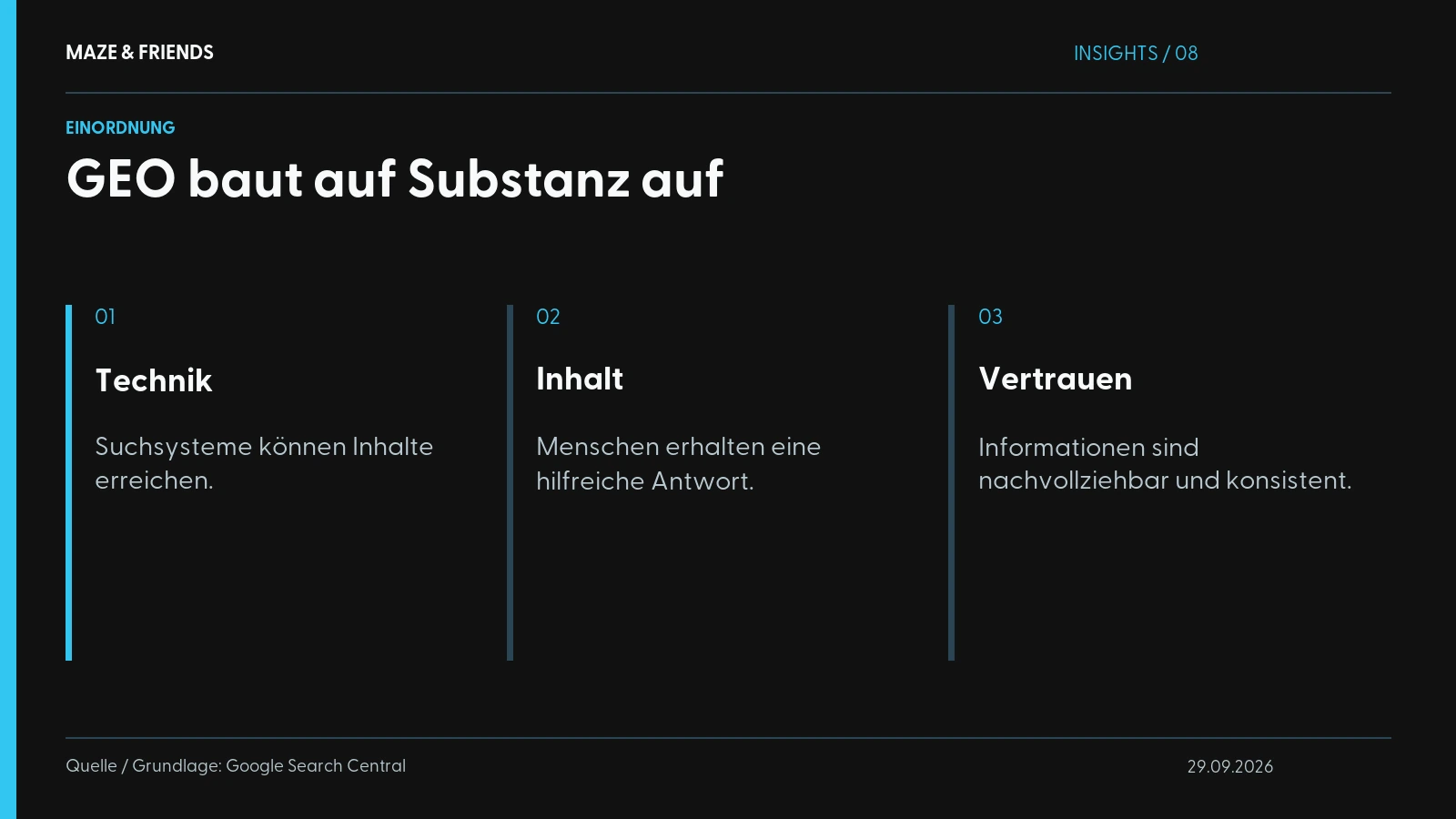
To avoid a false impression: GEO doesn’t replace SEO. Classic search won’t disappear overnight, and a good share of your visibility will continue to come from rankings. What changes is the weighting. And it becomes clear that both worlds share the same foundation, namely clear, credible, technically clean content.
GEO is work. There is no shortcut that lets you “hack” ChatGPT. What works is unspectacular: good substance, clean structure, real authority, technical craftsmanship. Where exactly the line between SEO and GEO runs and what it means for you strategically is covered in our article GEO instead of SEO, or both?.
AI cites what it understands
GEO makes your content citable for AI systems: clear answers, clean structure, an unambiguous brand and a technically accessible foundation. There is no guarantee of being named. But the likelihood can be increased systematically, and it can be measured too.
From the studio: Canal Toys: shop, guides and campaigns · Maze & Friends as its own client: SEO blog and case studies.
Frequently asked questions
What does generative engine optimisation mean, in simple terms?
Generative engine optimisation (GEO) means preparing content so that AI systems such as ChatGPT use it as a source and name your brand in their answers. In classic search, people choose from a list of links themselves. With a generative answer, the system has already made the selection and delivers finished continuous text. GEO therefore aims for a place in the answer, ideally with your brand named or a link. SEO remains the foundation.
What does the term generative engine optimisation literally mean?
Roughly “optimisation for generative search engines”, meaning AI systems that write answers themselves. “Generative” describes how ChatGPT, Gemini or Perplexity produce new text from several sources instead of outputting a list of links. “Engine” stands for this answer machine, “optimisation” for the work on your content so that the machine finds, understands and adopts it. In German-speaking countries, the English abbreviation GEO has caught on as well, often as “GEO-Optimierung”.
What does the abbreviation GEO stand for in marketing?
In online marketing, GEO stands for generative engine optimisation, the optimisation of content for AI answer systems such as ChatGPT, Perplexity or Google AI Overviews. It is easy to confuse with the older meaning. The Greek prefix “geo” stands for earth and turns up in marketing in geo-targeting, for example, which means serving ads by location. GEO in the new sense has nothing to do with places. If you want to be found in your region, you need local SEO; if you want to be named in AI answers, you need GEO.
Are GEO, AI SEO and LLM SEO the same thing?
In practice, largely yes: all three terms mean designing content so that AI systems find it, understand it and use it in their answers. LLM stands for large language model, the language model behind ChatGPT, Gemini or Claude. There is no binding distinction; agencies and tool providers use the terms differently. The label is secondary. What matters is what actually happens: citable content, an unambiguous presentation of your company, technical accessibility and mentions on third-party sites.
Where do ChatGPT, Perplexity and Google AI get their answers from?
From two sources: from knowledge in their training data and, when web search is active, from pages they retrieve live to match the question. This live retrieval is called retrieval. From several sources found, the model writes a new, coherent answer, deciding which statements to adopt and which sources to name. That is exactly where GEO comes in. Your content should be found during the gathering stage and judged worth citing when the answer is put together.
What makes content citable for AI systems?
Content is citable when an AI can adopt a statement from it without rewording and without context. For that, it has to be clear, backed up and unambiguously attributable. These points contribute most:
- self-contained sentences that answer a question completely
- headings that mirror real questions, plus lists and tables
- concrete figures, named methods and real examples instead of advertising claims
- an unambiguous presentation of your company that is the same everywhere
- consistent, up-to-date information across all pages
A generative engine does not reward keyword density.
What does GEO look like in a concrete example?
A provider of industrial films sets up its website so that ChatGPT names it when asked for an agency for industrial films. One page picks up exactly this question in its heading and answers in the first sentence what the company does, for whom and where. Name, service and location are identical on the website, LinkedIn and in industry directories. Proven references replace superlatives. The provider checks whether it works by regularly asking the question in ChatGPT, Perplexity and Google itself.
Where does the term generative engine optimisation come from?
It is generally traced back to a research paper by Pranjal Aggarwal and colleagues that appeared as a preprint in November 2023. In 2024 it was published at the KDD conference. The authors described GEO as a field of its own and built GEO-bench, a test dataset of search queries from various subject areas. In it, specifically revised content became more visible in generated answers, to different degrees depending on the subject area. The results come from a test environment. They can’t be transferred one-to-one to ChatGPT or Google.
Which AI systems does GEO apply to?
To all systems that write answers themselves, above all ChatGPT, Perplexity, Google AI Overviews, Google Gemini, Microsoft Copilot and Claude. The basic principles are similar across all systems: clear statements, clean structure, an unambiguous brand and confirmation from other sources. In detail, each system sets its own priorities, such as how heavily it searches the web live and which sources it prefers. Which systems matter for you depends on what your audience actually uses for research.
Can ChatGPT do SEO or GEO itself?
ChatGPT can speed up many tasks, but it doesn’t supply the actual substance. It helps with collecting customer questions, structuring texts, drafting copy or suggesting structured data, for example. It doesn’t replace your experience, real figures and examples from your business, or mentions on other sites. It is exactly this evidence that makes a source worth citing for AI systems. Google doesn’t reject AI-written text in principle, but it assesses whether content is helpful, however it was produced.
Which tools do I need for GEO?
To get started you don’t need specialist software, but good craftsmanship and a few free tools. Google Search Console and Bing Webmaster Tools show you whether your pages are indexed. Without an index, even an AI feature such as Google AI Overviews won’t find you. For the content, question and keyword research help, as does testing directly in ChatGPT, Perplexity and Google who gets cited today. Specialised AI trackers are only worthwhile once you know your core questions and want to evaluate many questions regularly.
What does E-E-A-T mean, and why does it matter for GEO?
E-E-A-T stands for experience, expertise, authoritativeness and trust. Google uses it to describe how it judges the quality of content.
This means, for example, named authors with demonstrable experience, backed-up statements, real practical examples and a company that reputable sources report on. The same signals count for GEO, because an AI system is more likely to adopt a traceably supported statement than a superlative of unknown origin. Honest assessments, including about what doesn’t work, have more impact than any advertising promise.
What is an entity, and why does it matter for GEO?
An entity is a clearly identifiable object, such as your company with a fixed name, industry, location and services. Search engines and AI systems can distinguish it from others.
AI systems link information about you from many sources. If name, description and core statements are the same on your website, LinkedIn, in directories and in expert articles, the system reliably attributes them to you. Contradictory details lower trust. In case of doubt, the AI then doesn’t name you at all. Structured data according to Schema.org, for example of the type Organization, makes these connections machine-readable.
Can an agency guarantee that ChatGPT will name my brand?
No. Nobody can seriously guarantee that, because the AI systems decide for themselves which sources they use. Generative answers also fluctuate from query to query and cannot be controlled directly. What you can influence is the likelihood, with citable content, clear structure, a presentation of your brand that is the same everywhere and a clean technical foundation. Anyone who promises you a guarantee or a trick to “hack” ChatGPT is selling you something they don’t control.
Next step
Want to know which of this fits your company? We will work it out together in 30 minutes. Free and without obligation.
Pick a time
Manuel Zellnig has been building visibility for companies since 2018: brand film, personal branding, performance marketing and AI visibility. Qualified advertising specialist (Werbeakademie Wien), Bachelor in Business Management (Carinthia University of Applied Sciences), author of the book ‘Mobile Apps zur Messung der Kundenzufriedenheit’ (2017, in German) and creative expert for the Austrian Economic Chamber (WKO) in two transformation guides. He measures before he recommends and writes here about what actually works in projects.
Publications and interviews: WKO transformation guide for printers (in German) · WKO transformation guide for florists (in German) · Interview with Ghezzo (in German) · ‘Heute’ on Viennese start-ups (in German)