


How to measure your AI visibility
Measure AI visibility: use prompt tests, server logs and GA4 to check whether ChatGPT, Perplexity and Google AI name your brand and link to your site.
In short: You measure AI visibility by systematically putting your core questions to ChatGPT, Perplexity and Google AI Overviews and recording whether your brand is mentioned, linked or recommended. In addition, you check in server logs and GA4 whether AI crawlers fetch your pages and whether visits from AI tools arrive. Vienna-based Maze & Friends establishes this baseline with a fixed set of questions and clean tracking.
More and more people get their answers directly from ChatGPT or Perplexity instead of searching through ten blue links, and at some point the question comes up: am I actually being named there? For founders and personal brands this is no academic question. If a potential client asks the AI “Who are the best people for topic X?” and your name doesn’t come up, you simply don’t exist in that moment. Very few have any data on this, so people hope and guess. Yet AI visibility can be measured like any other metric, if you know where to look.
This article is about measuring, meaning about a reliable basis. Why the game is shifting in the first place is explained in our overview of generative engine optimisation.
What does AI visibility actually mean?
First, the term, otherwise you end up measuring something other than what you actually mean.
AI visibility describes how present your brand, your person or your content is in the answers of generative AI systems. That means ChatGPT, Perplexity, Google AI Overviews, Gemini, Claude and co. Being visible can mean three different things, and the distinction matters:
- Mention: your name or brand appears in the running text of the answer, without a link. For personal brands this is often the first proof that the model knows you.
- Citation: your website is linked as a source. This carries more weight, because it can bring traffic and signals authority.
- Recommendation: the AI actively names you as a provider or expert for a specific question. This is the strongest form of visibility.
Classic SEO asks “Do I rank on page 1?”; AI visibility asks “Am I named in the answer, and if so, how?”. Why the two disciplines exist side by side rather than one replacing the other is something we took apart in GEO instead of SEO.

How do I measure whether my website is visible in AI answers?
There is no single button that spits out a clean number. Unlike Google rankings, ChatGPT has no official “Search Console” (yet). With three levels, you can still build a reliable picture.
1. The manual prompt test
The simplest method is also the most honest: you open ChatGPT, Perplexity and Google AI and ask exactly the questions your ideal client would ask and for which you want to be found.
In a structured form it looks like this:
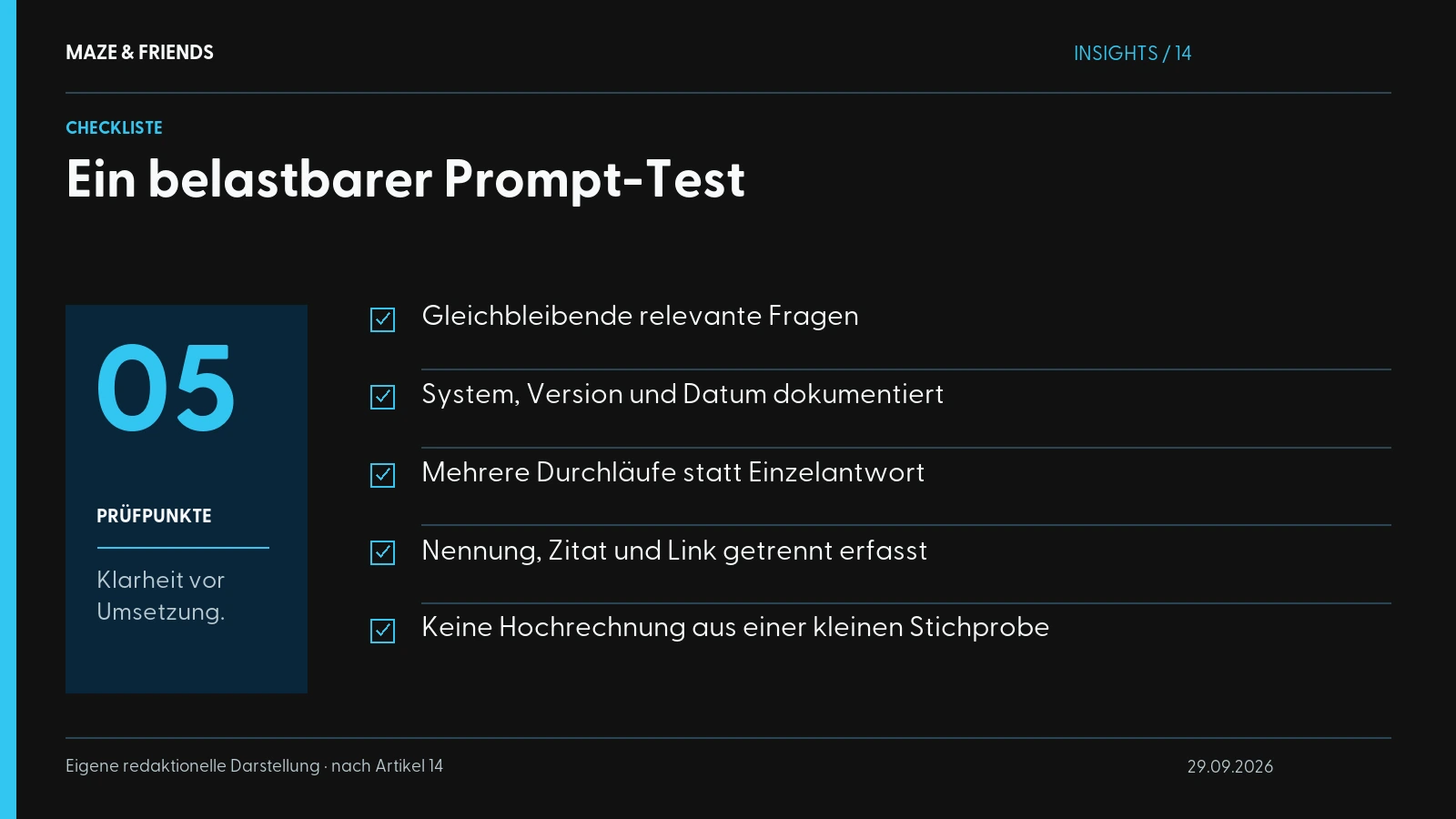
- Collect 15 to 30 relevant questions. Instead of “What is marketing?”, be specific: “Who offers personal branding on LinkedIn for founders in Vienna?” or “Best agency for server-side tracking in the DACH region”. Mix branded questions (are you named when your name is already in the question?) with unbranded questions (does your name come up when only the category is mentioned?).
- Ask every question in every tool. ChatGPT, Perplexity, Google AI Overviews, plus Gemini and Claude if your audience uses them.
- Record three things: Are you mentioned? Are you linked? In which position (named first or only as number seven)?
- Repeat at fixed intervals. Once a month is enough to start with. AI answers fluctuate, and a single test remains a snapshot.
A simple table is enough as a log:
| Question | ChatGPT | Perplexity | Google AI | Mentioned? | Linked? |
|---|---|---|---|---|---|
| Personal branding founders Vienna | yes | yes | no | 2 of 5 | Perplexity |
| Server-side tracking DACH | no | yes | no | 1 of 5 | Perplexity |
It’s manual work, but that is exactly what shows you how the models talk about your market, a feel no dashboard can give you. For a personal brand with a handful of core topics, the effort stays manageable.
2. Are the AI bots crawling your site at all?
For a model to cite you, it first has to be allowed to find your content. Perplexity and ChatGPT with search enabled send out their own crawlers. You can see this directly in your server logs.
In the logs or via your server access, look out for these user agents:
GPTBotandOAI-SearchBot(OpenAI / ChatGPT)PerplexityBotGooglebot(Google Search, whose index the AI Overviews also draw on)ClaudeBotandanthropic-ai(Anthropic)
If these bots regularly show up on your important pages, that’s a good sign. If they visit other pages on your domain but never your important ones, you probably have a technical problem: for example a robots.txt that blocks these bots, or content that is only loaded via JavaScript and stays invisible to the crawlers. Most people completely overlook this preliminary stage of visibility.
Google-Extended is a special case. According to Google (in German), there is no separate crawler behind it, just a token for robots.txt, which is why it never appears in any log. It lets you control whether Google may use your content to train Gemini and as a source for Gemini answers (grounding). It has no influence on AI Overviews, because they draw on the normal Google index (in German).
3. Is traffic from AI tools reaching you?
When Perplexity or ChatGPT link to you and someone clicks, that visit shows up as a referral in your analytics. In GA4 you find these sources by filtering for referral hosts:
chatgpt.comperplexity.aigemini.google.comcopilot.microsoft.com
Create a segment or an exploration in GA4 that groups these hosts. That way you can see over time whether AI-driven traffic is growing. For most people the volume is still small, but the quality is often high: anyone who arrives via an AI recommendation is usually pre-qualified and closer to a decision. All the more important is clean tracking. If your GA4 is set up sloppily, or consent and server-side issues swallow the referrer, you won’t see this traffic at all.

How do I get found in ChatGPT?
Measuring is one half; the other is the question of what improves the numbers. Getting found in ChatGPT depends on the same signals that make up classic SEO for ChatGPT, plus a few peculiarities.
In our work in the DACH region (Germany, Austria, Switzerland), these levers have worked most reliably so far:
- Become a citable source. In live searches, models tend to draw on pages that answer clearly, in a structured way and factually. Short, self-contained answer blocks (like the “In short” above) help, because they are easy to extract.
- Build topical authority, not individual articles. A brand with ten connected, good pieces of content on a topic is more likely to be treated as an authority than one with a single viral post.
- Be present where the models are reading. Besides your website, ChatGPT and Perplexity also draw their knowledge from mentions on third-party sites, in directories, trade media and partly Reddit and LinkedIn. For personal brands this means your visibility outside your own domain counts too.
- Structure your content so machines can read it. Clear headings that mirror real questions, definitions early in the text and clean markup help Google and every AI crawler alike.
The most important point for you as a founder: consistency. The models build their picture of you across many signals. If your name, your positioning and your core topics appear the same way everywhere, that anchors more easily. You’ll find a deeper framework for this in our overview of GEO, AEO and SEO.

Which tools measure AI visibility on an ongoing basis?
The manual test is the honest way in. But if you want to test ten questions across five models every month, manual work quickly turns into a chore. That’s when an AI tracker is worth it.
There is now a growing number of tools that automatically send prompts to several models and record how often and in what context your brand appears. They differ greatly in scope and price, and the market is moving fast. So instead of names with promises, here are the criteria to choose by:
| What to look for | Why it matters |
|---|---|
| Which models are covered? | ChatGPT and Perplexity are a must, Google AI and Gemini almost as important. |
| Suitability for the DACH region | Does the tool test German-language prompts and local questions properly? Many are US-centric. |
| Mention vs. citation | A good tool separates the two instead of just delivering “named: yes/no”. |
| Competitor comparison | Does it show you who is named instead of you? That’s often the most valuable information. |
| Raw data export | Can you combine the results with your GA4 and log data? |
Our position on this: a tracker doesn’t replace understanding. It automates the counting, but the interpretation remains your job: why am I named for this question and not for that one? Start small. Do the manual test, follow up on what you see, and only automate once you know which questions really matter. Anyone who buys a tool before knowing their core questions ends up measuring a lot and understanding little.

How do you start your first round of measurement?
Your setup for the first round of measurement in five steps:
- Define core questions. Write down 15 to 30 questions for which your ideal client should find you. Mix branded and unbranded questions.
- Establish a baseline. Ask every question in ChatGPT, Perplexity and Google AI. Enter mention, citation and position in a table.
- Check the crawlers. Look in your server logs to see whether GPTBot, OAI-SearchBot, PerplexityBot and Googlebot visit your core pages. If not: check
robots.txtand rendering. - Set up GA4 referrals. Create a segment for AI referral hosts so that from now on you see AI traffic clearly.
- Schedule a repeat date. The same round of measurement once a month. Only that way do you get a trend instead of a random snapshot.
After two or three rounds you have something most people in your market don’t: a data basis instead of a gut feeling.
Visibility you don’t measure is visibility you can’t steer
AI visibility feels vague and uncontrollable, and that is exactly the trap. As soon as you know your core questions, test systematically and keep an eye on crawlers and referral traffic, the diffuse “Am I being cited?” turns into a metric you can work on. Maze & Friends works on AI visibility according to this principle: understand, build, prove.
If you want to know whether your brand currently appears in ChatGPT, Perplexity and Google AI and what you can actually do about it, we’ll establish an initial baseline for you. Write to us: we’ll look at your starting point and show you in black and white where you stand.
From the studio: Canal Toys: shop, guides and campaigns · Maze & Friends as its own client: SEO blog and case studies.
Frequently asked questions
What is AI visibility?
AI visibility describes how present your brand, your person or your content is in the answers of AI systems such as ChatGPT, Perplexity or Google AI Overviews. The same applies to Gemini, Claude and Copilot. It has three levels: a mention of your name in the text, a citation with a link to your website, and a recommendation, where the AI actively names you as a provider or expert. The higher the level, the more valuable. Classic SEO asks whether you rank on page one; AI visibility asks whether and how you appear in the answer.
How can I check my AI visibility?
You check your AI visibility by regularly putting your core questions to ChatGPT, Perplexity and Google and analysing AI crawlers and AI visits. In detail, that means:
- Prompt test: record whether you are mentioned, linked or recommended, and in which position
- Crawler check: check in the server logs whether bots such as GPTBot, OAI-SearchBot or PerplexityBot fetch your important pages
- Traffic check: group visits from chatgpt.com, perplexity.ai, gemini.google.com and copilot.microsoft.com in GA4
Only all three levels together give you a reliable picture.
Is there a Search Console for ChatGPT?
No, so far there is no official tool for ChatGPT and Perplexity like Google Search Console that shows your mentions in answers. Google and Microsoft only provide data for their own AI answers: in 2026 Google gradually introduced reports on impressions in AI Overviews and AI Mode into Search Console, although without clicks. Bing Webmaster Tools show citations in Microsoft Copilot. For ChatGPT, Perplexity and Claude, you’re left with prompt tests, server logs and GA4.
Which metrics show how visible I am in AI answers?
The most important metrics for AI visibility are mention rate, citation rate, position in the answer and your share of all mentions compared with the competition. They are measured across a fixed set of questions:
- Mention rate: for how many questions your name comes up
- Citation rate: how often your website is linked as a source
- Position: whether you are named first or only far down
- Share versus competitors: who is named instead of you and how often
- Tone: whether the AI describes you correctly, positively, neutrally or critically
How many questions do I need for a meaningful AI visibility test?
For a meaningful AI visibility test, 15 to 30 questions that your ideal client would actually ask are enough. The mix is what matters: branded questions show whether the AI knows you and describes you correctly when your name is already in the question. Unbranded questions show whether your name comes up when only the category is mentioned, for example “Who offers personal branding on LinkedIn for founders in Vienna?”. Phrase them specifically rather than generally and keep the questions the same across all rounds of measurement, otherwise you can’t compare the results.
How often should I measure my AI visibility?
Measuring your AI visibility once a month is enough to start with, provided you ask the same questions in the same systems every time. A single test is only a snapshot, because AI answers fluctuate from query to query. Only repeated rounds of measurement show a trend that tells you whether your work on visibility is having an effect. After two or three rounds you have a data basis instead of a gut feeling. An additional measurement is worthwhile after major changes, such as a relaunch or new content on your core topics.
Why does ChatGPT give different answers to the same question?
ChatGPT and other AI systems phrase every answer afresh, which is why the same question can lead to different answers and sources. Factors include the exact wording, the model used, whether web search is active, language and location, and sometimes the previous conversation or saved preferences. For measurement this means: ask every question several times, always worded the same way, ideally in a new chat with no history. Then evaluate how often you are named across all runs instead of relying on a single answer.
How can I tell whether AI crawlers are visiting my website?
You can tell whether AI crawlers visit your website from their identifiers, the so-called user agents, in the server logs or in your hosting provider’s bot reports. Typical names are GPTBot and OAI-SearchBot from OpenAI, PerplexityBot from Perplexity and ClaudeBot from Anthropic. If you see them regularly on your important pages, the basic requirement is met. If they are missing there, there is probably a technical problem behind it, such as a robots.txt or firewall that locks them out, or content that is only loaded via JavaScript.
Should I block AI crawlers in robots.txt?
No, at least not the crawlers that AI systems use to feed their web search, if you want to be named in AI answers. OpenAI, for example, distinguishes between GPTBot, which collects content for training models, and OAI-SearchBot, through which pages appear in ChatGPT’s search answers. If you lock out OAI-SearchBot, your pages will no longer appear there as a source, according to OpenAI. Whether you allow training is a separate trade-off between reach and control over your content. Also check whether your hosting provider blocks AI crawlers by default.
How do I find visits from ChatGPT and Perplexity in GA4?
You find visits from ChatGPT, Perplexity and other AI services in GA4 via the session source, filtered by referral hosts such as chatgpt.com, perplexity.ai, gemini.google.com and copilot.microsoft.com. Create a segment or an exploration that groups these sources, so you can see the development over months. The number is a lower limit: visits without a referrer, for example from apps, and visits without cookie consent are missing. Clicks from Google’s AI Overviews arrive as normal Google Search traffic and can’t be analysed separately in GA4.
Does AI visibility bring any measurable traffic at all?
AI visibility does bring measurable traffic, but for most websites so far only on a small, growing scale. More important than the quantity is the quality: anyone who comes via an AI recommendation has already heard your name in a relevant context and is often closer to a decision. On top of that there is an effect that no analytics tool shows directly: mentions without a click strengthen awareness and can later show up as a branded search or a direct visit. Clean tracking is therefore a must, otherwise you underestimate this channel.
Why am I not named in ChatGPT even though I rank well on Google?
A good Google ranking doesn’t guarantee a mention in ChatGPT, because AI systems select and weight their sources differently from a list of results. They prefer clearly structured passages that can be cited on their own, and they take mentions on third-party sites such as trade media, directories or LinkedIn into account. So check three things: whether AI crawlers are allowed to reach your pages at all, whether your content answers the question asked directly, and whether other sources name you in connection with the topic. The competitor comparison in the prompt test shows you who is named instead of you and gives clues as to why.
Do I need a paid tool to measure AI visibility?
No, to start with the manual prompt test is enough; it mainly costs time and shows you how AI systems talk about your market. The effort grows with the number of questions, systems and rounds: 20 questions in four systems already make 80 queries per round of measurement, and correspondingly more with repetitions. When that turns into a chore, an AI tracker is worth it. When choosing one, check which systems it covers, whether it tests German-language and local questions properly, separates mention from citation, shows competitors and exports raw data.
Can I also measure the AI visibility of my own person?
Yes, you measure a person’s AI visibility with the same method as a brand’s, just with different questions. Ask for experts on your topic, for example “Who knows about server-side tracking in Vienna?”, and ask direct questions about your name. With name questions, you mainly check whether role, company and topics are reproduced correctly. Because the models put their picture together from many sources, your presence outside your own website also counts, for example on LinkedIn, in interviews or expert articles. The more consistent your presence, the clearer the picture.
How can I increase my AI visibility?
You increase your AI visibility with four levers: clear answers to real questions, topical depth, presence on third-party sites and consistent information about your brand. In concrete terms, that means short, self-contained answer blocks, several connected pieces of content on your core topics instead of individual articles, mentions in trade media, directories and on LinkedIn, and consistent details on name, positioning and topics. Measure before and after with the same questions. Only then can you tell which lever actually worked.
Next step
Want to know which of this fits your company? We will work it out together in 30 minutes. Free and without obligation.
Pick a time
Manuel Zellnig has been building visibility for companies since 2018: brand film, personal branding, performance marketing and AI visibility. Qualified advertising specialist (Werbeakademie Wien), Bachelor in Business Management (Carinthia University of Applied Sciences), author of the book ‘Mobile Apps zur Messung der Kundenzufriedenheit’ (2017, in German) and creative expert for the Austrian Economic Chamber (WKO) in two transformation guides. He measures before he recommends and writes here about what actually works in projects.
Publications and interviews: WKO transformation guide for printers (in German) · WKO transformation guide for florists (in German) · Interview with Ghezzo (in German) · ‘Heute’ on Viennese start-ups (in German)