


What a LinkedIn ghostwriter costs
LinkedIn ghostwriters: what drives the cost, who ghostwriting pays off for, when you are better off writing yourself and how to spot a good provider.
In short: A LinkedIn ghostwriter writes posts in your name and your voice so your personal brand becomes visible. What it costs depends on the share of strategy, the depth of formats and how much of your own time is involved. It pays off when your knowledge has market value but you lack the time or the craft; if your voice is the product, write yourself. Vienna-based Maze & Friends sends you a fixed-price quote after the initial call.
For you as a founder or executive, LinkedIn is the most important channel, because that is where your best clients, partners and talent scroll. Yet between client meetings, leadership and firefighting, your own content keeps getting pushed aside. Your head is full of opinions, but the cursor has been blinking in an empty field for twenty minutes. At some point the thought creeps in: Shouldn’t I just have someone write this for me?
It’s a fair question, and a delicate one. A poorly chosen ghostwriter produces interchangeable mush that your audience smells immediately; a good one makes you visible without making you pretend. Maze & Friends builds personal brands for B2B decision-makers and founders. Here is an honest look at where the price comes from, what ghostwriting delivers and when you would do better to keep your money.
What does a LinkedIn ghostwriter actually do?
A LinkedIn ghostwriter writes content for your profile, under your name, in your voice and on your topics. “Ghost” is meant literally: the author stays invisible, and to the outside world, you are the one posting. This also fits LinkedIn’s Professional Community Policies (in German), which prohibit sharing your own account with third parties. A content editor, by contrast, appears under their own name.
Good ghostwriters do far more than polish sentences. The real value lies in the work that comes before:
- Sharpening your positioning: what should you stand for? Which two or three core topics do you own, so your profile sends a clear signal instead of looking like a market stall that sells a bit of everything?
- Extracting topics and opinions: usually in regular interviews. The ghostwriter pulls out the knowledge you take for granted but that is worth its weight in gold to your audience.
- Structure and hook: on LinkedIn, the first two lines decide your reach. That is a craft you have to learn.
- Content calendar and consistency: over months, regularity wins; one brilliant post isn’t enough.
If you are only just working out what your brand should stand for, read our guide to personal branding for B2B decision-makers first. Without clear positioning, even the best ghostwriter only produces noise.

What does a LinkedIn ghostwriter cost?
What a LinkedIn ghostwriter costs depends on what you are buying. Pure writing is cheap. Strategy plus writing plus ongoing optimisation costs more, and it is usually what you really need. The following overview of LinkedIn ghostwriter costs in the DACH region (Germany, Austria, Switzerland), by model and scope, helps you place the offers you receive. It is not a price list:
| Model | What you get | Who it suits |
|---|---|---|
| Freelancer, writing only | a few posts based on your raw material, little strategy | Your positioning is set and you need reliable text production |
| Experienced solo ghostwriter | Interviews, strategy, content calendar, ghostwriting | Founders and specialists who want to outsource voice and rhythm |
| Personal branding agency | Positioning, ghostwriting, design, reporting, video where needed | Decision-makers with ambitious goals and several formats |
| Single post / trial assignment | One post to get to know each other | Test tone and way of working before you commit |
Prices between these models differ many times over, and there is no fixed price list: ask for a fixed-price quote for your specific case. There is hardly any upper limit when a well-known name with a large team is behind it. At the bottom end, things get risky fast: anyone promising you lots of posts for conspicuously little money is very likely selling you generic AI output that does your brand more harm than good.
When comparing LinkedIn ghostwriter prices, watch out above all for three cost drivers:
- Share of strategy. Pure text production costs little. Positioning work, audience research and messaging cost more, but they provide the real leverage.
- Depth of formats. Text only is inexpensive. Add carousels, graphics or video editing and the price rises noticeably.
- How involved you need to be. Does the ghostwriter need half an hour of your time each week, or do they pull everything themselves from calls and notes? Less of your time often means a higher price, but less friction.
Never measure the price only against “cost per post”. Measure it against the value of a single client that your visibility brings in over twelve months. For many B2B service providers, one new client easily covers the annual budget.
Why prices vary so widely
The market is young and opaque. Anyone can call themselves a “ghostwriter”. The range runs from a student with an AI subscription to a specialised personal branding agency with strategists, copywriters and designers. That is exactly why price alone says little. Always ask for real reference profiles, for how the reach of those profiles has developed and for the specific way of working. Anyone who can’t show you real examples usually doesn’t have any.
Is a LinkedIn ghostwriter worth it?
A ghostwriter is worth it when three things come together: you have knowledge with market value, your time is more expensive than outsourcing, and you lack either the writing craft or the discipline to stay consistent. If one of these is missing, the calculation tips over.
In concrete terms, having LinkedIn content created for you pays off above all in these cases:
- Your hourly rate is high. If your time as a founder or managing director is worth many times what a ghostwriter costs, outsourcing is simply maths.
- You have deep expertise but no practice in writing. The knowledge is there; only the transfer to the platform is sticking. This is exactly where a professional is efficient.
- You want reliability rather than a flash in the pan. Three weeks of enthusiasm, then radio silence: the classic pattern of people who write for themselves. A ghostwriter keeps the rhythm going, even when your quarter is on fire.
- Visibility pays directly into your business. In consulting, agencies, software or coaching, wherever trust carries the buying decision, consistent presence is worth hard cash.
What you can realistically expect: more qualified profile visits, more conversations in your direct messages, slowly growing reach and, as an underrated effect, a profile that warms up sales conversations before they start. What you should not expect is viral posts at the push of a button or leads in week one. Personal brands grow over months. Anyone promising you quick virality is selling you a lottery ticket.
One honest addition: ghostwriting is no substitute for substance. If there is no real expertise behind the nice façade, the brand collapses at the first probing question. The best content only makes visible what is already there. How to turn visibility into real authority is covered in more depth in our article on thought leadership on LinkedIn.
When should I write my LinkedIn content myself?
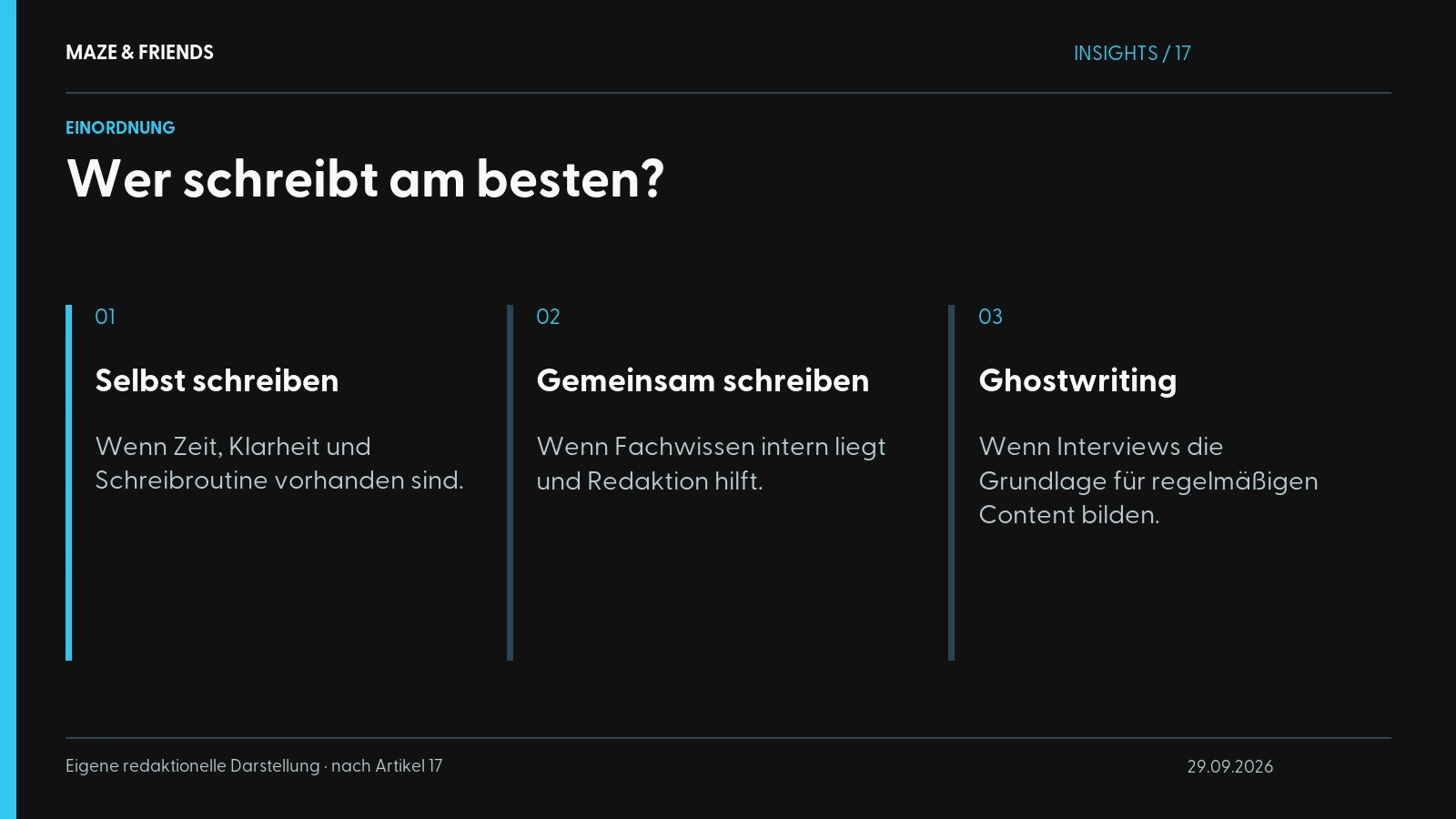
Write yourself if your personal voice is the actual product, for example as a creator, coach or solo founder whose brand is inseparable from the way you think. In that case, every outsourced post is a small loss of substance. Delegating is also premature if you are only just finding out what you stand for.
These situations clearly argue for doing it yourself:
- Your opinion is the brand. If people follow you because you think and write the way you do, no ghostwriter can deliver that one to one. The tone gets diluted, and attentive readers notice.
- You haven’t found your positioning yet. As long as you are not clear yourself about what you stand for, nobody can put it into words for you. Experiment first, then delegate. Our guide to building a brand as a founder helps you with exactly this first step.
- Your budget is tight and you have the time. In the early phase, time is often what you have most of. Then writing yourself is the cheapest investment in your craft.
- You want to learn the craft yourself. Anyone who writes consistently for a year understands their audience more deeply than any external author. That understanding pays off later, too.
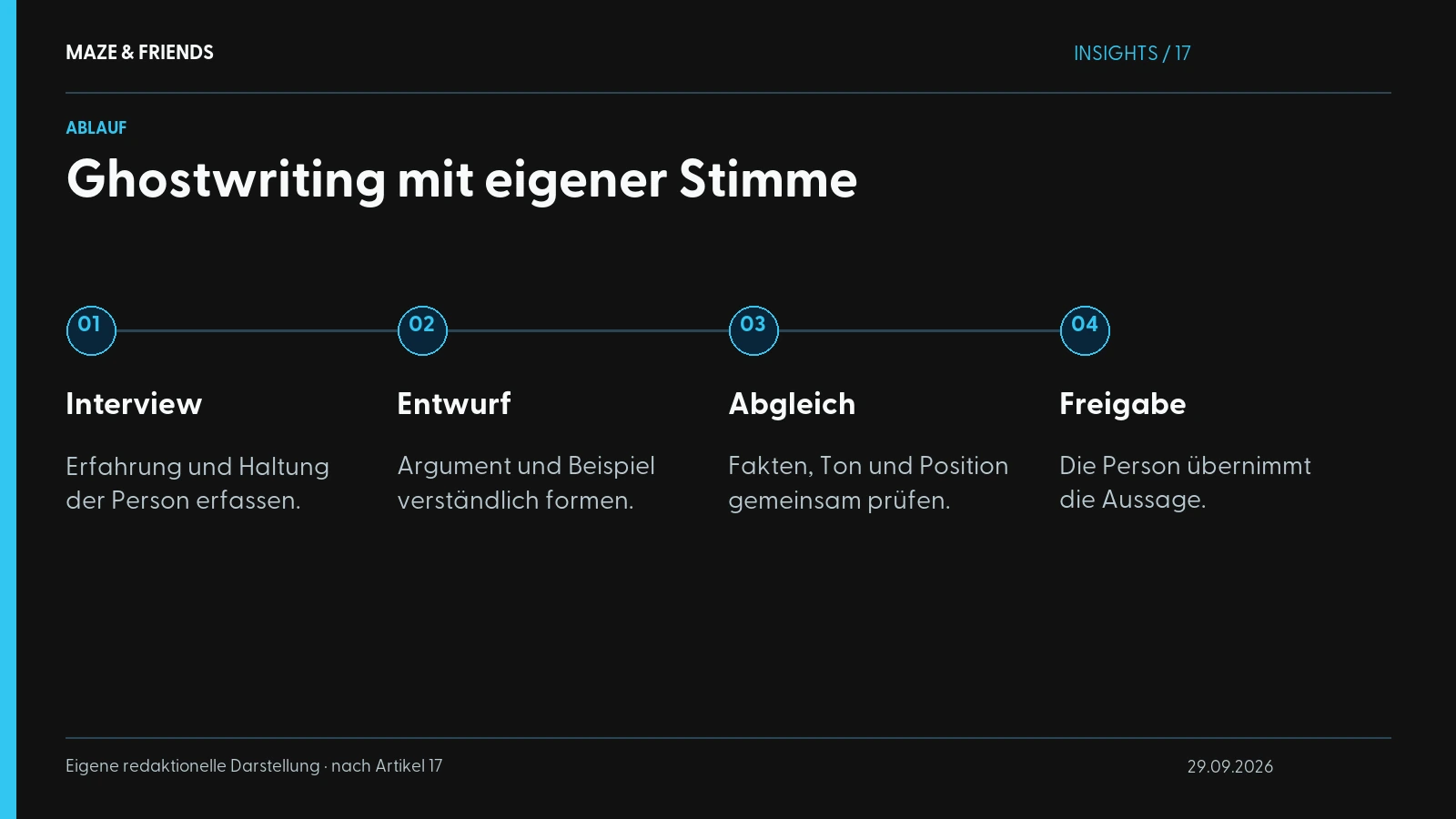
There is a sensible middle way that we often recommend: the hybrid model. Each week, you deliver your raw thoughts, opinions and anecdotes in a short call or a voice message. The ghostwriter shapes them into posts, and you approve them. Your voice stays intact while the time-consuming craft is outsourced: structure, hook, polishing and the content calendar. For most busy founders, this is the best compromise between authenticity and efficiency.
An honest rule of thumb
Ask yourself: If a client read one of my posts aloud, would they recognise me in it? If the answer is “absolutely, that’s pure me”, write yourself or work in hybrid mode. If it is “the content matters, not the exact wording”, ghostwriting is a sound decision. There is no right or wrong here, only what works for your brand.

How do you find a good ghostwriter?
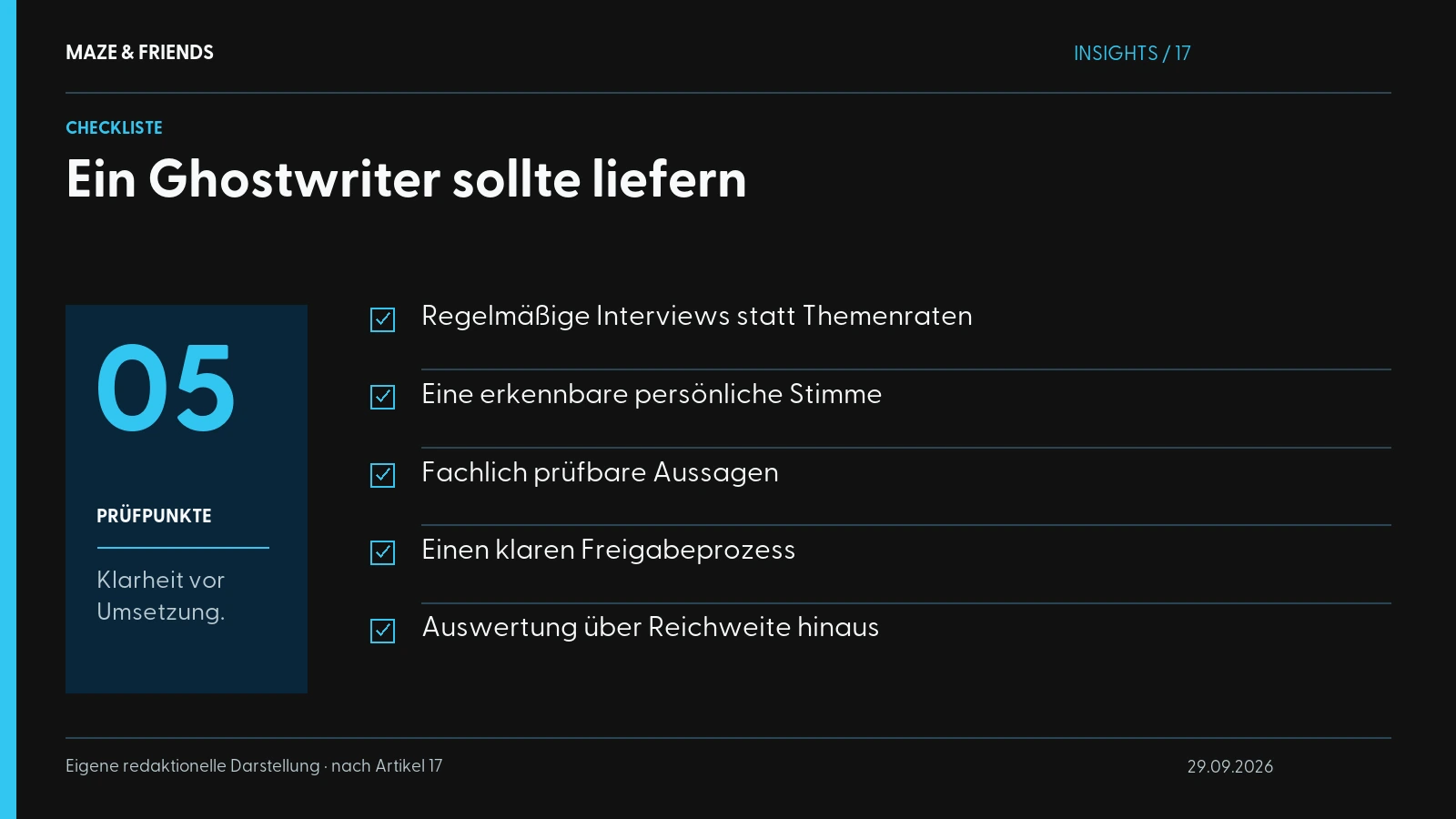
Once you decide to outsource, your choice decides between success and money lost. Check these points before you sign a contract:
- Real reference profiles. Ask to see active client profiles, not just screenshots. Does the content read like a person or like a template?
- The method for capturing your voice. How does the ghostwriter capture your tone? Are there structured interviews? Without this step, you get one-size-fits-all mush.
- Use of AI. As a tool, AI is perfectly fine; as a substitute for thinking, it is a warning sign. Ask specifically where the line is drawn.
- Approval. You should see every post before it is published. Anything else is a risk to your reputation.
- Strategy or just text? Do you get positioning and a content calendar, or only running text? The impact depends on it.
- Contract and exit. Short notice periods and a trial month are a good sign. Long, restrictive contracts are a bad one.
One last piece of advice from practice: start small. A paid trial month tells you more than any sales pitch. If the collaboration works, you scale up. If it doesn’t, you haven’t lost much.
Write yourself, go hybrid or outsource
Whether you write yourself, work in hybrid mode or outsource completely is not a gut decision. It depends on your positioning, your time budget and your business model. That is exactly what we like to talk about before anyone signs a contract.
Maze & Friends builds personal brands for founders and B2B decision-makers in the DACH region. If you want to know which route makes financial sense for you, book a no-obligation discovery call. If it is a fit, you then get a fixed-price quote for exactly your setup.
From the studio: Milan Milic: personal branding · Maze & Friends as its own client: SEO blog and case studies.
Frequently asked questions
What is a LinkedIn ghostwriter?
A LinkedIn ghostwriter writes posts for your profile under your name, in your voice and on your topics, while remaining invisible themselves.
To the outside world, you are the one posting, which is what distinguishes a ghostwriter from a content editor writing under their own name. Good ghostwriters deliver far more than nice sentences: they sharpen your positioning and two or three core topics with you, pull knowledge and opinions out of your head in regular interviews, build structure and the opening, meaning the first two lines that decide reach, and stick to a content calendar. The real value lies in the work before the writing.
What does LinkedIn ghostwriting cost per month in the DACH region?
What LinkedIn ghostwriting costs per month depends mainly on the share of strategy, the depth of formats and your own time commitment.
As orientation, not as a price list: freelancers who mainly write from your raw material form the lower end. Experienced solo ghostwriters with interviews, strategy and a content calendar sit above them, and personal branding agencies with positioning, design, reporting and video where needed sit at the top end. There is hardly any upper limit, while the bottom end gets risky: lots of posts for conspicuously little money are very likely generic AI output. At Maze & Friends, you get the specific monthly price as a fixed-price quote after the initial call.
What does a single LinkedIn post from a ghostwriter cost?
A single post, as a trial or get-to-know-you assignment, is the smallest entry point on the market and is usually billed as a flat fee per post.
A single post is a good way to get to know tone and way of working, but says little about impact. Personal brands are built through regular presence over months. So measure the price against the value of a single new client that your visibility brings in over twelve months, rather than against “cost per post”. For many B2B service providers, one new client covers the annual budget. A paid trial month tells you more than a single post.
Why do prices for LinkedIn ghostwriting vary so much?
Prices vary because the market is young and opaque: anyone can call themselves a “ghostwriter”, from a student with an AI subscription to an agency.
Three cost drivers explain the differences: the share of strategy, meaning whether positioning and audience work are included; the depth of formats, meaning whether carousels, graphics or video editing are produced alongside text; and how involved you need to be. Less of your time often means a higher price, but less friction. Because price alone says little, always ask for real reference profiles, how their reach has developed and the specific way of working. Anyone who can’t show real examples usually doesn’t have any.
Who is a LinkedIn ghostwriter worth it for?
A ghostwriter is worth it if your knowledge has market value, your time is more expensive than outsourcing and you lack the writing craft or the discipline.
Typical cases are founders and managing directors with a high hourly rate, specialists with deep knowledge but little writing practice, and anyone whose business rests on trust, such as consulting, agencies, software or coaching. If one of the three conditions is missing, the calculation tips over. You can realistically expect more qualified profile visits, more conversations in your direct messages and a profile that warms up sales conversations. Viral posts at the push of a button or leads in week one are not something to expect.
Should I hire a ghostwriter or write myself?
Write yourself if your voice is the product or you are still looking for your positioning; outsource if the content matters more than the exact wording.
An honest rule of thumb: if a client read one of your posts aloud, would they recognise you in it? If the answer is “absolutely, that’s pure me”, write yourself or work in hybrid mode. Writing yourself also suits you if your budget is tight and you have the time, or if you want to learn the craft. Anyone who writes consistently for a year understands their audience more deeply than any external author. Experiment first, then delegate.
What is the hybrid model in LinkedIn ghostwriting?
In the hybrid model, you deliver raw thoughts each week by call or voice message, the ghostwriter shapes them into posts, and you approve them.
Your voice stays intact while the time-consuming craft is outsourced: structure, opening, polishing and the content calendar. For most busy founders, this is the best compromise between authenticity and efficiency. What matters is that you deliver your raw thoughts regularly. If they don’t come, the ghostwriter has to guess, and that is exactly when the smooth, interchangeable posts appear that harm your brand.
Can people tell when a ghostwriter is behind a profile?
With poor ghostwriters, yes; with good ones, no. Anyone who works with structured interviews and hits your tone precisely makes the handover invisible.
Interchangeable, overly smooth content stands out to attentive readers, especially when the same formulas and phrases appear as in many other profiles. The difference lies in the way your voice is captured: regular conversations, your examples, your wording. It also helps if you see every post before it is published and change passages that don’t sound like you. If someone asks you about a post, you should be able to stand behind it without rereading it.
Is LinkedIn ghostwriting dishonest?
No, as long as the content, opinions and experience come from you and you approve every post; then the ghostwriter turns your thoughts into well-crafted text.
In business, help with writing has always been common, for example with speeches, specialist articles or interviews with executives. It becomes delicate when posts claim experiences or opinions you don’t have, or when nobody knows any more what you actually stand for. Then the brand collapses at the first probing question, and LinkedIn’s Professional Community Policies (in German) explicitly prohibit misleading information about qualifications and work experience. If someone asks you directly whether you have help, answer honestly. It costs you nothing if the substance comes from you.
Can’t I just write LinkedIn posts with AI?
AI helps with structuring and wording, but replaces neither your opinion nor your experience; raw AI text produces generic posts without a point of view that sink without trace on LinkedIn.
Use AI as a tool, for example for outlines, variations of an opening line or shortening a draft. The substance has to come from you: your projects, your mistakes, your judgement. The same applies to ghostwriters. As a tool, AI is fine; as a substitute for thinking, it is a warning sign. So ask specifically where the line is drawn. Offers with lots of posts for very little money are almost always generic AI output.
How long does it take for ghostwriting to pay off?
Expect several months: in the first weeks you usually see more profile visits and first conversations, while noticeable business effects take a few months of continuous work.
Personal brands grow through consistent presence; individual viral posts change little about that. This is exactly where a ghostwriter’s advantage lies: they keep the rhythm going even when your quarter is on fire, and prevent the typical pattern of three weeks of enthusiasm followed by radio silence. Anyone promising you quick virality is selling you a lottery ticket. So in the trial month, judge mainly tone and reliability, and the business result only after a period in which regular presence can take effect.
How do I recognise a good LinkedIn ghostwriter?
You recognise a good ghostwriter by real reference profiles, a clear method for capturing your voice and the fact that you approve every post before it is published.
- Active client profiles instead of screenshots
- Structured interviews to capture your tone
- A clear line on the use of AI
- Positioning and a content calendar instead of running text alone
- Short notice periods and a trial month instead of a restrictive contract
Start small: a paid trial month tells you more than any sales pitch. If the collaboration works, you scale up; if it doesn’t, you haven’t lost much.
What is the difference between a freelance ghostwriter and a personal branding agency?
A freelancer usually writes alone and more cheaply, often without in-depth strategy; a personal branding agency brings a team for positioning, copy, design and reporting from one source.
The freelancer suits you if your positioning is set and you mainly need reliable text production. The agency costs more but delivers more structure and reliability, for example when graphics, carousels or video are added or when ambitious goals are involved. In between are experienced solo ghostwriters with interviews and a content calendar. More important than the type of business is whether strategy and voice are worked out properly. Maze & Friends works as an agency for the personal brands of founders and B2B decision-makers in the DACH region.
How much time do I need to invest if a ghostwriter writes for me?
Depending on the model, expect a short weekly call or a voice message plus approvals; how much time you contribute is one of the three cost drivers.
Some ghostwriters need half an hour of your time each week, others pull a lot themselves from calls and notes. Less of your time often means a higher price, but less friction. It can’t work entirely without you: positioning, opinions and experience have to come from you, and you should see every post before it is published. Also plan time for replying to comments, because nobody can credibly take conversations under your posts off your hands.
What is the 4-1-1 rule on LinkedIn?
The 4-1-1 rule is a rule of thumb for your content mix: for every four posts that offer value to your audience, there is one subtly promotional post and one directly promotional post.
Value posts include your own analysis, practical knowledge or other people’s expert content that you share. The rule is not a LinkedIn law, and the exact interpretation varies by source. For personal brands in B2B, though, the basic idea holds: mostly substance, rarely selling. A good ghostwriter plans this mix deliberately in the content calendar so your profile builds trust instead of looking like an advertising channel. A clear invitation to talk to you about specific topics still belongs in the mix.
Next step
Want to know which of this fits your company? We will work it out together in 30 minutes. Free and without obligation.
Pick a time
Manuel Zellnig has been building visibility for companies since 2018: brand film, personal branding, performance marketing and AI visibility. Qualified advertising specialist (Werbeakademie Wien), Bachelor in Business Management (Carinthia University of Applied Sciences), author of the book ‘Mobile Apps zur Messung der Kundenzufriedenheit’ (2017, in German) and creative expert for the Austrian Economic Chamber (WKO) in two transformation guides. He measures before he recommends and writes here about what actually works in projects.
Publications and interviews: WKO transformation guide for printers (in German) · WKO transformation guide for florists (in German) · Interview with Ghezzo (in German) · ‘Heute’ on Viennese start-ups (in German)