


How to build a brand as a founder
Building a brand as a founder: from target group and positioning to visibility, in the right order and without expensive detours along the way.
In short: For a founder, building a brand does not mean settling on a logo and a few colours. It means claiming a clear position in the minds of your target group. You decide for whom you are the first choice, what you stand for and what sets you apart. Positioning comes first, visibility second. Maze & Friends from Vienna works with founders in exactly this order.
You have a product, a service, perhaps your first customers, and still nobody quite knows what you actually stand for. People mix you up with others, you explain yourself afresh in every conversation, and when someone asks “So what do you actually do?”, you hear yourself stumbling over the answer.
In almost every case, there is a positioning problem behind it. You can solve it without signing an expensive rebranding invoice or spending three months polishing a purpose statement that nobody reads in the end.
This is the path Maze & Friends takes with founders and personal brands in the DACH region (Germany, Austria and Switzerland), in the right order.
How do I build my own brand as a founder?
It starts with a misunderstanding that most people pay dearly for. A brand is what other people think about you when you are not in the room. What you say about yourself counts for less than you would hope.
That sounds trivial, but it has an uncomfortable consequence: you cannot invent a brand. You can only set the conditions and then deliver consistently until a clear picture settles in the minds of your target group. Brand building is therefore more a discipline than a design project: the same message, the same attitude, for months, at every touchpoint.
For you as a founder, that means three levels that have to fit together:
- The person (personal brand): at the start, you are the most credible brand you have. People buy from people, especially when an offer needs explaining.
- The offer: what people pay you for, and why you in particular.
- The company: the framework that holds both and that should one day work without you.
At the start these three levels blend into one another, and that is a good thing. It would be a mistake to build an anonymous company brand straight away while nobody knows you. Your face, your opinions and your experience are your biggest head start. Use it.
In what order do you build a brand?
The most common waste of money and time happens because founders start with the visible (logo, website, Instagram) instead of the invisible (position, message, target group). The order that really holds up is the reverse:
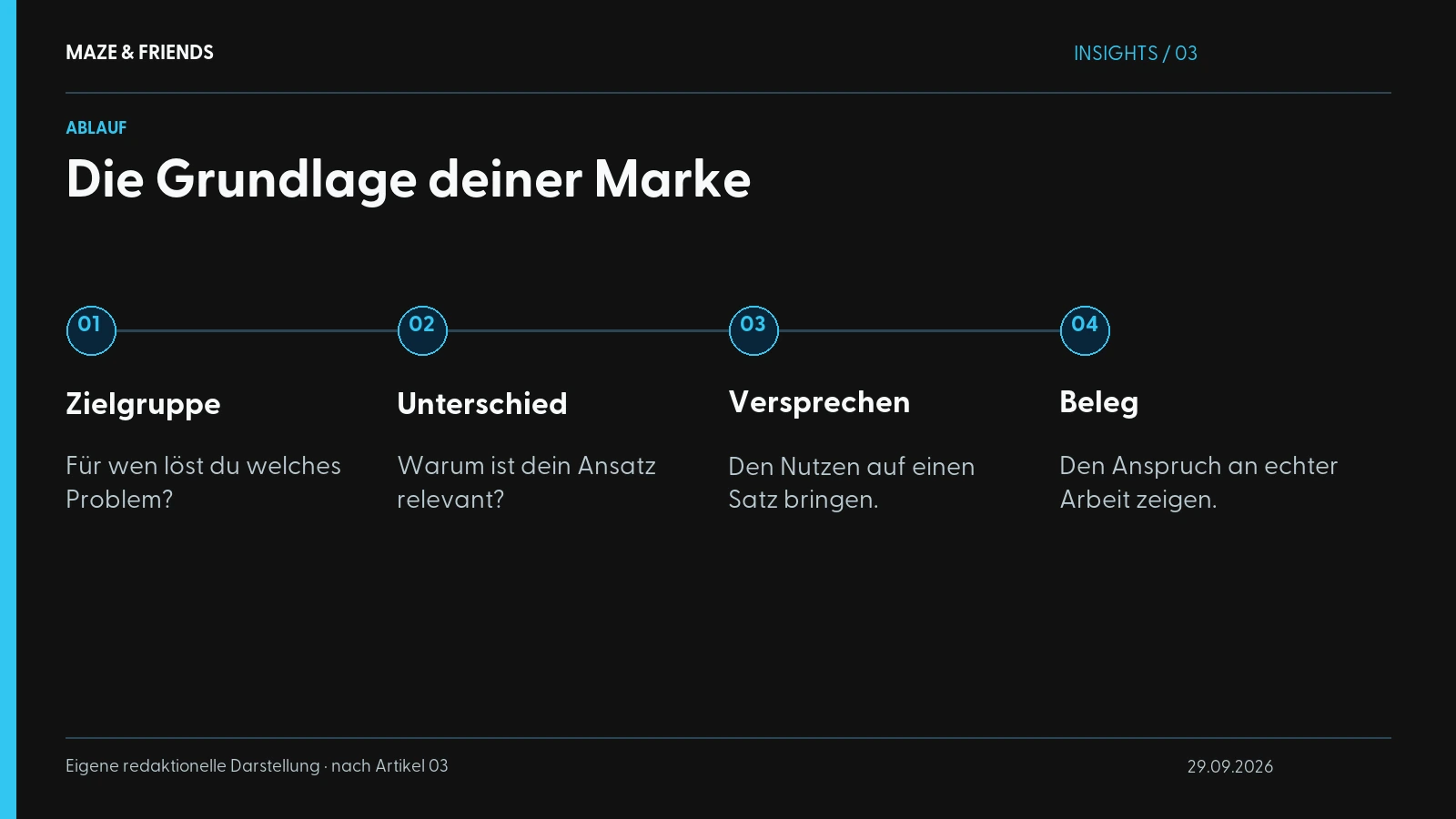
- Sharpen your target group: for whom are you indispensable? And for whom, deliberately, not?
- Define your positioning: which place do you occupy that nobody else occupies in the same way?
- Formulate your core message: one sentence that people understand and remember.
- Visual identity: logo, colours, typography, and only now, as an expression of the strategy rather than a substitute for it.
- Channels & visibility: LinkedIn, website, content. They amplify what comes before them.
If you start at step 4, you are building a beautiful house on sand. If you begin at step 1, you can even afford step 4 more cheaply later, because the brief is clear.

How do you build a brand? The path from zero to clear positioning
Brand positioning is the decision about which one place you want to occupy in the minds of your target group. It means the clearest place for one very specific problem of one very specific group, and rarely the place of the best or the cheapest.
The mistake many founders make: they want to appeal to as many people as possible and end up indispensable to nobody. Positioning means giving things up. You gain sharpness by deliberately leaving things out.
1. Get radically specific about your target group
“Small and medium-sized businesses” is not a target group. It is a phone book. A target group you can work with sounds more like this: “Founders of B2B SaaS companies in the DACH region who are hiring their first salesperson and realising that their story does not land.”
Ask yourself:
- Who has the problem I solve most urgently?
- Who can and wants to pay for it?
- Who do I enjoy working with and repeatedly do good work for?
Your starting point lies where these three overlap. The narrower, the better at the beginning. Narrow positioning does not exclude anyone who comes along later. It simply attracts the right people first.
2. Find your angle
Now for the most important question: why you and not someone else? Your angle usually comes from the combination of experience, attitude and approach. Others have the offer itself too.
Useful ways to find your angle:
- The enemy: what are you against? Which common practice in your industry do you think is wrong? A clear opinion is positioning in its purest form.
- The proof: what have you been through or achieved that makes you credible? Lived experience beats any claim.
- The method: do you have your own way of solving a problem? Give it a name and make it tangible.
An example from our own practice: Maze & Friends deliberately positions itself against the classic split between consulting and execution. The claim “Consulting that also delivers” puts exactly such an angle into words. It says immediately what we are against, namely slide decks without results, and what you get from us.
3. Put it into one sentence
If your positioning is right, you can say it in one sentence a twelve-year-old would understand. A proven pattern:
I help [target group] [achieve a result] by [your approach / angle].
If this sentence takes you three attempts and lots of commas, your positioning is not finished yet. The sentence is the litmus test.
What does brand building involve? The building blocks at a glance
Brand building covers everything that shapes the image of your brand in the minds of your target group: strategic foundations, the visible presence and consistency over time. Here are the building blocks, sorted by importance for the start:
| Building block | What it is | How important at the start |
|---|---|---|
| Positioning | Your place in the minds of your target group | The foundation without which nothing holds |
| Core message | Your sentence, your three key statements | Very high |
| Personal brand | You as a visible, tangible person | Very high for offers that need explaining |
| Visual identity | Logo, colours, typography, imagery | Medium, follows from the strategy |
| Website | Your central stage, under your control | High, but start lean |
| Content & channels | LinkedIn, blog, newsletter | High as an amplifier, not as a substitute |
| Consistency | The same message, everywhere, every time | Very high, constantly underestimated |
Two things that belong on any such list and are still often overlooked:
Clean tracking. It sounds unromantic, but it is the difference between “I think this works” and “I know this works”. If you do not measure which message, which channel and which content actually brings in customers, you are flying blind. Especially as a founder on a tight budget, clarity about your data is the basis of every decision.

Your own time. Brand building is not a project with an end date. It is a muscle you train regularly. Over a longer period, a few good, honest LinkedIn posts beat any glossy campaign that fizzles out after two weeks.
Personal branding as the fastest lever for founders
If you want to build a brand on your own right now, your own person is usually the cheapest and fastest channel. Personal branding has little to do with self-promotion. It makes your knowledge and your attitude visible enough that the right people start associating you with a topic.
Specifically for the DACH market, where LinkedIn is the central stage in B2B:
- Own one topic. Post about the one thing you want to be associated with, instead of about everything. Repetition creates recall.
- Opinion before summary. Nobody needs the three-thousandth summary of a trend. People remember those who take a position.
- Tell stories from practice. Concrete situations, real lessons, mistakes included. That is credible, and nobody can copy it.
- Show your face. People follow people. With a company logo as your profile picture, you give away trust at the start.
We have described in more detail how to build a personal brand that pays off with decision-makers in particular in our article on personal branding for B2B decision-makers. The principle stays the same: first know what you stand for, then get loud.

What are the most common mistakes in brand building?
These are the patterns we come across most often with founders:
- Starting with the logo. Design without strategy is decoration. Pretty, but interchangeable.
- Wanting to please everyone. If you are there for everyone, nobody remembers you. Breadth is the enemy of a brand.
- Taking yourself too seriously. At the start, perfectionism is the number one brake on visibility. Better visible and honest than perfect and silent.
- Channels before message. Five channels with an unclear message are worse than one channel with a clear one.
- Inconsistency. Changing your positioning every three months destroys exactly what brand building is meant to achieve: recall.
- Not measuring. Without data you never know what works, and you optimise by gut feeling.
Knowing these patterns saves you the most expensive detours and sharpens your position against the competition, instead of just describing yourself nicely.
Clarity first, then visibility
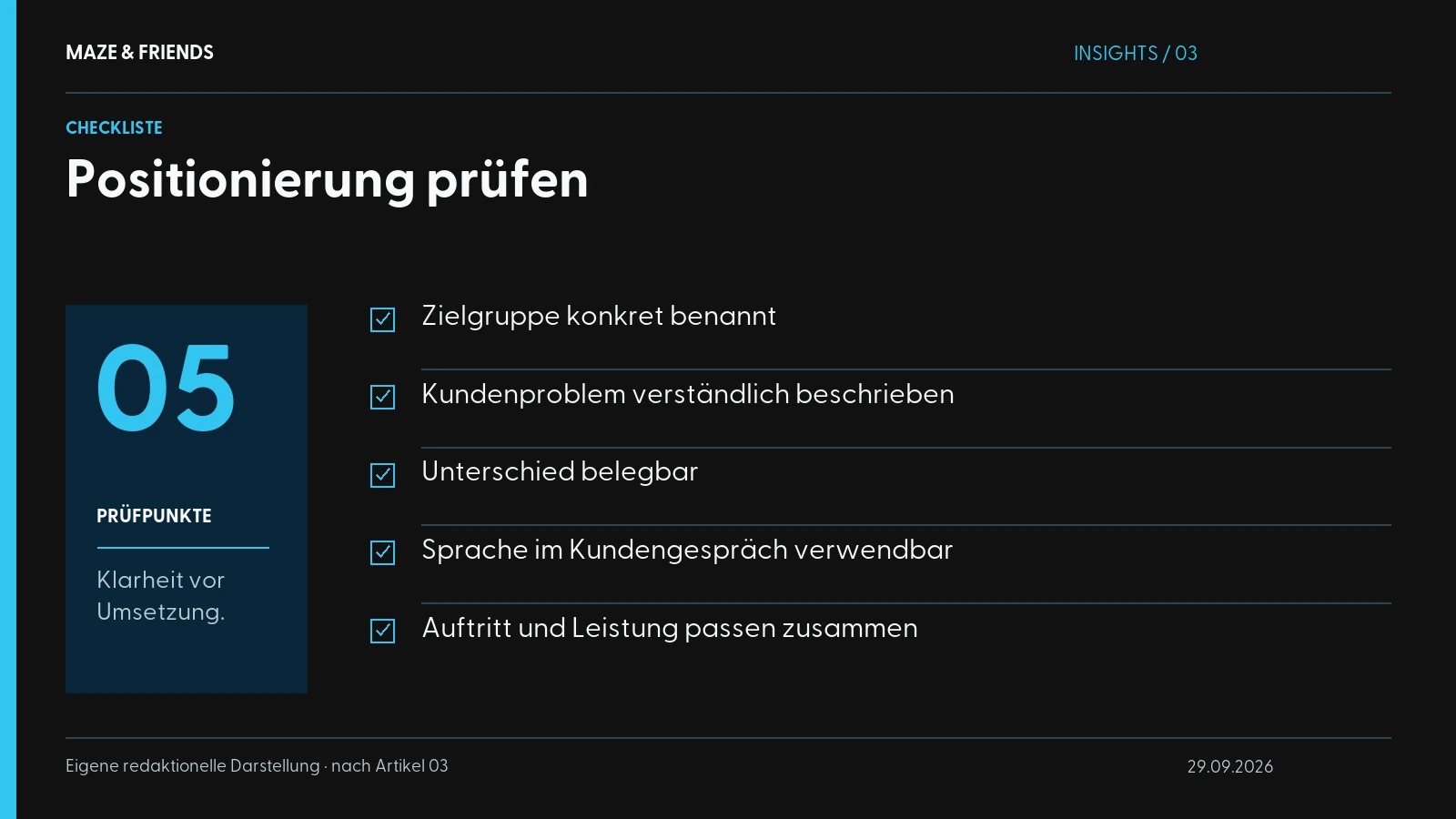
To build a brand as a founder, you need clarity and stamina in the right order, not secret knowledge. If you think your positioning through honestly, everything after it gets easier: the website almost writes itself, your content has a direction, and you no longer stumble over the question “So what do you actually do?”.
You can read how this works for decision-makers in particular in Personal branding for B2B decision-makers. Take an hour, write down your one sentence and see whether it passes the litmus test. That is the first real step. If you want an outside view along the way, Maze & Friends will sharpen your positioning with you in an initial call.
From the studio: AHOM Retreats: brand and social ads · 79degrees: branding and brand films.
Why visibility decides the success of young companies was already a topic in 2021, when Manuel Zellnig was quoted in the Austrian daily “Heute” on Viennese start-ups (in German).
Frequently asked questions
How can you build a brand?
As a founder, you build a brand from the invisible to the visible: first target group, positioning and core message, then visual identity and finally channels and visibility.
- Sharpen your target group: for whom are you indispensable, and for whom deliberately not?
- Define your positioning: which place do only you occupy?
- Formulate your core message: one sentence that people understand and remember
- Visual identity: logo, colours and typography as an expression of the strategy
- Channels: LinkedIn, website and content as amplifiers
If you start with the logo, you are building a beautiful house on sand.
What is the difference between a personal brand and a company brand?
Your personal brand is your visible person, with knowledge, attitude and a face; the company brand is the framework that should one day work without you.
Between the two lies the offer: what people pay you for, and why you in particular. At the start these three levels blend into one another, and that is a good thing. People buy from people, especially when an offer needs explaining, which is why a personal brand builds trust faster than an anonymous company brand. The mistake would be to build a brand without a face straight away, while nobody knows you yet. Later, you gradually transfer the substance into the company brand.
What is a brand strategy?
A brand strategy defines whom your brand is for, which place it occupies in the minds of your target group and what sets it apart.
Its core is positioning, complemented by your core message, your attitude and the rules that keep your presence consistent everywhere. Logo, website and content are derived from the strategy. A good brand strategy is above all about giving things up: you gain sharpness by deliberately leaving things out. Without it, every design and channel decision is a matter of taste; with it, each one can be justified.
What types of brand strategy are there?
The classic distinction is between an individual brand, a family brand and an umbrella brand: each product with its own brand, a product group under a shared brand, or all offers under the company’s name.
With an individual brand strategy, every product gets its own presence, which requires budget and attention for each brand separately. For founders with one core offer, that rarely makes sense. Usually an umbrella brand combined with your personal brand goes furthest, because trust and awareness are concentrated in one place. At the start, positioning matters more than brand architecture: only once it is clear what you stand for is it worth asking about further brands.
How do I find the right positioning for my brand?
Your positioning lies where three questions intersect: who has your problem most urgently, who pays for it, and who do you work well with?
Get radically specific here: “small and medium-sized businesses” is far too broad as a target group. Then look for your angle, in other words why you and not someone else. It usually comes from a clear counter-position to a common practice, from lived experience or from a method of your own. Narrow positioning does not exclude anyone who comes along later. It simply attracts the right people first.
Where exactly do I start with brand building?
Start with one sentence that says for whom you are indispensable: “I help [target group] [achieve a result] by [your approach].”
Use this sentence to test your positioning. If it takes three attempts and lots of commas, it is not finished yet. A twelve-year-old should understand it, and the person you are talking to should be able to pass it on. Take an hour for this before you think about logo, website or channels. Afterwards, the sentence becomes the touchstone for every decision, from website copy to LinkedIn posts.
How long does it take to build a brand?
Solid positioning is in place after a few weeks of focused work; for your brand to take root in the minds of your target group, think in months rather than weeks.
Brand building is never finished; you train it like a muscle. A few good, honest LinkedIn posts over a longer period beat any glossy campaign that fizzles out after two weeks. What matters is consistency: the same message and attitude for months at every touchpoint. If you change your positioning every three months, you destroy exactly the recall it is all about.
How much money do you need to build your own brand?
You need little money to get started, because positioning is thinking work; it gets expensive when you invest in design, ads or a website without a strategy.
The order decides the cost more than the budget does. If you begin with target group, positioning and core message, you can even afford the visual identity more cheaply later, because the brief is clear. Start your website lean and invest early in clean tracking, so you know which message and which channel bring in customers. Reworking things because the strategy was missing is the most expensive item. Thinking first and spending second saves the most.
Do I need to register or protect my brand as a founder?
It is not compulsory, but it is sensible: brand building shapes how your target group sees you, while registration protects your name or logo legally.
Before you invest heavily in a name, check whether it is available and can be protected. The responsible bodies are the Austrian Patent Office in Austria, the German Patent and Trade Mark Office (DPMA) in Germany and the European Union Intellectual Property Office (EUIPO) for the whole EU. Which countries, classes and costs make sense for you is best clarified there or with a specialist law firm. A legal check does not replace positioning, and vice versa.
What are examples of brand values?
Typical brand values are honesty, reliability, pragmatism, courage or closeness; but they only become strong when they describe concretely how you act and what you forgo.
Everyone signs up to “quality” or “customer focus”, which is why they do not set anyone apart. A useful value has a price: honesty can mean advising a client against a project, even if you would earn money from it. A clear stance against a common practice in your industry is often the strongest value, because it shows immediately what you stand for. At Maze & Friends, the stance “Consulting that also delivers” works in exactly this way, because it is directed against slide decks without results.
Which building blocks matter most at the start of brand building?
At the start, positioning, core message and your personal brand count most; visual identity, website and channels follow from them and amplify them.
Positioning is the foundation without which nothing holds. Core message and personal brand have very high priority, especially for offers that need explaining. The website matters, but should start lean; content and channels act as amplifiers, not as substitutes. Two building blocks are almost always underestimated: consistency, meaning the same message everywhere, and clean tracking. Without data, you do not know which message and which channel actually bring in customers.
What are the most common mistakes founders make in brand building?
The most common mistakes founders make are starting with the logo instead of the strategy and wanting to please everyone; both make the brand interchangeable.
Add to that perfectionism that keeps you invisible, too many channels with an unclear message and constant changes of positioning that destroy any recall. Another expensive mistake is not measuring and optimising by gut feeling. The remedies are simple but uncomfortable: a narrow target group, one clear sentence, one channel you use consistently, and data instead of assumptions. Better visible and honest than perfect and silent.
Do I need an agency to build a brand as a founder?
No, not necessarily: you should do the core work on positioning and message yourself, because nobody knows your offer better than you do.
An agency is worthwhile if you need speed, an outside view of your blind spots or clean execution of website, content and tracking. Even then, the thinking stays with you; the agency asks the uncomfortable questions and does the implementation. While you are still testing your offer, invest time in conversations with customers rather than money in an elaborate design. Larger budgets pay off once your positioning has passed the test of practice.
How do I measure whether my brand building is working?
Your brand building is working when people recommend you for your topic and enquiries arrive with a clear expectation that matches your positioning.
Watch for qualitative signals: do prospects ask specifically about what you want to stand for? Do you have to explain yourself less in the initial call? Add figures from clean tracking on your website and channels, so you can see which message, which channel and which content actually bring in customers. Reach alone is not success if the wrong people are watching. Especially on a tight budget, this clarity about your data is the basis of every decision.
Why is personal branding the fastest lever for founders?
For founders, personal branding is usually the fastest route to a brand, because people buy from people and a face builds trust faster.
It has little to do with self-promotion: you make your knowledge and your attitude visible enough that the right people associate you with a topic. In DACH B2B, LinkedIn is the central stage for this. Own one topic instead of posting about everything, take a position instead of summarising trends, tell stories from practice, mistakes included, and show your face. The order still matters: first know what you stand for, then get loud.
Next step
Want to know which of this fits your company? We will work it out together in 30 minutes. Free and without obligation.
Pick a time
Manuel Zellnig has been building visibility for companies since 2018: brand film, personal branding, performance marketing and AI visibility. Qualified advertising specialist (Werbeakademie Wien), Bachelor in Business Management (Carinthia University of Applied Sciences), author of the book ‘Mobile Apps zur Messung der Kundenzufriedenheit’ (2017, in German) and creative expert for the Austrian Economic Chamber (WKO) in two transformation guides. He measures before he recommends and writes here about what actually works in projects.
Publications and interviews: WKO transformation guide for printers (in German) · WKO transformation guide for florists (in German) · Interview with Ghezzo (in German) · ‘Heute’ on Viennese start-ups (in German)