


Winning clients as a service provider
Winning clients as a service provider means making trust visible: with proof, real case studies and clear offer logic for services nobody can touch.
In short: Winning clients as a service provider works differently from selling products: your service is invisible, and the client can’t test it before buying. So what you sell is not the service itself but the confidence that it works. The experience of Vienna-based Maze & Friends: verifiable proof, real case studies and offer logic that reduces the client’s risk have the strongest effect.
A furniture store puts its sofa in the showroom; the customer sits down, feels the fabric, sees the colour. A software company gives you a free trial account. You, on the other hand, sell strategy, advice, concepts and support, things that only exist once the client has already paid. Before they hold anything in their hands, they have to believe you.
This is the core of marketing for service providers: you ask people to spend money on a promise. No wonder winning clients feels like hard going for many consultants, agencies and self-employed service providers. The prospect is sceptical, compares and hesitates, usually because they can’t gauge the risk and rarely because of your offer. That risk can be reduced systematically, and this article shows you how.
Why is winning clients harder for service providers than for products?
Because your service is a credence good. Economics distinguishes three kinds of offers, and the difference explains your entire marketing problem:
- Search goods can be checked before purchase. A laptop, a car, a pair of shoes: look, touch, compare, decide.
- Experience goods can only be judged after use. A meal at a restaurant, a hotel stay, a haircut.
- Credence goods are hard to assess objectively even after purchase. Tax advice, management consulting, marketing, coaching, many health and trade services.
Most services sit somewhere between experience goods and credence goods. Before buying, the client doesn’t know what they will get, and often not even afterwards whether they got the best. So they decide on the signals that point to the quality of the service. Those signals are your marketing.
That is also one reason why personal recommendations still carry so much weight for service providers in the DACH region (Germany, Austria, Switzerland). A recommendation replaces the missing test signal with the judgement of someone the prospect already trusts. Your task is to produce this proof of trust yourself instead of leaving it to chance.

What does “selling trust” mean in practice?
Selling trust means reducing the client’s perceived uncertainty to the point where choosing you feels safe. Neither the lowest price nor the loudest presence achieves that.
Every prospect has three questions running in the back of their mind:
- Can they actually do this? (competence)
- Have they done it before for someone like me? (relevance and proof)
- What happens if it goes wrong? (risk)
Good marketing for service providers answers all three before the client asks them out loud. The rest of this article is essentially the toolkit for doing so.

How do you make an invisible service visible?
By delivering proof instead of claims. The difference:
- A claim is anything you say about yourself. “We are experienced, reliable, creative.” It costs nothing and proves nothing, because every competitor writes the same.
- Proof is anything someone else, or a verifiable result, says about you.
Rule of thumb: for every claim about yourself, you need a piece of proof right next to it. “We deliver fast” is a claim. “Client X had their first campaign live in 14 days, here is what they said” is proof. Whenever you notice you are writing about yourself, stop and ask: who apart from me confirms this?

Which kinds of proof really convince?
Not all proof is equally strong. Here is the hierarchy, from weak to strong:
| Type of proof | Strength | Why |
|---|---|---|
| Self-description (“competent, reliable”) | weak | pure claim, not verifiable |
| Logos & certificates | medium | show the framework, not the result |
| Testimonial (quote) | medium | credible with name, photo, company |
| Named reference | strong | verifiable, “a case like mine” |
| Case study with figures | very strong | shows approach and result |
| Live demonstration (audit, analysis) | very strong | client experiences competence in advance |
| Third-party reviews & recommendations | very strong | independent, hard to fake |
Two things make proof strong: verifiability (name, figure, source) and similarity (the proof comes from a case that resembles the prospect’s own). An anonymous five-star quote convinces less than a named reference from the same industry and company size.
That is why the impact of your proof depends directly on your positioning: the more sharply you know who you work for, the better your proof fits. If you are unsure here, first work out how to sharpen your positioning. Without it, even the best case studies fizzle out.

How do you turn a project into a convincing case study?
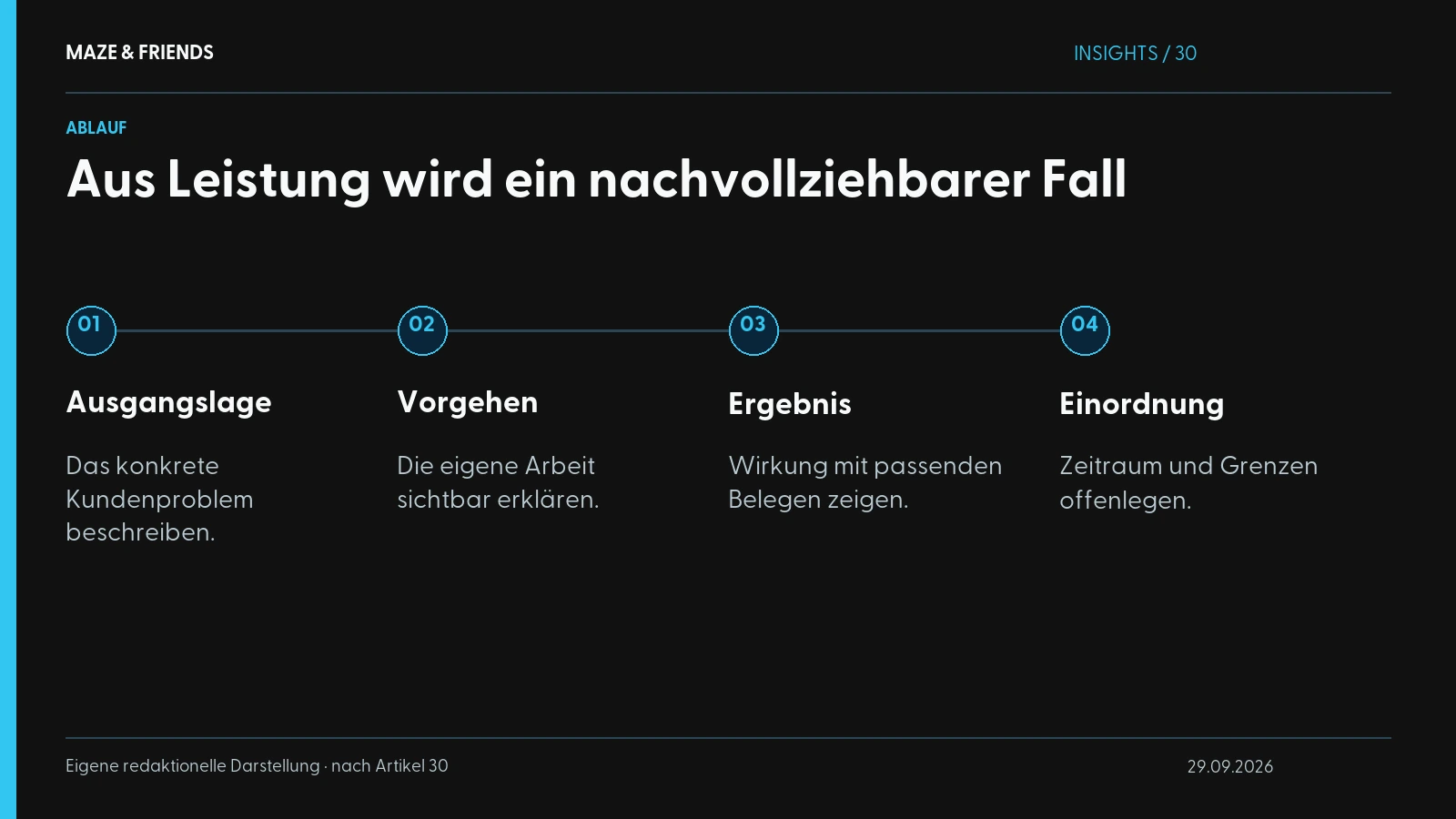
In marketing for service providers, the case study has the strongest effect, because it bundles competence, relevance and result into one story. A good case study follows five steps:
- Starting point: where was the client? What problem, what pressure? (So the reader recognises themselves.)
- Task: what specifically needed solving? Where was the real hurdle?
- Approach: what did you do, in what order, and why that way? (This shows how you think, often more convincing than the result itself.)
- Result: what came out of it? As concrete as possible: figures, time frame, before and after.
- Client voice: a real quote from the client, with name and role.
Two notes for the DACH region. First, many clients are not allowed or not willing to publish hard figures. Ask anyway, and offer to anonymise values (“mid six-figure revenue” instead of an exact number). Second, an honest case study with a difficulty that was overcome is more credible than the flawless success story nobody quite believes. More important than the format is that the figures and the client’s words are real and verifiable.
What should your offer look like so that it builds trust?
Trust also comes from the way your offer is built. Four levers help:
- A clear scope instead of “bespoke”. “Individual support” sounds nice but creates uncertainty. A clearly defined package that states what is included, what isn’t and what it costs comes across as more professional, because the client knows where they stand. The keyword: productised service.
- An entry offer with little risk. An audit, an analysis, a strategy workshop at a fixed price. With an offer like this, the client tests you on a small project before awarding the big one. For you, it is proof and sales conversation in one.
- Risk reversal. With services, “money back” is often difficult, but you can shift the risk in other ways: a clearly defined first stage with an exit point, a first result by a fixed date, transparent milestones.
- A visible process. When the client sees in advance how working together runs in steps 1, 2 and 3, vague “consulting” turns into a tangible process. That is the basic idea behind “consulting that also delivers”: showing that, and how, you implement what you recommend.
In marketing for consulting firms, this counts twice. It rarely fails for lack of competence, more often because the competence hasn’t been translated into a tangible offer that can be booked. The more abstract the service, the more concrete the packaging has to be.
How does lead generation work for service providers without going cap in hand?
Lead generation for service providers works best when it follows the same logic as everything else: proof before claims. Instead of asking cold “Do you want to work with us?”, you first deliver proof of your competence, and the enquiry comes almost by itself.
The most effective mechanics for winning clients as a consultant or service provider:
- Expert content that solves a real problem. Useful knowledge instead of advertising copy, as in this article, is the core of content marketing. People who watch you think and take something away from it trust you faster. It is also your SEO foundation.
- The entry offer as a lead magnet. The audit or analysis described above is also your best lead channel: a reason to get in touch that gives the client something straight away.
- A referral system instead of chance referrals. Ask satisfied clients actively and at the right moment, straight after a visible success. In the DACH region this is still one of the strongest channels, too strong to leave to chance.
- Visibility in front of the right audience. Talks, industry events, trade fairs, podcasts, LinkedIn. Especially in Vienna and among German-speaking mid-sized companies, personal networks often make the decision. The stage beats the ad.
- Targeted outbound with substance. If you approach people cold, do it with a specific observation or a benefit as the hook. A “We are an agency and …” won’t do.
One common thread runs through all of this: you win leads by delivering first. That turns the dynamic around, and the supplicant becomes the adviser.
What does building trust cost, and how long does it take?
It takes longer than you would like, and it costs mostly work rather than budget. Trust can’t be switched on like a channel; it is a stock you build up. In the advice-heavy DACH market with long decision paths, expect months rather than weeks before content, case studies and referrals take hold.
That is not bad news. It means the head start you build is hard to copy. A competitor can undercut your price, but can’t rebuild a dozen credible case studies and a network of satisfied clients overnight. That is exactly why trust is the most effective, if slowest, competitive advantage for service providers.
A realistic order if you are starting from zero:
- Sharpen your positioning (for whom, which problem).
- Turn two or three existing projects into case studies.
- Build an entry offer.
- Get expert content and a referral system running.
- Only then add paid reach on top.
Anyone who does step 5 first burns budget, because they send cold clicks to a page without proof.
Proof before claims
Winning clients as a service provider succeeds when you make the invisible visible: with verifiable proof, case studies from your target segment and an offer that keeps the client’s risk small. Paid reach only comes in once this foundation is in place.
You don’t have to build this system on your own. If you want to know where your biggest gap in trust and proof lies, whether in positioning, case studies, offer or lead generation, take a look at how Maze & Friends approaches marketing for service providers: strategy, content and performance from one team.
Or take the first step as recommended above: with a concrete analysis instead of a sales pitch. Tell us where your client acquisition is getting stuck, and we’ll work out in an initial call where the biggest lever is.
From the studio: car.acho: website, photos and videos · Optik Küssenpfennig: ads and content calendar. More about the service: performance marketing.
How traditional businesses can reset their positioning and client acquisition is also described in the transformation guides of the Austrian Economic Chamber (WKO), to which Manuel Zellnig contributed as a creative expert: transformation guide for print shops and transformation guide for florists (WKO, Kreativwirtschaft Austria, both in German).
Frequently asked questions
What does client acquisition mean?
Client acquisition covers every step a company takes to win new paying clients, from the first contact through building trust to the signed contract. The term is often used interchangeably with prospecting or winning new business; in the narrower sense, prospecting means actively approaching people.
For service providers, client acquisition has one particular feature: the service can’t be checked before purchase. So you sell less the service itself than the confidence that it works. Good client acquisition makes that confidence visible through proof, real references and a clear offer.
How can I win clients as a service provider?
As a service provider, you win clients by making trust visible: with proof, real case studies and an offer with little risk. Because your service is invisible before purchase, the prospect decides on signals: can they do it, have they done it before for someone like me, and what happens if it goes wrong?
The most effective routes are expert content that solves a real problem, an entry offer such as an audit, an active referral system, visibility on stage and on LinkedIn, and targeted outreach with genuine value for the recipient. The common thread: you deliver first instead of asking.
How can I win new clients quickly?
The fastest way to win new clients is through your existing network: actively ask satisfied clients for referrals and offer prospects a small entry package at a fixed price. Both use trust that already exists instead of having to build it from scratch.
But it is also clear that, for service providers, sustainable client acquisition takes months rather than weeks before content, case studies and referrals take hold. Paid ads bring clicks quickly, but those clicks fizzle out if your website shows no proof and no clear offer. Speed comes less from more advertising than from less uncertainty on the client’s side.
What are examples of client acquisition?
Typical examples of client acquisition for service providers are referrals, case studies, expert content, entry offers and appearances in front of the right audience. In practice, that can look like this:
- A fixed-price audit in which the client experiences your competence in advance
- A case study with starting point, approach, result and a quote from the client
- A targeted request for a referral straight after a visible project success
- A talk at an industry event or a podcast appearance
- Outreach with a specific observation as the hook instead of “We are an agency and …”
All of them deliver proof before you ask for the contract.
What does client acquisition cost service providers?
For service providers, client acquisition costs mainly work rather than budget: positioning, case studies, expert content and a referral system are built with time, and paid reach only comes later. How high the costs are in practice depends on how much you do yourself, which channels you use and how long your clients take to decide.
In the advice-heavy DACH market with long decision paths, expect months rather than weeks. The good news: the head start is hard to copy. A competitor can undercut your price, but can’t rebuild a dozen credible case studies and a network of satisfied clients overnight.
Why are services considered credence goods?
Many services count as credence goods because the client can’t check their quality before purchase and often can hardly judge it objectively even afterwards. Economics distinguishes three types: search goods such as a laptop can be checked beforehand, experience goods such as a hotel are judged after use, and credence goods such as tax advice, management consulting or marketing hardly at all.
Most services sit between experience goods and credence goods. So the client decides on signals that point to the quality of the service. Exactly these signals, meaning references, case studies, reviews and a clear process, are your marketing.
What convinces clients to hire a service provider?
Clients hire a service provider when the decision feels safe: visible competence, a similar case as proof and a manageable risk. Being cheap or loud doesn’t replace that sense of security.
The strongest effect comes from proof that is verifiable and comes from a similar case: case studies with figures, named references, third-party reviews and live demonstrations such as an analysis. Logos and certificates only show the framework, and self-descriptions such as “experienced and reliable” prove nothing at all. From the same industry and company size, a named reference convinces more than an anonymous five-star quote.
Which channel brings service providers the most clients?
For most service providers, the personal recommendation is the strongest channel. A recommendation replaces the missing test signal with the judgement of someone the prospect already trusts. Especially in Vienna and among German-speaking mid-sized companies, personal networks often make the decision.
The mistake is leaving referrals to chance. Ask satisfied clients actively and at the right moment, straight after a visible success, and turn every good project into a reference or case study that keeps working for you. Expert content, talks and LinkedIn complement referrals because they make you visible to people who don’t know you yet.
What belongs in a convincing case study?
A convincing case study tells how you solved a specific client problem, bundling competence, relevance and result into one story. The five building blocks:
- Starting point: where was the client, and what pressure were they under?
- Task: what specifically needed solving?
- Approach: what did you do, in what order, and why?
- Result: figures, time frame, before and after
- Client voice: a real quote with name and role
Three strong, verifiable case studies from your target segment beat ten superficial ones. If clients don’t want to show hard figures, offer to anonymise values, for example “mid six-figure revenue”.
What do I do if I don’t have any references yet?
Without references, you create your first proof differently: with a pilot project at a special price in exchange for an honest testimonial, a publicly documented analysis or a fully worked example. The way you think is proof too, because an audit or a well-founded assessment shows competence before you have your first big client.
Expert content that solves a real problem has a similar effect, because prospects watch you think. What matters is that every figure and every quote is real and verifiable. An honest case study with a difficulty that was overcome convinces more than a flawless success story nobody quite believes.
Do I need content marketing as a small service provider?
Yes, small service providers also benefit from content marketing, meaning useful expert content instead of advertising, but not in bulk. A few thorough pieces that solve a real problem for your target group are enough to have an effect; weekly posts without substance achieve less.
For service providers, expert content is doubly valuable: it proves competence, because readers watch you think, and it brings you, via search engines, to people who are actively looking for a solution. Good guides answer the questions clients ask before buying, openly and concretely. That is also your foundation for SEO, meaning being found on Google.
Is paid advertising worthwhile for service providers?
Paid advertising is worthwhile for service providers once the foundation of trust is in place, meaning your website, case studies and a clear offer deliver proof. Ads only amplify what is already there: if you send cold clicks to a page without signals of security, you pay for visitors who bounce.
A realistic order if you are starting from zero: sharpen your positioning, turn two or three existing projects into case studies, build an entry offer, get expert content and a referral system running, and only then add paid reach. Anyone who starts with advertising burns budget.
Why do fixed service packages create more trust than “individual support”?
Fixed service packages create more trust because the client knows in advance what is included, what isn’t and what it costs, while “individual” creates uncertainty. This is known as a productised service.
Further levers are an entry offer with little risk, such as a fixed-price audit or workshop, risk reversal through a first stage with an exit point, and a visible process in clear steps. This applies to consulting firms in particular, because they rarely fail for lack of competence and more often because of an offer that isn’t tangible and bookable. The more abstract the service, the more concrete the packaging has to be.
Why is positioning so important for winning clients?
Positioning determines how convincing your proof is: the more sharply you know whose problem you solve, the better your case studies, content and offer fit. A prospect looks for the case most similar to their own.
Without a clear target group, you collect one-off references that never quite fit anywhere, and even strong case studies fizzle out. With positioning, you can cover your most important client types with proof and align your content with their questions. That is why sharpening your positioning comes first, even before case studies, entry offer and advertising.
Which tips help service providers win clients?
The most important tip for winning clients as a service provider: put a piece of proof next to every claim about yourself, because every competitor writes “experienced, reliable, creative”. “We deliver fast” is a claim; “Client X had their first campaign live in 14 days”, with the client’s own words, is proof.
What also works: actively asking for referrals instead of waiting for chance, a clearly defined offer instead of “individual support”, a small entry offer at a fixed price, and cold outreach only with a concrete hook. Before case studies and offer are in place, paid advertising is the most expensive mistake.
Next step
Want to know which of this fits your company? We will work it out together in 30 minutes. Free and without obligation.
Pick a time
Manuel Zellnig has been building visibility for companies since 2018: brand film, personal branding, performance marketing and AI visibility. Qualified advertising specialist (Werbeakademie Wien), Bachelor in Business Management (Carinthia University of Applied Sciences), author of the book ‘Mobile Apps zur Messung der Kundenzufriedenheit’ (2017, in German) and creative expert for the Austrian Economic Chamber (WKO) in two transformation guides. He measures before he recommends and writes here about what actually works in projects.
Publications and interviews: WKO transformation guide for printers (in German) · WKO transformation guide for florists (in German) · Interview with Ghezzo (in German) · ‘Heute’ on Viennese start-ups (in German)