


The branding process in six phases
The branding process step by step: six phases from discovery to rollout, what each one delivers, what drives the cost and how to recognise good work.
In short: A branding process takes you from idea to finished brand in six phases: discovery, brand strategy, verbal identity, corporate design, brand guidelines and rollout. At the end you hold more than a pretty logo, namely a system that connects positioning, language and design. Vienna-based Maze & Friends works in exactly this order: strategy first, design second.
You have an offer that works, perhaps your first paying customers and revenue worth showing. Only the brand around it looks cobbled together: a logo that was made in a hurry, colours that look different on the website than on LinkedIn, a name nobody pronounces quite right in meetings. Add to that the quiet suspicion that this is costing you deals or applications right now.
It’s rarely a question of taste. It’s usually a question of order. A brand is built before anyone opens the design software, in the strategy. Knowing that spares you expensive loops and a result that starts to wobble again after six months.
This article walks through the complete process step by step: which phases there are, what lands on your desk at the end of each one and how to tell that the work is being done properly.
What is part of branding, and what isn’t?
First the terms, because they often get mixed up:
- Brand is the image that forms in your target audience’s minds – your reputation when you’re not in the room.
- Branding is the active work of shaping that image deliberately, step by step, in a fixed order.
- Corporate design is the visible part of it: logo, colours, typeface, imagery.
- Brand development (in German “Markenentwicklung”) is the umbrella term for exactly this kind of build from the ground up.
What explicitly does not count is quickly ordering a logo. A logo sits at the end of a chain of decisions. Starting with the look is like building a house from the roof down. That’s why good branding follows a fixed order, which we’ll look at now.

How long does brand development take?
Realistically, a complete brand development takes four to twelve weeks, depending on scope. A focused founder branding project moves faster; a B2B project with several decision-makers, naming and a broad rollout takes longer.
What eats up the most time is rarely the creative work. It’s usually the coordination. How quickly does your team make decisions internally? That’s why it pays to agree from the outset who signs off – ideally a small group that can actually decide, rather than a committee in which every colour becomes a debate of principle.

How does a branding process work?
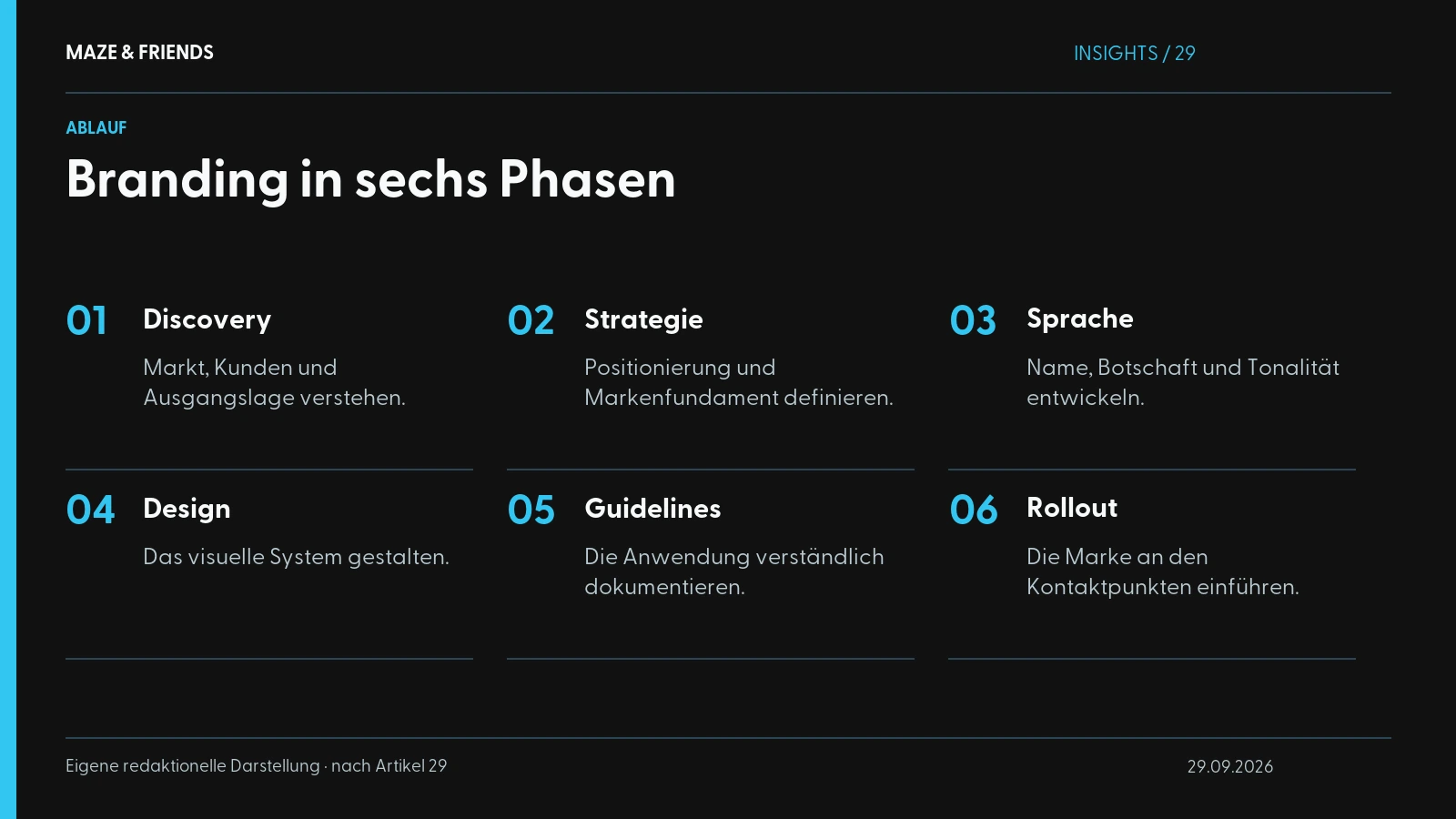
In a good process, each phase lays the groundwork for the next. These are the six stages from idea to living brand.
1. Discovery: understand before you design
Before anyone thinks about colours, there’s listening. The discovery phase is about genuinely understanding your business: what do you sell, to whom, and why do people buy from you of all companies? Typical building blocks are a kick-off workshop, interviews with the founders and, especially valuable in B2B, with existing customers, plus a sober analysis of the competition and the market environment.
The goal is to find blind spots, not to confirm your opinion. Often it turns out here that people value you for something quite different from what you think. The result is a condensed briefing: insights, open questions and a shared understanding of the starting point. Skip this step and from here on you’re only guessing.
2. Brand strategy: the foundation
The brand strategy is the foundation on which language and design are built later. This is where you define what your brand stands for and what sets it apart. Key elements:
- Positioning: your place in the market, in one sentence that outsiders understand too.
- Brand core: attitude, values and your central promise.
- Target groups & personas: who you reach and what drives these people.
- Message house: the core messages, ranked by importance.
This phase creates the most value – and it’s the one most often skipped, because it feels less “visible” than a logo. A word of warning: if an agency starts straight away with design drafts without having answered these questions, you’re buying decoration, not a brand.
3. Verbal identity: name, message, tone of voice
A brand is seen, but it is also read and heard. This phase creates your brand’s language: a name if needed (naming), a claim, the central messages and, above all, the tone of voice, meaning the way you speak. Matter-of-fact or cheeky? On equal terms or formally reserved?
For founders, this is an often underestimated lever. A clear, consistent voice makes you instantly recognisable in your pitch, on your website and on LinkedIn – long before anyone consciously notices your logo. The deliverable: a messaging and tone-of-voice guide with example sentences that your sales team and freelancers can use as well.
4. Corporate design: the visible brand
Now, and genuinely only now, does the design work begin. Corporate design translates the strategy into something visible: logo, colour palette, typography, imagery, icons and a layout system that works on every channel. The key word is “system”: instead of a single pretty logo, you are buying a toolkit, and with it any number of applications can be produced consistently.
Good designers derive every decision from the strategy and can justify it – “this colour, because …” instead of “looks good”. Usually you first get one or two directions to choose from, which are then refined in one or two rounds. Endless rounds of revisions are a sign that the strategy before them wasn’t solid.
5. Brand guidelines: the rulebook
A brand is only as good as its consistent application. That’s why everything is recorded in brand guidelines – also called a brand manual or style guide. They set out how the logo, colours, typeface and language are used correctly, including clear do’s and don’ts.
As soon as more than one person works on your communication, whether team, agency or freelancers, this rulebook makes sure the brand doesn’t look slightly different with every new post. For growing teams, it is the difference between “looks professional” and “looks improvised”.
6. Rollout: the brand goes live
Finally, the brand goes out into the world: website, business cards, social media templates, presentations, email signatures and, depending on the business, packaging, trade fair stands or signage. A good rollout thinks in both directions – outwards to customers and inwards to the team, so that everyone understands the new brand and carries it.
For many founders, this is the emotional moment when an idea becomes something tangible. In practice, it comes down to prioritising: what has to be ready for the launch, and what can follow in the weeks after? Nobody needs 40 templates on day one.
Which deliverables should you expect?
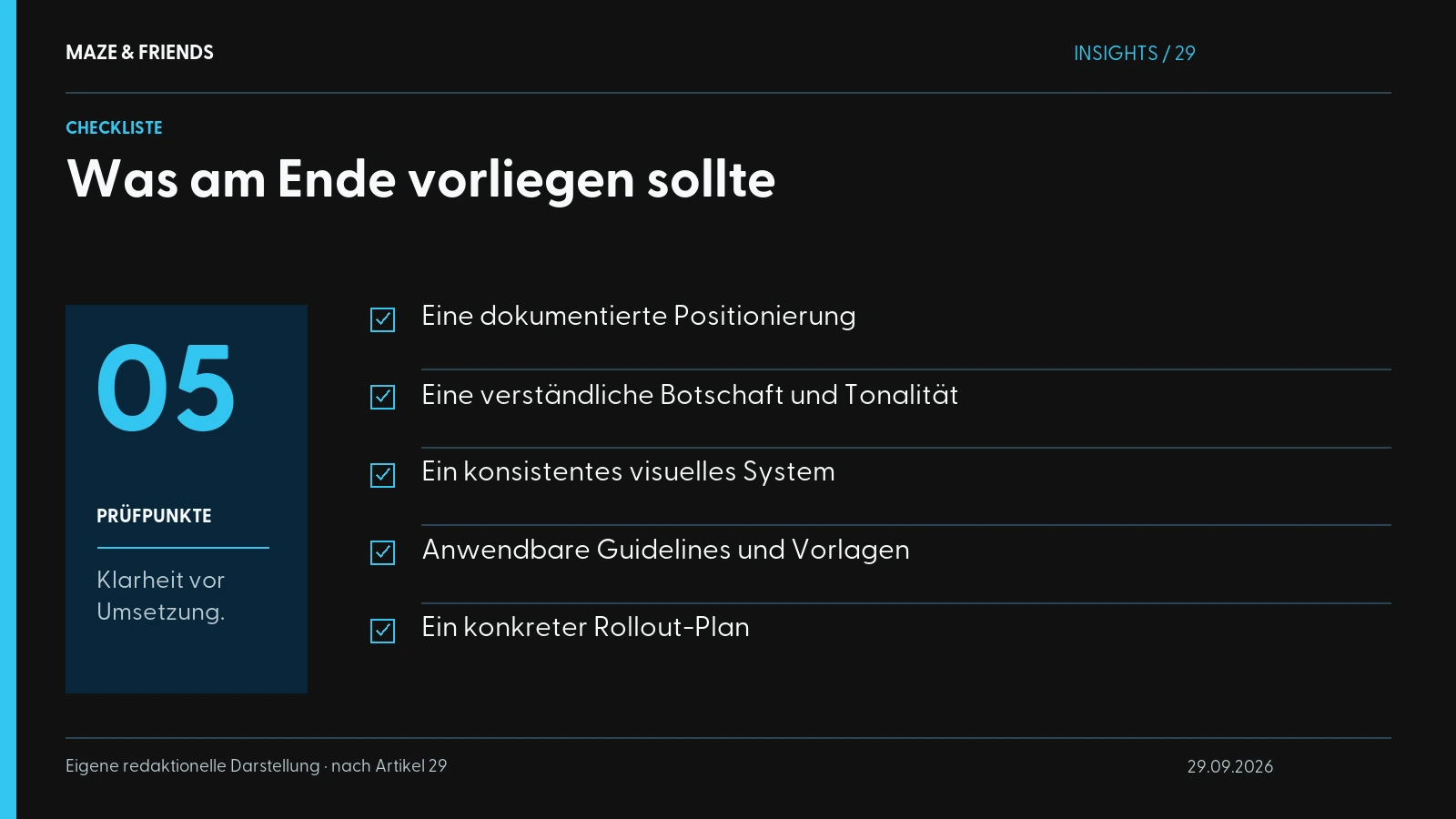
Serious brand work delivers something tangible at every stage. That way you can check progress instead of waiting months for one big reveal:

| Phase | What lands on your desk at the end |
|---|---|
| Discovery | Insights briefing, competitor analysis |
| Brand strategy | Brand platform: positioning, core, personas, messages |
| Verbal identity | Naming/claim, messaging & tone-of-voice guide |
| Corporate design | Logo, colour and type system, imagery, design toolkit |
| Brand guidelines | Brand manual with do’s & don’ts |
| Rollout | Finished applications (website, social, print) + templates |
What does it cost to have a brand developed?
There are no serious flat prices, because the effort depends heavily on scope. These factors drive the cost:
- Scope of the strategy: is a compact workshop enough, or does it take market research and many stakeholder interviews?
- Naming, yes or no: developing a viable name that can be checked legally is a project in its own right.
- Number of applications: just the logo and website – or packaging, trade fair and a template set as well?
- Seniority: are you working with newcomers or with experienced people who also think strategically?
A reliable figure only exists once these four points are settled; at Maze & Friends, as a fixed-price quote after the initial call. A freelancer logo is cheaper, but then you get a logo without the system behind it. Decide based on what is at stake: for a brand that is supposed to carry you for the next five years, strategy is not the line item to save on.
Do it yourself or hire a branding agency?
Not everyone needs an agency straight away. In the very first phase, when you’re still testing your offer and every euro counts, a clean, simple interim solution is often enough; how to approach this situation on a small budget is covered in our article on building a brand as a founder. Don’t waste a large budget here on a design you’ll throw out again in three months.
It gets serious when you scale: when branding decides which deals you win and lose, when you compete against established players in B2B or when your sales team needs materials that build trust. That’s when outside experience pays off, less because of nicer visuals than because of the method and the uncomfortable questions nobody asks you internally.
If you’re based in Austria and want to work with people who think strategy, content and execution under one roof, you’ll find the right setting with us as a branding agency in Vienna. If you’re reworking an existing brand, read our guide to rebranding, because the process differs in important ways.
Strategy first, design second
A brand holds up when the order is right: first understand and position, then language and design, finally guidelines and rollout. Each phase delivers a tangible result you can use to check progress. Start with the look, and you pay for it later in correction loops.
In an initial call with Maze & Friends, we look at your starting point together, work out which phases make sense for you and tell you what brand development realistically means in your case.
From the studio: Scharfe Kralle: branding and brand guide · AHOM Retreats: brand and social ads.
How traditional businesses reset their positioning and customer acquisition is also described in the transformation guides of the Austrian Economic Chamber (WKO), to which Manuel Zellnig contributed as a creative expert: transformation guide for print shops and transformation guide for florists (WKO, Kreativwirtschaft Austria, both in German).
Frequently asked questions
What is branding, in simple terms?
Branding is all the work on a brand: defining what it stands for and for whom, and translating that consistently into language, design and presence.
A logo sits at the end of a chain of decisions. Branding covers positioning, brand core and messages just as much as tone of voice, corporate design and rules for applying them. The goal is a system that makes you recognisable and predictable. Starting with the look is like building a house from the roof down.
How does developing a brand work?
Developing a brand runs through six phases: discovery, brand strategy, verbal identity, corporate design, brand guidelines and rollout. Each phase lays the groundwork for the next.
Discovery is about listening: conversations with founders and existing customers, plus a sober analysis of competition and market. The strategy defines what the brand stands for and what sets it apart. Language and tone of voice come next, and only then logo, colours and typography. Guidelines secure consistent application, and the rollout brings the brand to the website, templates and the team. Reverse the order and you end up in expensive correction loops.
How long does branding take?
Depending on scope, a complete brand development realistically takes four to twelve weeks.
A focused founder branding project moves faster; a B2B project with several decision-makers, naming and a broad rollout takes longer. What takes the most time is rarely the creative work. It’s usually the coordination. How quickly are decisions made on your side? So agree from the outset who signs off, ideally a small group that can actually decide, rather than a committee in which every colour becomes a debate of principle. Fixed feedback dates are the best way to keep to the schedule.
How much does branding cost?
What a well-founded brand development with strategy and corporate design costs depends on depth and scope; only a fixed-price quote gives you a reliable figure.
There are no serious flat prices, because the effort depends heavily on scope. The main cost drivers are the depth of the strategy work, any naming, the number of applications in the rollout and the seniority of the team. A freelancer logo is cheaper, but gives you only a logo with no strategy behind it. Decide based on what is at stake: for a brand that is supposed to carry you for the next five years, strategy is not the line item to save on.
How much does a logo cost?
What a logo costs depends on whether you get a single mark or a logo system with rules for every channel. A single logo from a freelancer is considerably cheaper than a brand development.
A mark on its own is quickly ordered. More work, and more valuable, is a logo derived from a strategy that works on every channel with variants and a colour and type system. That difference explains the wide price gaps on the market. If you’re only just testing your offer, a clean, simple interim solution is often enough. As soon as the brand helps decide deals and applications, a logo that is part of a system pays off.
What is the difference between branding and corporate design?
Branding is all the work on your brand; corporate design is its visible part: logo, colours, typography and imagery. Branding reaches from strategy through language to design.
Corporate design is therefore one discipline within branding and no substitute for it. Good corporate design derives every decision from the strategy and can justify it, so “this colour, because …” instead of “looks good”. It is also conceived as a toolkit that lets you produce any number of applications consistently. Order only a logo, and you get design without a foundation.
What is a branding kit?
A branding kit, often called a brand kit, is your brand’s compact toolbox: logo files in every variant, colour values, typefaces, templates and the most important usage rules.
For everyday work, it is the working version of the brand guidelines. Team, freelancers and agencies use it so that presentations, social media posts and proposals look the same everywhere. A good kit is created at the end of brand development, from the corporate design and the guidelines. A kit without strategy behind it does ensure a uniform look, but says nothing about what the brand stands for or how it speaks.
How do I create a brand book?
A brand book, also called a brand manual or style guide, records how your brand is used correctly, including clear do’s and don’ts. It is created towards the end of brand development.
It typically contains:
- Positioning, brand core and core messages
- Tone of voice with example sentences
- Logo rules with variants and clear space
- Colour and type system plus imagery
- Application examples for website, social media and print
Write it for the people who work with it every day, not as a glossy document for the drawer.
What is the 3-7-27 rule in branding?
The 3-7-27 rule is a rule of thumb from marketing practice, not a study: the first impression forms in seconds, while recognition and trust need many repeated contacts.
Depending on the source, the numbers are interpreted differently, for example as seconds, contacts or repetitions. The useful core is this: a brand takes root by repeating the same message at every touchpoint, and a single big appearance is not enough. That is exactly what brand guidelines and a planned rollout are for. Change your look or message every few months, and you start counting from zero each time.
How much do I need to contribute to branding myself?
Your most important contribution is knowledge and the ability to decide: you bring in the offer, customers and goals, give honest feedback and sign off promptly.
The start involves a kick-off workshop and interviews, in B2B ideally with existing customers too, because they often show what you are really valued for. In the strategy phase, you check whether positioning and messages are right; later you give feedback on the drafts. You can delegate design and detailed work, but not the decision about what your brand stands for. Most of your time therefore goes into thinking things through properly in the strategy sessions, hardly any into production.
How do I recognise a good branding agency in Vienna?
You recognise a good branding agency in Vienna by the questions it asks before the design and by clear results for each phase.
Look for references with results rather than just pretty pictures, and check whether strategy, content and execution are thought through together. Good agencies also tell you openly when you don’t need a large brand development yet, for instance while you are still testing your offer. For the Austrian market, it helps if the team knows the decision-makers and the tone of the country’s mid-sized companies. Vienna-based Maze & Friends works on this principle: strategy first, then design and execution, with logo and corporate design created in-house.
Does a B2B company actually need branding?
Yes, especially in B2B, because purchasing decisions there are expensive and risky, and people buy from suppliers they trust.
A clear brand makes you predictable, sets you apart from interchangeable suppliers and makes life easier for your sales team, because they don’t have to explain in every conversation what you stand for. Applicants read the brand too. “We sell through relationships” and branding are not a contradiction: the brand ensures that a contact already has a clear impression before the first conversation. A B2B project with several decision-makers does, however, need more time for coordination.
How many drafts do I get in a branding project?
The usual is one or two design directions to choose from, which are then refined in one or two rounds.
More drafts sound like more value, but they often make the decision harder and shift it towards matters of taste. When the strategy is solid, every direction can be justified and choosing becomes easier. Endless rounds of revisions are a warning sign: usually the strategy before them wasn’t clear enough, and the design phase ends up renegotiating what should have been settled in the positioning. So agree the number of rounds in the quote before the project starts.
Is a brand finished after the rollout?
No, after the rollout comes brand management: the brand has to be applied consistently, reviewed regularly and developed further with care.
Small adjustments to language or design are normal, as long as they follow the guidelines. Prioritising already helps during the rollout: what has to be ready for the launch, and what can follow in the weeks after? Nobody needs 40 templates on day one. A bigger overhaul, on the other hand, is a project of its own, the rebrand, with its own process and the question of how much of the familiar you keep. The better the strategy at the start, the less often you need a hard break later.
What are typical branding mistakes?
Typical mistakes are skipped discovery and strategy phases, decisions made by large committees and missing guidelines; the result then often starts to wobble after just a few months.
If you use discovery only to have your own opinion confirmed, you won’t find any blind spots. If an agency starts straight away with drafts, you’re buying decoration instead of a brand. Without guidelines, the brand looks slightly different with every new post as soon as more than one person communicates. During the rollout, trying to have everything finished at once instead of prioritising does harm. And the team that is supposed to carry the new brand in everyday life is often forgotten.
Next step
Want to know which of this fits your company? We will work it out together in 30 minutes. Free and without obligation.
Pick a time