


Choosing a business photographer in Vienna
Finding a business photographer in Vienna: how to recognise good business photos, how a shoot works, what drives the price and which mistakes cost impact.
In short: Business photos are working tools: they work on LinkedIn, on your website, in press materials and pitch decks, often for years. A good business photographer in Vienna stands out through three things rather than the camera: they first clarify where the images will be used, guide people confidently in front of the camera and photograph personality rather than poses. Maze & Friends photographs according to exactly these criteria.
Your LinkedIn presence is becoming more important, the website still shows photos from six years ago, and the team photo was taken at the Christmas party. At some point someone says “We really need some professional photos”, and the search for a business photographer in Vienna begins. Yet all the portfolios look the same: people in front of a grey background, arms crossed, smile on setting three. This is about what lies behind them: what business photos have to achieve today, how a good shoot works, what determines the price and how to tell craftsmanship from a conveyor belt.

What do business photos have to achieve today?
Ten years ago, the business photo was an obligatory image for the About us page. Today it is the face of your entire digital presence, and that presence has changed:
LinkedIn has become the main stage. For managing directors, experts and anyone working on their personal brand, the profile picture is the first impression with every post, every request, every comment. A picture that is ten years old or looks like an ID card photo undermines even the best positioning.
People beat logos. Posts by real people achieve many times the reach of company pages on social networks, because the platforms favour faces and people trust people. That’s why everyone who communicates visibly needs good pictures, not just the boss.
AI systems read consistency. If you want to be perceived as an expert, by ChatGPT and other AI assistants too, you need a consistent presence across your website, LinkedIn, press and directories. Using the same professional images everywhere is an underrated building block of that consistency.
Business photos have thus gone from decoration to infrastructure, and it pays to get them right once.
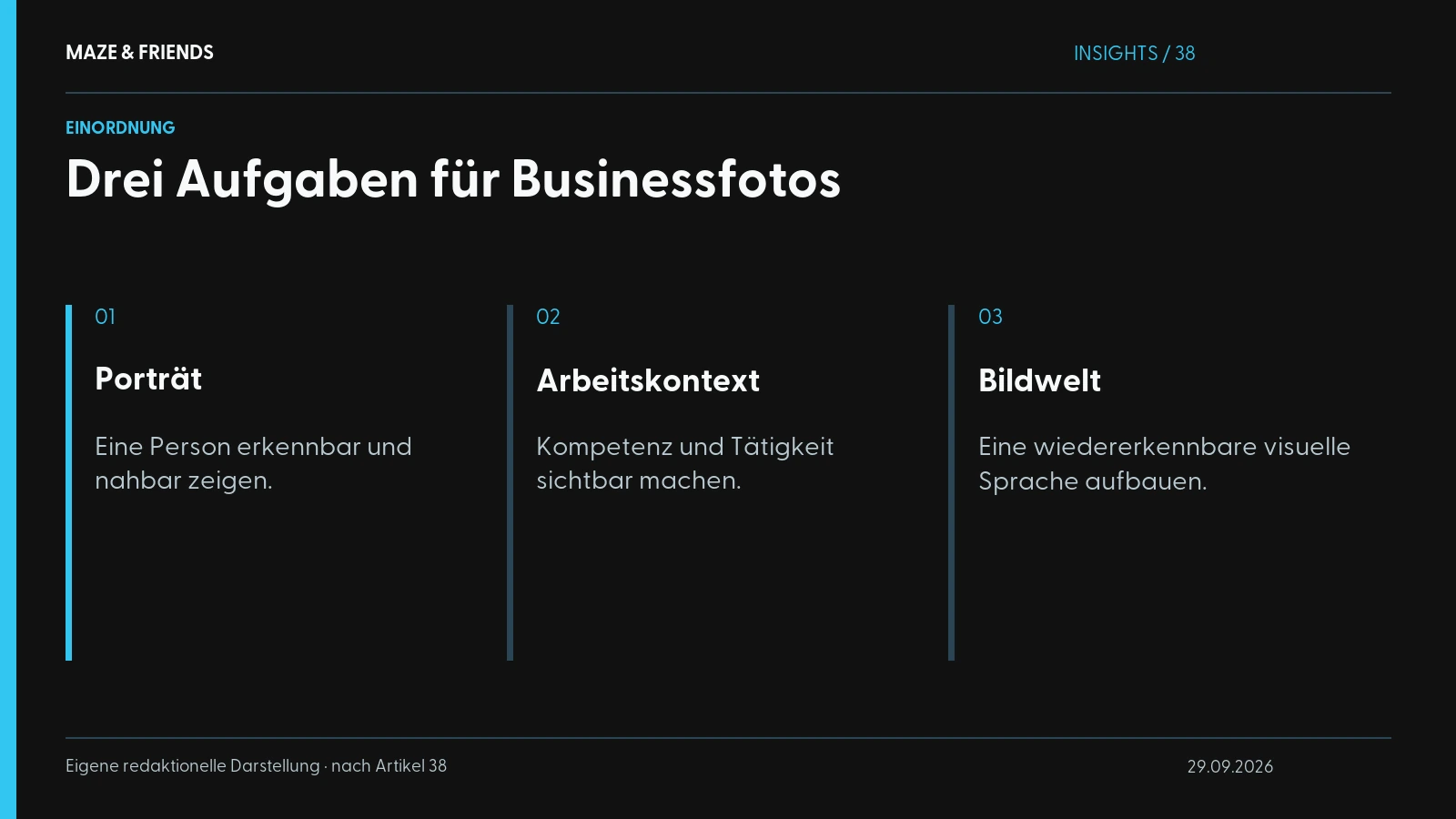
What kinds of business photos are there?
The terms often get mixed up. Sorted, it looks like this:
| Format | What it is | Where it works |
|---|---|---|
| Business portrait | Classic individual portrait, deliberately composed | LinkedIn, website, press, speaker profiles |
| Business photos / corporate photography | People in real work situations | Website, careers page, social media, brochures |
| Employee photos / team photos | Consistent portraits of the whole team + group pictures | Team page, email signatures, employer branding |
| Application photo | Individual portrait for the job market | CV, job portals |
| Event and reportage photos | Documentation of real moments | Event reports, social media, references |
The most important difference lies between the first two rows: the portrait shows who you are; the reportage shows how you work. A modern website needs both. The trend is clearly moving away from the sterile studio look towards documentary authenticity: real rooms, natural light, people doing something instead of posing. This visual language works better on every platform, because credible beats slick.

How does a good business photographer in Vienna work?
You can recognise the quality of a provider from the process sooner than from the portfolio:
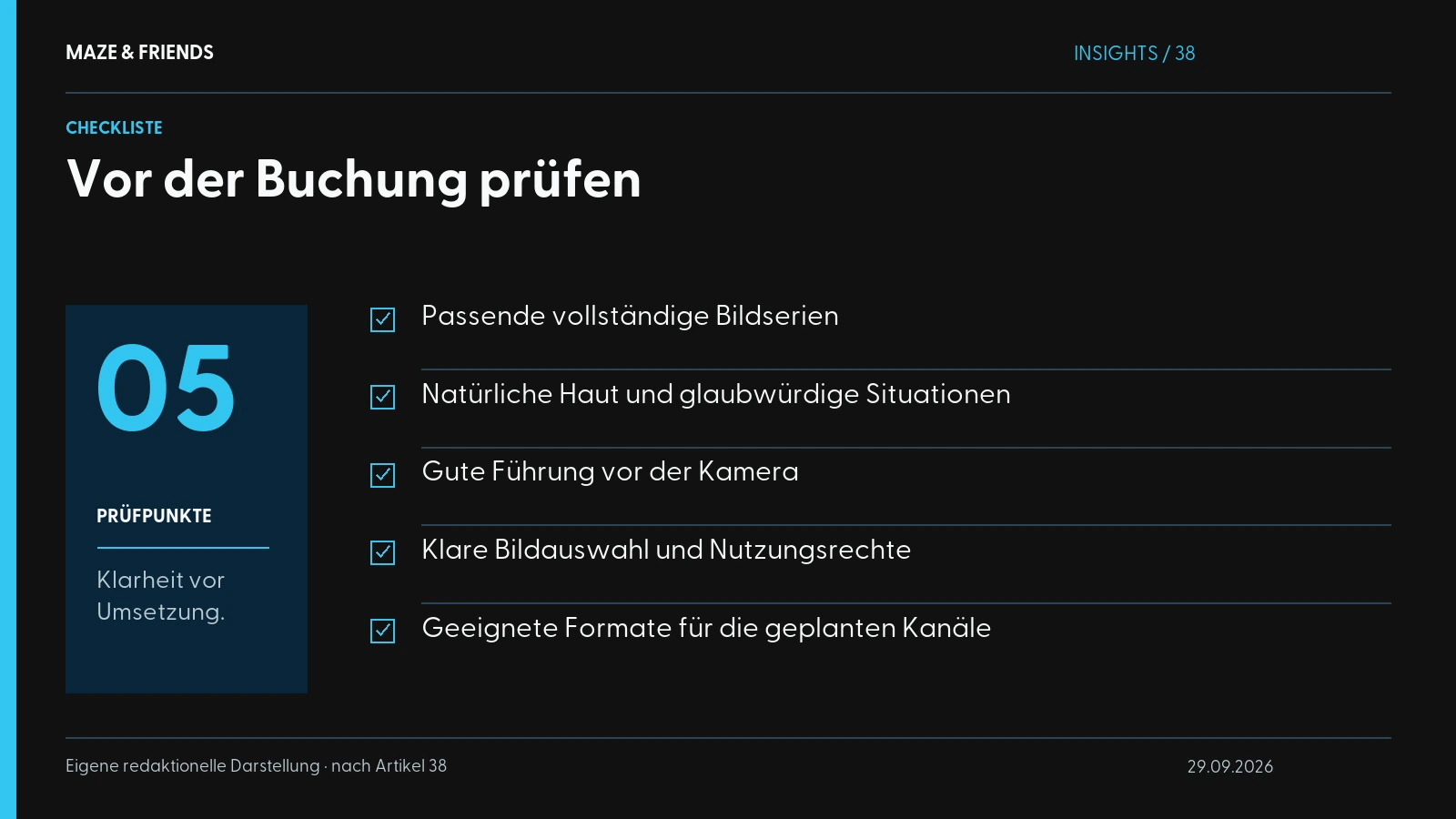
- A briefing before the appointment. A good photographer first asks where the images will be used: LinkedIn needs a different format and a different presence from the website homepage, the press needs landscape format with space around the subject, social media needs vertical format. Anyone who doesn’t ask about the purpose produces beautiful pictures that don’t work.
- Choosing the location. A studio looks controlled but can turn out sterile; your own premises or the city look more genuine and tell a story. In Vienna, the best business photos are often taken where you actually work, provided the photographer has mastered the light on location.
- Direction during the shoot. This is the actual core skill. Hardly anyone likes standing in front of the camera, and whether someone comes across as tense or confident depends on the direction: conversation instead of commands, movement instead of a frozen pose, time to warm up. Ask directly in the initial call: “How do you work with people who don’t like being photographed?” The answer tells you more than any portfolio.
- Selection and editing. Professional editing refines light, colour and skin tone naturally, without smoothing you beyond recognition. You should look like yourself on a very good day.
- Delivery in usable formats. Web-optimised, print-ready, square for the profile picture, vertical for social media, including cleared usage rights for all planned channels. Unclear usage rights are the most common nasty surprise after the shoot.

What do business photos cost in Vienna?
What business photos cost in Vienna depends mainly on three drivers: the number of images, changes of location and the scope of the usage rights. Then there is the size of the team and whether an individual portrait or a team shoot over half a day or a full day is planned. At Maze & Friends you get a fixed-price quote for exactly your scope after the initial call.
The more relevant calculation, though, is the period of use: good business photos work for two to three years across all channels. Calculated per day, they are a very inexpensive marketing tool. It gets expensive the other way round: when bad photos undermine a strong positioning, that costs you continuously, just invisibly.
A practical tip for efficiency: combine the photo shoot with a video shoot. With the same people, the same locations and on the same day, you get material for recruiting or brand film purposes in addition to the photos. One production day, two disciplines: that almost always works out better than two separate appointments.
What are the most common mistakes with business photos?
- Everyone has their own done. Five executives, five photographers, five visual languages, and the team page looks thrown together. Better: one shoot, one style and one appointment a year for new joiners.
- The image doesn’t match the positioning. If you want to come across as an approachable consultant, you don’t need a corporate board portrait with crossed arms. Visual language is positioning language and therefore belongs in the briefing.
- Once and never again. People change; a profile picture that is visibly more than three years old comes across as a broken promise at every real meeting. Rhythm: new photos every two to three years.
- Only portraits, no situations. For your website, careers page and social media, you need people in action: in conversation, at the workpiece, in the room. If you only produce headshots, you have nothing to hand for half of the uses.
Business photos as part of your personal and employer brand
Business photos are the foundation of a visible personal brand. The strategy behind it is set out in Personal branding for B2B decision-makers. If you want to put the team in the picture to win over applicants, read Employer branding explained.
From the studio: Sparta Bautenschutz: business photography · Bahnoperator: business photography.
Frequently asked questions
How do I recognise a good business photographer in Vienna?
You can recognise a good business photographer in Vienna by the fact that they first ask about the intended use, guide people confidently and photograph personality rather than poses.
That is exactly the order in which you should choose, because the camera doesn’t make the difference. Look at complete image series, not just individual pictures: do skin and situations look natural, do the formats suit different channels? Ask in the initial call how they work with people who don’t like being photographed. The answer reveals a lot about how they work. Also make sure that image selection and usage rights are clearly agreed.
What does a professional business photo shoot cost?
What a business photo shoot costs depends mainly on the number of images, changes of location and the scope of the usage rights; a fixed-price quote after a briefing is the reputable approach.
Individual portraits can be planned compactly, team shoots are usually organised as a half or full day, and the effort grows with team size and number of images. Ask for the number of images, formats and usage rights to be itemised separately in the quote. Also factor in the period of use: good business photos work for two to three years across all channels. At Maze & Friends you get the fixed-price quote after the initial call.
What are business photos?
Business photos are professional portraits and situational images of people in a professional context, which often work for years on LinkedIn, on the website, in press materials and pitch decks.
They include the classic business portrait, corporate photos of people in real work situations, consistent team and employee photos, and event and reportage pictures. The portrait shows who you are, the reportage shows how you work. A modern website needs both. Today, everyone who communicates visibly to the outside world needs good pictures, not just management.
What does a good business photo look like?
A good business photo shows you as you look on a very good day, matches your positioning and works in the format of the channel.
It looks credible rather than slick: real rooms, natural light and a posture that suits the role. If you want to come across as an approachable consultant, you don’t need a corporate board portrait with crossed arms. Editing refines light, colour and skin tone naturally, without smoothing you into a different person. And the format follows the use: square for the profile picture, landscape format with space around the subject for the press, vertical for social media.
What should you look out for with business photos?
With business photos, what counts above all is clarifying the purpose in advance, choosing a consistent style for the team and photographing situations as well as portraits.
- Clarify the purpose: LinkedIn, website, press and social media need different formats.
- One style: one joint shoot instead of five photographers, plus an annual appointment for new joiners.
- Positioning: the visual language has to suit your role.
- Situations: show people in conversation, at the workpiece or in the room.
Which poses work for business photos?
For business photos, postures that arise from movement and conversation work best. Rehearsed poses such as crossed arms and a frozen smile look stiff.
A good photographer works with conversation instead of commands, lets you walk, sit or explain something and gives you time to warm up. That produces pictures that look confident rather than tense. This applies equally to women and men: what matters is that posture, clothing and surroundings suit your role. Bring examples you like and discuss them in the briefing beforehand. Hardly anyone likes standing in front of the camera, and this is exactly where good direction makes the difference.
What should you wear to a business photo shoot?
For a business photo shoot, it’s best to wear what you would wear to an important client meeting: one notch more deliberate than everyday, but recognisably you.
It has proven useful to bring two or three outfits, one more formal and one more casual, so that pictures for different uses are created. Calm colours without small, busy patterns work best in photos. Above all, everything has to fit properly, because the camera sees badly fitting clothes more mercilessly than the mirror. If several people are being photographed, a quick agreement on colours and formality is worthwhile so that the team page looks consistent.
How many pictures do you need from a business shoot?
From a business shoot you usually only need two or three strong portraits per person and a handful of situational pictures.
The portraits cover the most important uses: a square profile picture, an image for the website and a landscape format for the press. The situational pictures show you in conversation, at work or in the room and carry your website, careers page and social media. Twenty variations of the same pose are worthless; eight different, ready-to-use pictures are a working year’s worth of material. Because the number of images drives the price, it pays to decide beforehand which motifs you really need.
Are business photos better in a studio or on your own premises?
If your own premises tell a story, such as a workshop, an office or a cityscape, they are almost always the better choice for business photos than a studio.
On-location pictures look more authentic and set you apart from competitors who all stand in front of the same grey background. The precondition is a photographer who masters the available light rather than suffering it. The studio plays to its strengths when maximum consistency is required across many people and appointments, or when the premises simply have nothing to offer. In Vienna, the best business photos are often taken where you actually work.
What is the difference between an application photo and a business portrait?
An application photo is made for the job market and optimised for broad acceptance; a business portrait is a positioning tool that shows your role and personality.
The application photo should look correct and restrained and ends up in your CV or on job portals. The business portrait shows you as an expert, founder or executive and works on LinkedIn, the website, in the press and in speaker profiles. If you communicate visibly, you need the portrait. The application photo is then usually a by-product that comes out of a good business shoot anyway.
How up to date does a LinkedIn profile picture have to be?
A LinkedIn profile picture should be recent enough that someone recognises you immediately at your first real meeting; as a rule of thumb, no older than three years.
After visible changes such as a new hairstyle, beard or glasses, you should renew it sooner, otherwise the picture comes across as a broken promise at the meeting. As for the format: the face large enough for the thumbnail in the feed, a calm background, eyes on the camera. All other business photos need a rhythm too; every two to three years has proven itself, ideally linked to a fixed shoot date for the team.
Can I take business photos myself or create them with AI?
Self-made or AI-generated business photos are possible, but they rarely replace a professional shoot, because direction, light and authenticity are missing.
With a smartphone and good window light, you might at best manage a decent individual picture, but hardly a consistent series for the team, website and press. AI generators quickly deliver slick portraits that often don’t really look like you. That is exactly the problem: your profile picture should make you recognisable at the first meeting, and an idealised version doesn’t do that. AI makes more sense in editing, for example for backgrounds, as long as the face stays real and you are open about it.
Do I need my employees’ consent for team photos?
Yes, before you publish team photos on your website, social media or in documents, you should obtain the consent of the people shown, ideally in writing. The Austrian Economic Chamber (WKO) (in German) also names consent as a prerequisite for employee photos on the website.
Recognisable people touch on data protection and personality rights, such as the protection of personal images under section 78 of the Austrian Copyright Act (UrhG) (in German). Record in the consent where the images will be used, for example on the team page, in email signatures or in employer branding, and what happens when someone leaves the company. Inform the team well before the shoot, so that everyone can prepare and nobody feels ambushed. In borderline cases, such as event or reportage photos with many people, a brief legal check is worthwhile.
What usage rights do I need for business photos?
For business photos you need usage rights for all channels on which you want to use the images, agreed in writing before the shoot.
Typical channels are the website, LinkedIn and social media, and often press materials, print such as brochures, or paid advertising. These additional channels in particular should be stated explicitly in the agreement, because unclear usage rights are the most common nasty surprise after the shoot. The Austrian Federal Guild of Professional Photographers (Bundesinnung der Berufsfotografen) (in German) advises agreeing usage rights for the specific purpose, ideally in writing. The scope of the rights is also a price driver, so it’s best to mention it in your enquiry. Also ask for confirmation of the formats in which you will receive the images: web-optimised, print-ready, square for the profile picture and vertical for social media.
Is it worth combining a photo shoot and a video shoot?
A combined photo and video day almost always works out better than two separate appointments, because the same people and locations only have to be organised once.
On the same day, material for a recruiting video, brand film or social media is created alongside the business photos. That saves coordination, travel and above all the time of your team, who only stand in front of the camera once. Joint planning is important so that photo and video don’t slow each other down, for example through agreed time slots for portraits and scenes. On such days, Maze & Friends works as a combined photo and video team on request.
Next step
Want to know which of this fits your company? We will work it out together in 30 minutes. Free and without obligation.
Pick a time