


What rebranding is and how it works
Rebranding explained clearly: what it involves, when it pays off and how the process runs in five phases. Including how it differs from a refresh.
In short: Rebranding means deliberately realigning an existing brand: from the strategic foundation (positioning, values, target group) to the visible surface (name, logo, design, language). A refresh only modernises the surface, a rebrand changes the strategy as well. A rebrand pays off when the brand no longer fits the business. Boredom is not a reason. Maze & Friends from Vienna starts every rebrand with analysis and strategy, and the logo comes afterwards.
You are thinking about reworking your brand. Perhaps the logo is ten years old, perhaps your offer has shifted, perhaps your presence simply no longer fits. In this guide you will find a clear definition, the process in five phases and everything that determines the effort. Afterwards you will know whether a rebrand is worth it for you or whether a refresh will do.

What is rebranding?
Rebranding means deliberately changing an existing brand. German offers its own words for this, such as “Markenüberarbeitung” (brand revision) or “Markenrelaunch”. Even so, the English term has caught on across the German-speaking world, because it is more precise than most translations.
The most important distinction first, because it has the biggest influence on effort and cost:
- Rebrand (full): you change the strategic foundation of your brand, meaning positioning, target group and core message, and derive an entirely new presence from it. The name is often part of it.
- Refresh: you keep the strategy and modernise the surface. The logo gets fine-tuned, colours become more contemporary, the design is tidied up. The core stays.
Many people reduce a rebrand to what is visible: new logo, new colours, done. That is the most expensive fallacy. A logo is the tip of an iceberg, and underneath lies the real substance: what you stand for, for whom, and why someone should choose you over the competition. If you only swap the tip and the rest stays vague, you have spent money on cosmetics.
A rebrand is therefore a strategic decision about how your brand should be perceived. That decision is then carried through consistently into design and language. Design without strategy is decoration. Strategy without implementation is a PDF nobody reads.

What are the reasons for a rebrand?
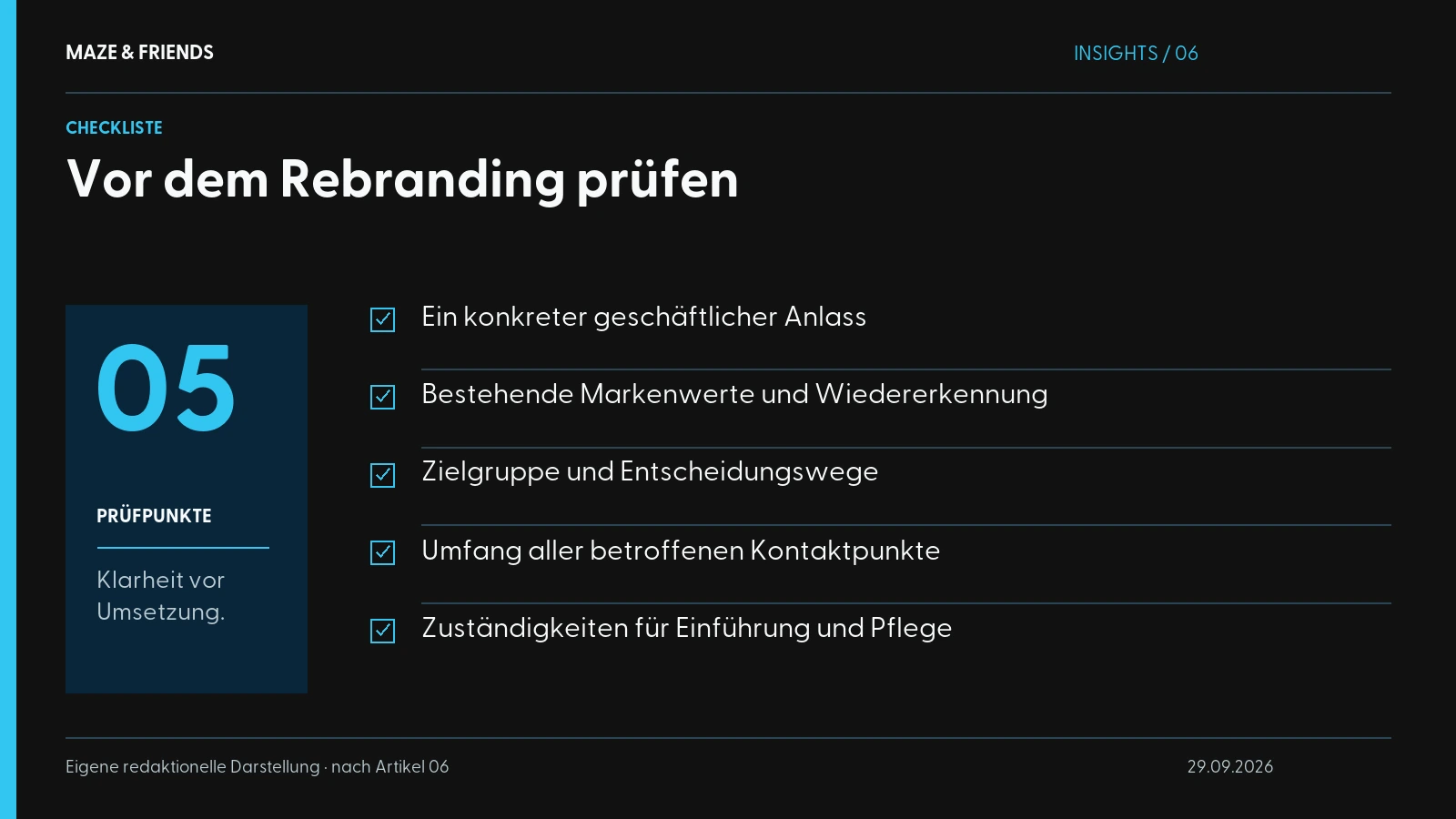
A rebrand is no good as an end in itself or as a matter of taste. In five situations, however, it almost always makes sense:
1. Your brand has fallen behind your business. You started out as a photographer and today mainly run employer branding campaigns, yet your presence still tells the old story. A classic case: the brand no longer fits what you actually sell.
2. You are mistaken for something you are not. Your target group does not understand what sets you apart from the competition. Or worse, it puts you in the wrong box. That is a positioning problem, and positioning is the core of every rebrand.
3. A hard break. A merger, takeover, spin-off, a name conflict (legal or trademark-related), expansion into a new market. Here a relaunch is often unavoidable.
4. Your presence is visibly dated. A logo from the early 2010s, a website that crumbles on a phone, inconsistent materials. That costs you credibility before you have said a word.
5. A reputational legacy. Sometimes a brand carries baggage that no longer holds true, such as an old story or a burnt name. Then the break is deliberate.
And the counter-test: if you are just bored, leave it. If your revenue is right, your customers categorise you correctly and your presence works, a rebrand is money thrown away. A new logo will not repair a broken offer or weak sales.
What does a rebrand involve?
The simplest way to think about it is in two layers: the strategic foundation, which you cannot see but which tips the balance, and the visible implementation. A clean project works on both, in that order.
The foundation (strategy layer)
- Positioning: the core. What do you stand for, for whom, and what makes you different? Without this answer, everything that follows is guesswork.
- Target group and ICP: who do you really want to reach? (ICP = ideal customer profile, your ideal customer.)
- Brand values and stance: what matters to you, and where do you take a position?
- Core message and wording: the one sentence people should pass on about you.
- Naming (only for a full rebrand): including legal checks.
The surface (implementation)
- Logo and brand mark: the identifying sign, in every variant you need.
- Colour palette, typography, imagery: the visual system that creates recognition.
- Brand guidelines: the rulebook that keeps the brand looking the same everywhere.
- Website: usually the most important touchpoint. Here in Vienna we like to build it on Webflow, because you can then edit it without an agency. More on this on our page about web design for company websites.
- Templates and applications: presentations, social media tiles, business cards, email signatures.
- Clean tracking: often forgotten. If you change the domain or structure, you need clean analytics and server-side tracking (GA4, CAPI), otherwise you lose your data foundation.
The most common mistake in practice: the strategy layer is skipped because it is “invisible” and harder to sell than a pretty logo. Yet it is exactly this layer that decides whether the rebrand moves anything or just looks different. Our article on the branding process shows how the foundation is built step by step.

How does a rebrand work?
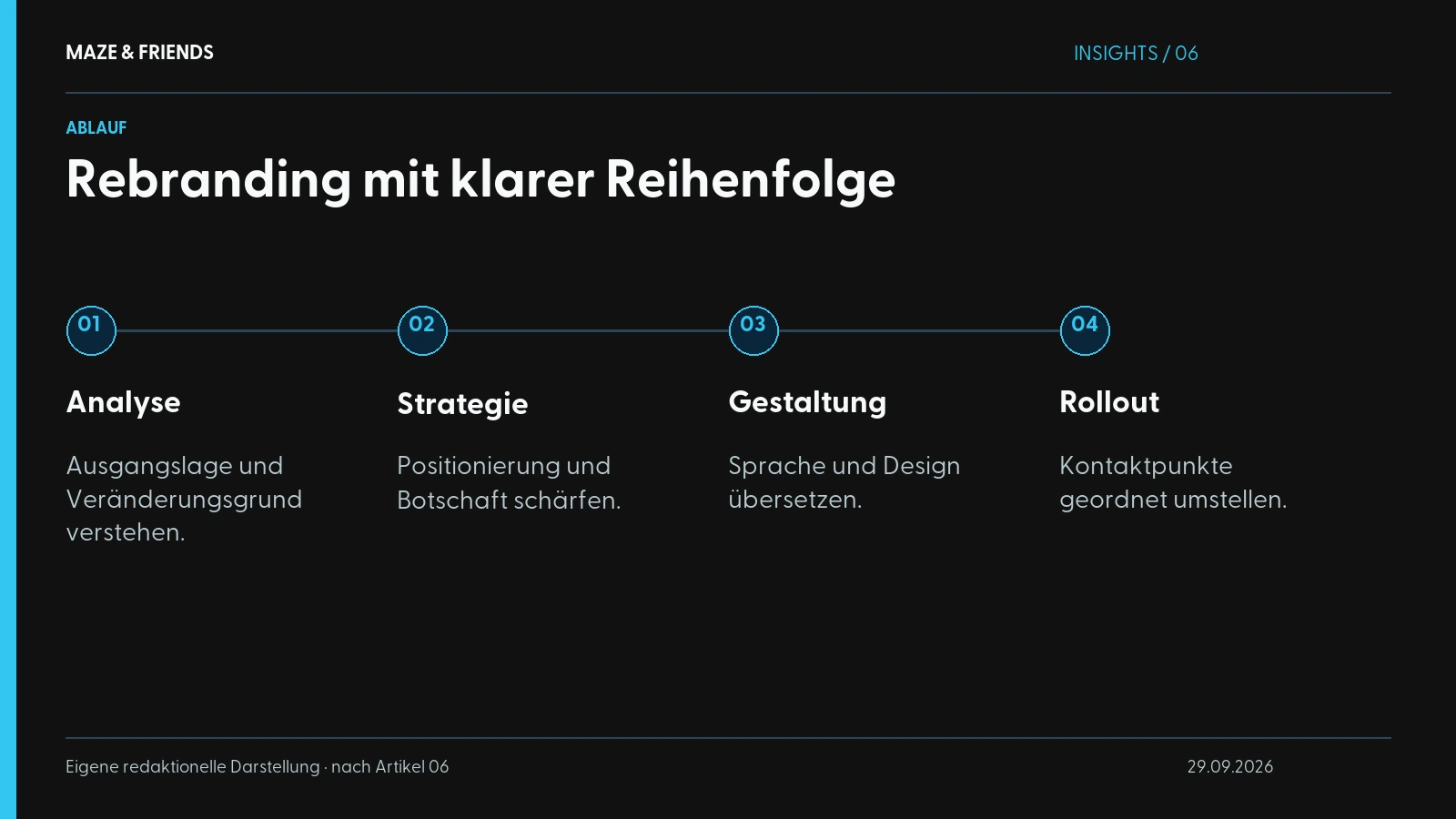
A sound rebrand follows a clear structure. This is the process Maze & Friends runs in practice:
Phase 1: analysis and discovery. First, the stocktake. What works, what does not? Competition, target group, perception, figures. This is where the honest decision is made on whether you need a full rebrand or just a refresh, and no phase saves you more money later.
Phase 2: strategy and positioning. Now the foundation is laid: positioning, target group, values, core message. The result is a clear strategy paper from which every later design decision can be derived.
Phase 3: creation and design. Only in this phase does the design work begin: logo, colour palette, typography, imagery. Because the strategy is in place, these are reasoned decisions rather than matters of taste.
Phase 4: implementation and roll-out. Guidelines, website, templates, every touchpoint. This is the most labour-intensive part. It is where most projects lose consistency.
Phase 5: launch and communication. The brand goes live, externally with customers and the market, internally with the team that has to live the new brand. Domain or structural changes require clean 301 redirects and working tracking, so that you do not burn your SEO.
A realistic timeframe: a refresh can be done in four to six weeks. For a full rebrand with a new name and website, expect something more like three to six months. Anyone promising you a complete brand in two weeks is skipping phases 1 and 2, and you will notice later.
What does a rebrand cost?
What a rebrand costs depends on its depth. These levels determine the effort:
| Scope | What you get | Relative effort |
|---|---|---|
| Logo refresh | Logo fine-tuning, colour and font update, mini guideline | lowest |
| Brand refresh | Refresh + reworked imagery, guidelines, basic templates | medium |
| Rebrand with strategy | Positioning + complete design system + website | high |
| Full rebrand | Everything incl. naming, website, roll-out, tracking | highest |
The scope ranges from a logo refresh, which only freshens the surface, to a brand overhaul with strategy, a new website and a roll-out across every touchpoint. What matters is that scope and price match. Maze & Friends provides a fixed quote for this after the initial call.
What makes a project expensive is above all the depth of the strategy, a new name including legal checks, the scope of the website and the number of touchpoints in the roll-out. Be wary of package deals without analysis, because the strategy is missing there. The same goes for quotes whose amount cannot be explained by the scope of services. Our article on the cost of a rebrand covers what makes up the price and when the investment pays off.
Strategy first, then the logo
A rebrand pays off when your brand no longer fits your business. It will succeed if it starts with the strategy. First clarify whether a refresh is enough or a real rebrand is needed, and do not let a beautiful presentation dazzle you if the foundation is missing.
Our stance: we tell you up front whether you need a rebrand at all. If a refresh is enough, we will not sell you a full project. Our page on branding and brand development shows how we develop brands in-house, from positioning to corporate design.
From the studio: Scharfe Kralle: branding and brand guide · 79degrees: branding and brand films.
How traditional businesses reposition themselves and rethink how they win customers is also described in the transformation guides of the Austrian Economic Chamber (WKO), to which Manuel Zellnig contributed as a creative expert: transformation guide for printing companies (in German) and transformation guide for florists (in German) (WKO, Kreativwirtschaft Austria).
Frequently asked questions
What does rebranding mean?
Rebranding means deliberately realigning an existing brand, from the strategic foundation to the visible surface of name, logo, design and language.
The foundation includes positioning, target group and core message. The order matters. First you clarify what the brand stands for, for whom and why people should choose it over the competition, and only then do the logo, colours and tone of voice follow. That makes a rebrand a strategic decision about how your brand is perceived. In the end, it should fit your business and your target group again.
What is rebranding called in German?
German speaks of “Markenüberarbeitung” (brand revision), “Markenrelaunch” or the realignment of a brand. In everyday use, however, the English term rebranding has caught on.
The reason is precision. “Relaunch” is often used only for a new website, while “revision” sounds like cosmetics. Rebranding covers both: the strategic realignment and the new presence that follows from it. When you discuss it with agencies, designers or your team, clarify early whether you mean a refresh of the surface or a genuine repositioning. That is exactly what makes the biggest difference to effort and cost.
What is the difference between a rebrand, a redesign and a refresh?
A rebrand changes the strategic foundation of a brand. A redesign or refresh keeps the strategy and only modernises the visible surface.
In a refresh, the logo gets fine-tuned, colours and fonts become more contemporary, the design is tidied up. Because the core stays, it is faster and costs less. A rebrand derives an entirely new presence from new positioning, often including the name. An honest analysis at the start shows which option you need. If your positioning still holds, a refresh is usually enough. If you are being put in the wrong box, only a real rebrand helps.
What are examples of rebranding?
Typical examples are a photographer who today mainly sells employer branding campaigns, a merger of two companies, or a provider shedding a tarnished name.
In the first case, the presence still tells the old story even though the offer has shifted. In the second, several identities have to become one. How much a radical break can polarise was shown at the end of 2024 by Jaguar’s much-discussed rebrand. For mid-sized companies, the more instructive cases are usually the unspectacular ones, where the brand fits what the company actually sells again.
When does a rebrand make sense?
A rebrand makes sense when the brand no longer fits the business, you are being put in the wrong box, or a hard break forces the change.
Such breaks include a merger, takeover, spin-off, a name conflict or expansion into a new market. A visibly dated presence can also be a reason, because it costs credibility before you have said a word. Run the counter-test anyway. If revenue, how customers categorise you and your presence are all right, a rebrand is money thrown away. Being bored with your own logo is not reason enough.
What are the steps of a rebrand?
A sound rebrand runs in five phases: analysis, strategy and positioning, creation and design, implementation and roll-out, and launch and communication.
- Analysis: stocktake and the decision between rebrand and refresh
- Strategy: positioning, target group, values, core message
- Creation: logo, colour palette, typography, imagery
- Roll-out: guidelines, website, templates, every touchpoint
- Launch: external and internal communication, including redirects and tracking
The order tells you about the quality. Anyone who starts with creation makes decisions based on taste rather than reasons.
How long does a rebrand take?
A refresh usually takes four to six weeks, a full rebrand with new strategy, new name and new website more like three to six months.
The design rarely eats up most of the time. What takes longer is the roll-out across every touchpoint and internal coordination, meaning how quickly decisions get made on your side. Anyone promising you a complete brand in two weeks is usually skipping analysis and strategy, and you will notice later from a presence that soon starts to wobble again. Schedule fixed approval dates. And keep the approval group small.
What costs should I expect for a rebrand?
The costs depend on the scope: a logo refresh is the smallest item, a brand overhaul with strategy, website and roll-out the largest.
Four things drive the costs: the depth of the strategy, a new name including legal checks, the scope of the website and the number of touchpoints in the roll-out. A reliable figure only exists once the scope is clear, and at Maze & Friends it comes as a fixed quote after the initial call. Be careful with package deals without analysis, as the strategy is missing there. The same applies to quotes whose amount cannot be explained by the scope of services.
Do I have to change the company name when rebranding?
No, a new name is only needed for a full rebrand, for example after a merger, in a name conflict or for a deliberately hard restart.
Usually the name stays, and you work on positioning, design and communication. That costs less and protects the awareness you have built up over years. If a new name does come, a legal check belongs in the process before you commit. Clarify trademark questions with a specialist or the relevant authority, in Austria for example the Austrian Patent Office. Plan the domain, redirects and how you inform existing customers at the same time.
Will I lose my Google ranking when I rebrand?
Only if the technical implementation is poor. With clean 301 redirects, an up-to-date sitemap and working tracking, you carry over most of your SEO substance.
It gets tricky when you change the domain or URL structure. Then every old address has to point permanently to the matching new page. Redirecting everything to the homepage is not enough. At the same time, you need continuous analytics and server-side tracking, for example with GA4 and the Conversions API, or you lose your data foundation at exactly the moment of the switch. Otherwise you burn rankings built up over years.
How do I communicate a rebrand to customers and the team?
Communicate a rebrand internally first and externally second. Your team needs to understand and carry the new brand before customers and the market see it.
Internally, that means explaining why you are changing, what stays the same and how to apply the new guidelines and templates. Externally, you need a clear message that states the reason and shows existing customers what changes for them and what does not. Then you roll the brand out consistently across all channels. With domain or structural changes, redirects and tracking belong in the same launch plan.
What are typical rebranding mistakes?
The most common mistake is skipping the strategy part and only swapping the logo and colours. Then you have spent money on cosmetics.
Also typical: the roll-out loses consistency, so old and new brand exist side by side for months. Or internal communication is forgotten, and the team does not live the new brand. With domain changes, 301 redirects and continuous tracking are missing. Some rebrands also start out of boredom rather than a real business reason. Design without strategy is decoration, strategy without implementation is a PDF nobody reads.
Is a rebrand worth it for small businesses and the self-employed?
Yes, if there is a real reason: your offer has shifted, you are being put in the wrong box or your presence is visibly dated.
If you simply no longer like your old presence, probably not. With smaller budgets, a focused refresh with clear positioning often makes more sense than a full project with a new name. The self-employed and personal brands in particular do best to sharpen their positioning first, because that improves website, profiles and offers at the same time. A good partner tells you honestly up front whether you need a rebrand at all.
Should I do a rebrand myself or hire an agency?
You can manage a small refresh yourself with a good designer. A real rebrand with new positioning almost always benefits from an outside perspective.
That has less to do with craft than with distance. Internally, rarely does anyone ask you the uncomfortable questions about target group, differentiation and perception. Your partner should start with analysis and strategy, and the logo drafts come later. At Maze & Friends you hear up front whether a refresh is enough. Then there is no full project. The decisions about your brand remain yours.
How can I tell whether a rebrand was successful?
A rebrand was successful when the business problem it was started for has become smaller, for example because your target group categorises you correctly again.
Before you start, decide how you will measure success: number and quality of enquiries, feedback from sales, job applications, website conversions or visibility in search. Across the switch, you need a clean data foundation with continuous tracking and working redirects. Only then can you compare before and after. Compliments on the new logo are nice. They are not a measure of success.
Next step
Want to know which of this fits your company? We will work it out together in 30 minutes. Free and without obligation.
Pick a time