



GEO instead of SEO? Why GEO builds on SEO
GEO instead of SEO? Why generative engine optimisation builds on SEO rather than replacing it, and what mid-sized companies should do about it now.
In short: GEO (generative engine optimisation) builds on SEO; it does not replace it. GEO makes sure that AI systems such as ChatGPT, Perplexity or Google’s AI Overviews cite your content in their answers. The basis remains good search engine optimisation: a clean technical foundation, clear content, trust signals. What’s new is how you structure and phrase content. That is why Vienna-based Maze & Friends thinks about SEO and GEO together.
More and more people no longer click through ten blue links. They ask ChatGPT, Perplexity or Google itself directly and get a finished answer. For mid-sized industrial companies this means: whether a buyer or technical decision-maker gets to see your company no longer depends solely on ranking in first place. It also matters whether the AI mentions you in its answer.
This is where the term GEO comes in. In initial calls we regularly hear the question: “Do we have to change everything now? Is SEO dead?” The short answer is no. Why GEO builds on SEO, how the two differ and what you can do now as a mid-sized company is what you’ll read here.
What is GEO in marketing?
GEO stands for generative engine optimisation, roughly “optimisation for generative search systems”. It covers all systems that answer your question with a fully written text instead of a list of links: ChatGPT, Perplexity, Google Gemini and the AI Overviews that Google now places above the classic search results.
There is one important difference from classic search. On Google you click on a result and land on a website. A generative answer delivers the information directly, and the AI chooses which sources to cite. GEO is therefore about more than the click; it is about the mention: does your brand, your product, your expertise become part of the answer the AI gives?
Why does this matter now? These systems are increasingly used as a matter-of-course research tool, in B2B too. A technical buyer looking for a supplier of precision components can now ask an AI first instead of clicking through ten manufacturer websites. If you don’t appear in that answer, you don’t exist for that person in the first moment.
How these systems work technically and what “citable” means in practice is shown in the article Generative engine optimisation explained.

Will GEO replace SEO?
No, GEO won’t replace SEO, because generative systems use exactly the sources that SEO makes findable.
Technically, that’s pretty clear. Generative systems need a source. They draw on content that sits somewhere on the web, indexed and findable. Perplexity and Google AI Overviews search the classic search index in real time for this. In its documentation on AI features in Search (as of December 2025), Google describes how AI Overviews and AI Mode run several related searches at the same time and only link to pages as sources that are indexed and eligible to appear in Search with a snippet. So anything no crawler can read and no index contains won’t get mentioned either. The fundamentals that have always made good SEO haven’t gone away. They are the entry ticket.
What changes is the level above. Classic SEO asks: how do I get found for this keyword? GEO asks: how do I get cited in a generated answer? That calls for different moves, such as clear definitions, precise answers to real questions and well-structured paragraphs that an AI can lift out cleanly. The foundation stays the same.
In consultations we often use an image. SEO is the foundation with the load-bearing walls; GEO is the storey you add on top. You can’t build a floor in mid-air. Anyone posting “GEO instead of SEO” is confusing an extension with a replacement.
What is the difference between SEO and GEO?
Both want the same thing: for the right people to find you. But they start at different points:
| Aspect | SEO (classic) | GEO (generative) |
|---|---|---|
| Goal | Ranking in the list of results | Mention in the AI answer |
| Success metric | Clicks, positions, organic traffic | Citation frequency, visibility in AI answers |
| Where it happens | Google search results page | ChatGPT, Perplexity, AI Overviews, Gemini |
| What counts | Keywords, backlinks, technology, content | Clear answers, structure, trust, unambiguity |
| User behaviour | Clicks through to your site | Gets the answer delivered directly |
In everyday work the difference looks like this: with SEO you optimise a page to rank as high as possible for a search term. With GEO you additionally prepare the same content so that an AI can pull a clean, citable statement from it. In concrete terms, you answer the central question directly at the beginning and on its own, define technical terms clearly, structure the text with subheadings that mirror real questions, and back up your statements in a traceable way.
Then there’s a third term: AEO, answer engine optimisation. The line between SEO, GEO and AEO is blurred, and many people use the terms interchangeably. Roughly speaking, AEO targets direct answers (such as featured snippets and voice assistants), GEO the generative systems. In practice they overlap heavily.

Which is better, SEO or GEO?
The question makes about as much sense as “Which is better, the foundation or the roof?” Each serves a different purpose, and you need both.
It does have a kernel of truth, though, because budget is finite and you have to prioritise. Our assessment from practice:
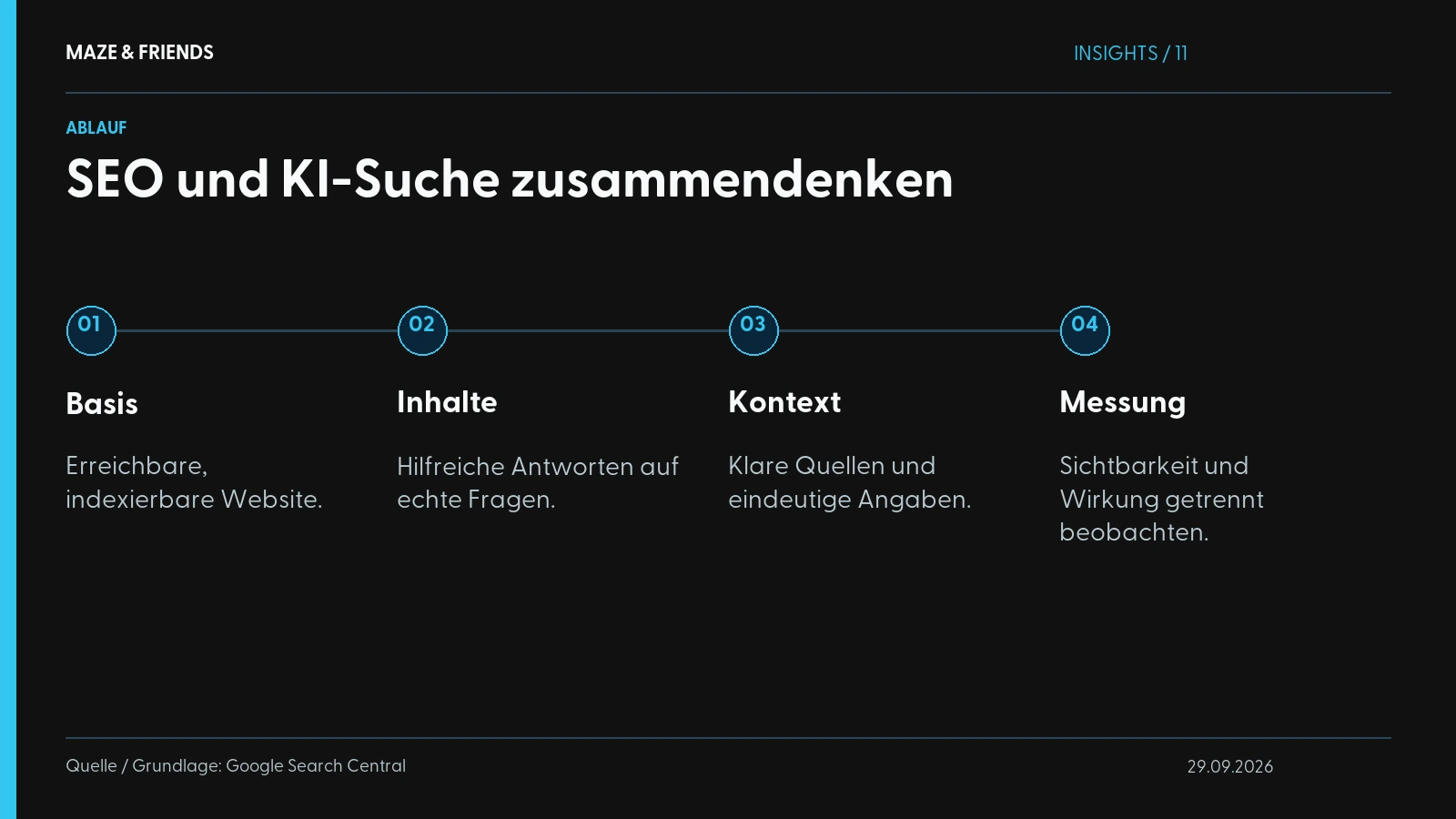
- If your SEO foundation is still shaky, start there. If your pages load slowly, are poorly structured or not properly indexed at all, no GEO tactic will help you, because the AI won’t find you in the first place. First the house, then the extra storey.
- If your SEO is running solidly, GEO is the lever that sets you apart from the competition. Many mid-sized companies in the DACH region (Germany, Austria, Switzerland) haven’t done anything here yet. That is a head start, as long as many are still waiting.
Don’t let a hype article promising “GEO instead of SEO” talk you out of SEO that works. Switching it off means tearing down the load-bearing wall to make room for a skylight. To “SEO or GEO?”, the answer is almost always: both, in the right order.
What should you do now as a mid-sized company?
Maze & Friends works through this checklist itself when we prepare a company for AI answers. You can get most of the points started in-house.
- Check your foundation. Is your website technically clean, fast and accessible to crawlers? Are your most important pages indexed? Without that, nothing works. OpenAI, for example, writes in its documentation on its own crawlers that sites which block OAI-SearchBot will not appear in ChatGPT’s search answers. If you’re unsure, a technical check brings clarity, like the one we carry out as the first step in search engine optimisation for companies.
- Answer real questions directly. Go through the questions your customers actually ask: in sales, in support, in initial calls. For each one, build a page or paragraph that delivers the answer immediately and on its own. AI systems prefer to pick up content that can be cited without context, and that is exactly what content marketing with real answers is about.
- Define your technical terms clearly. Explain in simple, unambiguous sentences what your product does, who it is for and what makes it special. An AI can’t cleanly cite vague marketing prose.
- Build trust signals. Name authors with their qualifications, link to reputable sources, show real references and figures (only proven ones; invented figures get noticed sooner or later). Traceable evidence makes your content more credible, for people and machines alike.
- Structure for machines. Meaningful headings, short paragraphs, tables, bullet points, a clean structured data format (Schema.org). This helps the AI understand your content and lift it out.
- Measure whether you show up. Ask ChatGPT, Perplexity and co. about your topic yourself and see whether and how you are mentioned. That is your GEO baseline. Without measurement, you’re groping in the dark.

How Maze & Friends implements and measures these points for companies is shown on the service page AI visibility (GEO).
From our work with mid-sized companies in the DACH region: most often, nothing happens at all. Out of uncertainty, many wait until “the AI search thing has settled”. It won’t settle; it will become the norm. Whoever sets up their GEO optimisation now will be a step ahead when others are only just starting.

Build on top instead of tearing down
“GEO instead of SEO” is a catchy slogan and factually wrong. AI search is changing how people find information. But that doesn’t make good search engine optimisation superfluous, because it is the precondition for GEO. Anyone who now panics and changes everything loses. Anyone who maintains their foundation and adds the GEO storey in a targeted way becomes visible in the systems where your customers increasingly search.
Your next concrete step: sit down once and ask ChatGPT and Perplexity about your core topic and your most important products. See whether you appear, who gets cited instead and what your answer would have to look like to be included. That is your baseline.
If you’d like an assessment of your situation: Maze & Friends looks at your setup and tells you where your lever is, in the SEO foundation, in the GEO storey or in both. Talk to us about your GEO roadmap; the initial call comes with no obligation.
From the studio: Canal Toys: shop, guides and campaigns · Maze & Friends as its own client: SEO blog and case studies.
Frequently asked questions
What does GEO SEO mean?
GEO SEO refers to the combination of search engine optimisation and generative engine optimisation: content should rank on Google and be cited by AI systems at the same time. SEO makes sure your pages are technically accessible, indexed and visible for search terms. GEO builds on that. It shapes the same content so that an AI can extract clear, backed-up statements and adopt them in its answer. Both share the same foundation, which is why they are thought about together today.
What distinguishes GEO from SEO?
SEO aims for rankings and clicks in the list of results; GEO aims to be named or cited in the answers of AI systems. The most important differences:
- Goal: ranking and click for SEO, a mention in the answer for GEO
- Query: short search terms for SEO, whole questions in natural language for GEO
- Unit: whole pages for SEO, individual extractable statements for GEO
- Measurement: positions and traffic for SEO, citation frequency in AI answers for GEO
The technical foundation is the same for both. That is why the disciplines complement each other.
What does “GEO instead of SEO” mean?
“GEO instead of SEO” stands for the widespread claim that optimising for AI answers is replacing classic search engine optimisation. It is wrong. Generative systems need sources that are crawlable, indexed and findable, and that is exactly what SEO ensures. Without this foundation no AI will find you, however well written your texts are. “GEO on top of SEO” would be more accurate. You keep maintaining the existing foundation and add the GEO work on top in a targeted way.
Is SEO still relevant when more and more people ask AI?
Yes, because AI systems with web search draw on exactly the content that SEO makes findable. Google itself says that proven SEO fundamentals also apply to its AI features such as AI Overviews and AI Mode. Part of research is shifting into AI answers. But their sources are indexed, well-structured websites. What’s new is the level above: alongside rankings, it increasingly matters whether your content is phrased so clearly that an AI cites it.
Should I invest in SEO or GEO first?
Invest in SEO first if the technology is shaky, and in GEO once your SEO foundation is running solidly. Slow, poorly structured or non-indexed pages won’t be found by an AI either, and any GEO tactic then fizzles out. Once the foundation is in place, GEO sets you apart from the competition, because many mid-sized companies in the DACH region haven’t done anything there yet. It’s rarely an either-or. Usually it’s a question of order.
What is the difference between GEO and AEO?
AEO (answer engine optimisation) targets direct answers such as featured snippets and voice assistants; GEO targets the fully written answers of generative AI systems such as ChatGPT or Perplexity. Featured snippets are the highlighted answer boxes above the Google results. The line is blurred, and many people use the terms interchangeably. In practice the moves overlap heavily: answer questions directly, structure cleanly, define technical terms clearly. What pays into one almost always helps the other, and your classic SEO.
Do I need separate content or a new website for GEO?
Usually you need neither a new website nor parallel content. You revise existing pages so that an AI can cite them more easily. Four changes are typical: answer the central question on its own right at the start, define technical terms clearly, phrase subheadings as real questions and back up statements with sources or real figures. Add to that a technical check of whether crawlers can read your content at all. You only need a rebuild if the technical foundation won’t hold.
Do keywords still matter for GEO?
Yes, as signposts to topics. How often a term appears in the text, on the other hand, doesn’t matter. In classic search people type short search terms; to an AI assistant they ask whole questions in natural language, often with details about their situation. Keyword research still shows you which topics are in demand. For GEO you turn them into your customers’ specific questions and answer them directly. Clarity and evidence help a lot here; repeating the search term does nothing.
Do I need separate optimisation for Google’s AI Overviews?
No. According to Google, there are no additional technical requirements and no special optimisations for Google’s AI Overviews and AI Mode. For a page to be linked there as a source, it must be indexed and eligible to appear in Google Search with a text excerpt, the snippet. That is a classic SEO fundamental. Clear answers and a clean structure still pay off twice, for Google Search and for AI systems such as ChatGPT or Perplexity, which choose their sources themselves.
Will AI answers cost me visitors to my website?
For simple knowledge questions, AI answers can cost visitors, because users read the answer directly and click through to a website less often. That is why the goal is shifting. Alongside the click, the mention counts, meaning whether your brand is part of the answer, because a mention shapes the impression even without an immediate visit. When someone checks out a provider in earnest, they need your website, and then it matters whether your name came up beforehand. So measure your success by organic traffic and, in addition, by mentions in AI answers and branded searches.
Is GEO also worthwhile for small and medium-sized businesses?
Yes, especially for small and medium-sized businesses, because many competitors among mid-sized companies in the DACH region haven’t done anything in this direction yet. In a clearly defined niche you become a cited source much faster than in the mass market, where big brands have been present for years. The precondition is a solid SEO foundation. Building on it usually costs less than many fear, because the most important steps improve existing pages instead of building new ones.
Is GEO just hype?
Not mere hype: more and more people research with ChatGPT, Perplexity or Google’s AI answers, in B2B too. Much of what is sold under the label is exaggerated, though, such as guaranteed mentions, secret tricks or the slogan “GEO instead of SEO”. Serious work relies on proven fundamentals: technically clean pages, clear answers, real evidence and measurement that shows whether you appear in AI answers. There is a fine line between a genuine need to act and panic selling.
What are the most common mistakes when getting started with GEO?
Most often, out of uncertainty, nothing happens at all, because many wait until AI search has “settled”. Almost as expensive is the opposite: scaling back working SEO because an article promises “GEO instead of SEO”. Also typical are GEO tactics on a shaky technical foundation, vague marketing language that no AI can cite cleanly, and invented or embellished figures. Measurement is often missing too. Without a baseline from ChatGPT, Perplexity and Google, you never know whether your work is having an effect.
Next step
Want to know which of this fits your company? We will work it out together in 30 minutes. Free and without obligation.
Pick a time
Manuel Zellnig has been building visibility for companies since 2018: brand film, personal branding, performance marketing and AI visibility. Qualified advertising specialist (Werbeakademie Wien), Bachelor in Business Management (Carinthia University of Applied Sciences), author of the book ‘Mobile Apps zur Messung der Kundenzufriedenheit’ (2017, in German) and creative expert for the Austrian Economic Chamber (WKO) in two transformation guides. He measures before he recommends and writes here about what actually works in projects.
Publications and interviews: WKO transformation guide for printers (in German) · WKO transformation guide for florists (in German) · Interview with Ghezzo (in German) · ‘Heute’ on Viennese start-ups (in German)