


GEO for B2B: get ChatGPT to recommend you
GEO for B2B in practice: how to get your complex offer cited and recommended in ChatGPT, Gemini and Perplexity, with a measurable effect on your pipeline.
In short: GEO for B2B (generative engine optimisation) makes sure that AI systems such as ChatGPT, Gemini and Perplexity name your company as the solution when someone researches a provider there. Complex B2B offers need citable content for this, an unambiguous entity, meaning a distinctive company profile on the web, and mentions on third-party sites. Vienna-based Maze & Friends measures success by pre-qualified enquiries rather than click numbers.
Your website ranks on Google, your sales team knows every technical term, your machines are running. And yet something is happening in the background that you can’t see: a purchasing manager types into ChatGPT “Who supplies custom assemblies for small-batch production in the DACH region?” and gets three names. Yours isn’t among them.
That is how a growing share of B2B research works today. The buying committee settles a good part of the purchase decision before anyone fills in a form or picks up the phone. If you don’t appear in this phase, you never make it onto the shortlist. This is exactly where GEO comes in, and because your offer needs explaining, you even have an advantage that many e-commerce brands lack.
What is GEO, and what does it do differently from classic SEO in B2B?
GEO stands for generative engine optimisation: the targeted work of getting generative AI systems to pick up your content, reproduce it correctly and recommend your company. Closely related is answer engine optimisation (AEO), which targets direct answers such as answer boxes, featured snippets and voice assistants, while GEO focuses on visibility in generative AI answers. Both share the same goal: not a blue link on page one, but a place in the answer itself.
The difference from SEO lies in the mechanics. SEO optimises for a ranked list of links from which a person chooses. GEO optimises for becoming part of a synthesised answer that the system assembles from many sources. With SEO you win a position. With GEO you get cited, or you don’t get mentioned at all.
We have taken the fundamentals apart, meaning definitions, history and GEO versus SEO in detail, in Generative engine optimisation explained and GEO instead of SEO. This article skips the theory and turns to putting GEO for B2B into practice: how does a complex offer actually get recommended?

How do ChatGPT, Gemini and Perplexity decide whom to recommend?
Put simply, there are two ways your company can end up in an AI answer.
The first is training knowledge: the model “knows” you from its training data because you have been consistently present on the web for years. This route is slow and can only be influenced gradually, but it is robust.
The second is live retrieval: Perplexity always does it, ChatGPT and Gemini increasingly so. They fetch current web results for the question and cite them directly. This route is faster, and this is where most GEO successes in B2B happen.
Across both routes, the systems prefer the same patterns:
- Directly answerable: content that answers exactly the question asked in a self-contained passage.
- Extractable: the systems pull out individual text passages rather than whole pages. A statement that stands on its own gets extracted. A fact buried in advertising copy doesn’t.
- Consensus across sources: AI models give weight to what several independent sources confirm. If only your own website claims you are a leader, that counts for little. If trade media, directories and comparison articles name you, it is treated as established.
- An unambiguous entity: the system must understand beyond doubt who you are: name, category, location, service. Risk of confusion means you don’t get named.

How do you get recommended in ChatGPT? The four building blocks for mid-sized companies
To be recommended in ChatGPT, you have to serve exactly these patterns. Four building blocks, ordered by their impact for complex B2B offers:
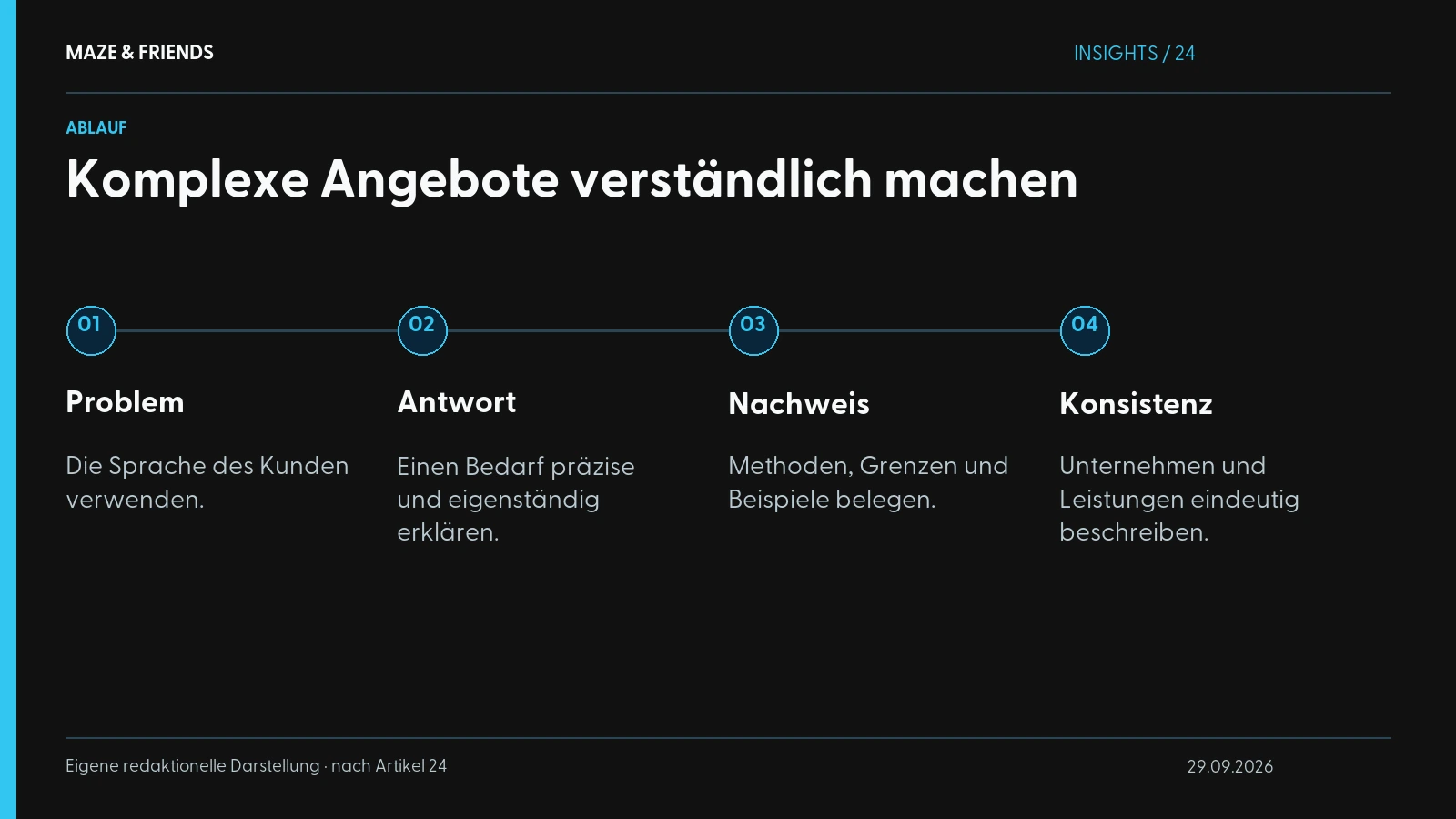
1. Problem language instead of product language
Complex means that searchers often only know their problem, not the product name. So people rarely ask about “five-axis simultaneous machining”; they ask: “How do I manufacture complex geometries economically in small quantities?” Your content has to match how the other side formulates the problem and lead cleanly from there to the answer, in the language of the industry rather than your internal product language.
2. Citable, self-contained answers
Write every core statement so that it is true and makes sense without the surrounding text. Instead of “This saves an enormous amount of time”, write: “Modular fixture construction reduces set-up time for small batches because the same base is used for several workpieces.” Concrete, verifiable, understandable out of context: that is what a sentence an AI will cite looks like.
3. Make your entity unambiguous
Make sure that name, category, location and service are stated the same way everywhere: website, legal notice, LinkedIn, industry profiles, directories. Structured data (Schema.org for Organization, Service and FAQ) helps the systems assign the facts correctly. According to Google Search Central (in German), the usual SEO fundamentals apply to the AI features in Google Search, and structured data must match the visible text (as of 31 December 2025). A Viennese special-purpose machine builder that calls itself an “automation partner” one day and a “plant engineering company” the next makes things unnecessarily hard for the AI.
4. Mentions on third-party sites (off-page GEO)
Often the lever with the greatest impact: trade media, industry directories, “best providers” lists, case reports, interviews, guest articles. This is the digital PR side of GEO. Because the systems rely on consensus, what counts above all is what others say about you, much less what you say about yourself. This is exactly the work we take on as a B2B marketing agency in Vienna: strategy, content and implementation from a single source.
This overview shows which type of content pays into which research question:
| What someone asks in AI search | Content that makes you recommendable |
|---|---|
| “How do I solve [technical problem]?” | Problem guide / use case with a clear solution |
| “How does [service] work, what does it cost?” | Transparent page on process and price range |
| “Who offers [niche] in the DACH region?” | Positioning page plus listings in directories |
| “[Provider A] vs. [Provider B]” | Factual comparison and differentiation content |
| “What should I look for when choosing [category]?” | Criteria and guide content |
How does AI search in B2B differ from B2C?
AI search in B2B follows a different logic from the consumer sector. Search volume is low, the questions are specific and technical, the order value is high. It’s about the one right mention at the right moment, when the buying committee builds its shortlist. Volume plays hardly any role.
And this is where your advantage lies in the German-speaking market: for many B2B niches there are hardly any reliable German-language sources. The answer layer is thinly populated. Whoever delivers clearly structured, technically correct content now becomes a cited source faster than in the crowded English-language market. In the context of GEO, needing explanation is not a disadvantage; it is your chance to overtake the competition.

How does GEO affect your pipeline?
If you measure GEO by click numbers, you’ll be disappointed. For B2B, generative engine optimisation rarely delivers large amounts of traffic. The value lies elsewhere, and that is the actual business case.
Anyone who comes to you via an AI recommendation arrives pre-qualified. They heard your name from a system they perceive as neutral. That is warm trust, not a cold contact. With complex offers, this noticeably shortens the work of explaining and persuading: the AI has already put your offer in context.
GEO works exactly where you have been blind so far: in the “dark” part of B2B purchasing, the long research phase in which nobody talks to your sales team. That is where the shortlist is drawn up. If you don’t appear there, you’re out of the race before it has started.
On measurement: attribution is difficult because a lot happens before the first click. Reliable signals are:
- self-reported attribution in the form (“How did you hear about us?”)
- an increase in branded and direct searches as well as direct visits
- asking in the initial call which tools were used during research
- measurable referrals from Perplexity or ChatGPT in your analytics tool
Don’t expect a switch that fills the pipeline overnight. GEO secures you a growing, high-quality share of the research phase and defends your visibility in the answer layer before the competition does.
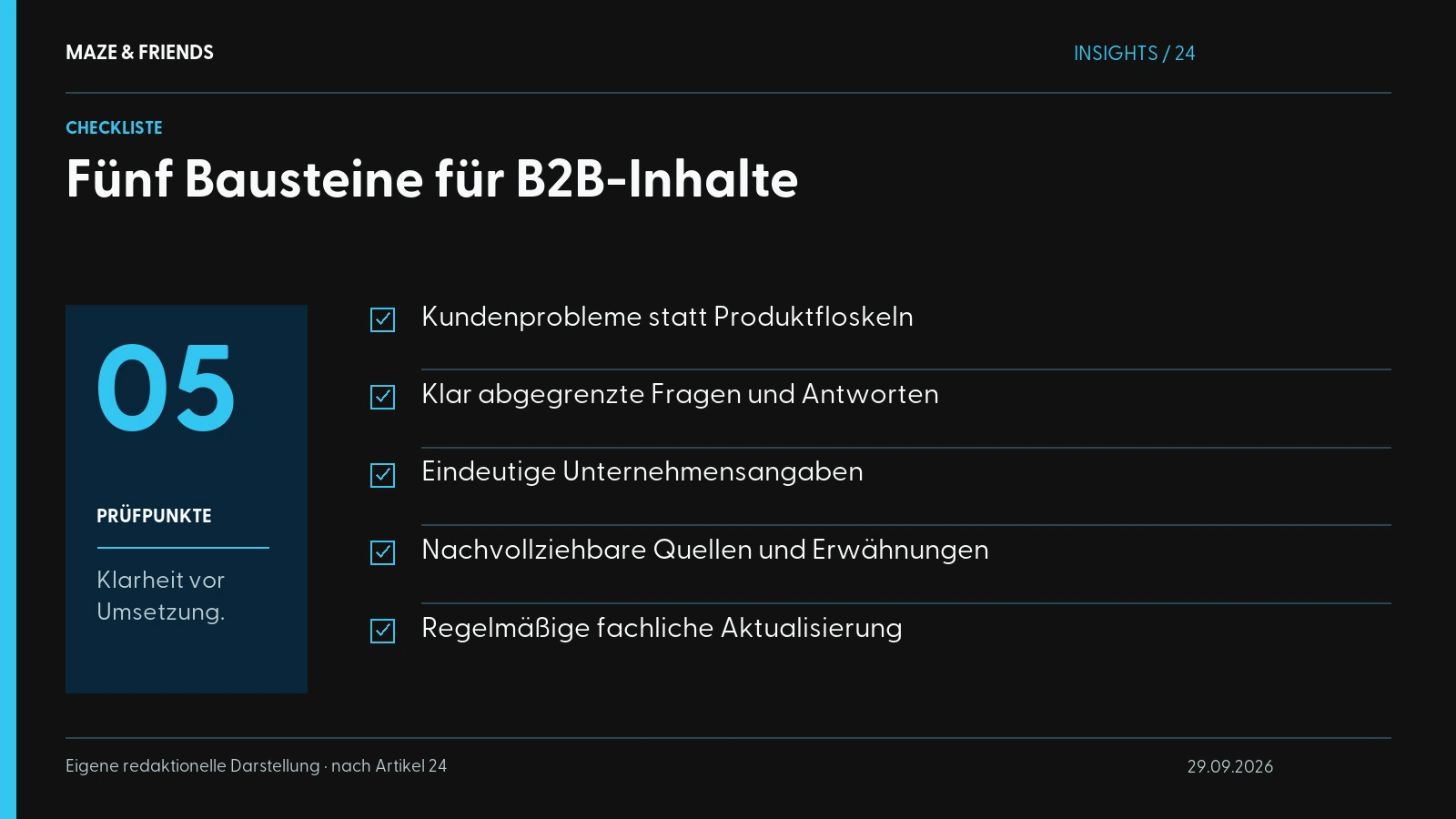
Your checklist for getting started with GEO
- Collect the 15–20 real questions your target customers ask, in their problem language rather than your product language.
- For each question, a page or section with a citable, self-contained answer.
- Standardise name, category, location and service across all profiles.
- Add Schema.org markup for Organization, Service and FAQ.
- Get three to five credible third-party sources going (trade publication, directory, comparison article, case reference).
- Test in ChatGPT, Gemini and Perplexity what is being said about you and your category today.
- Introduce a simple attribution signal (e.g. the field “How did you hear about us?”).
In the answer, not just on page one
GEO for B2B decides whether your company makes it onto the shortlist that buying committees build with AI assistants. What works is content in your customers’ problem language, citable answers, an unambiguous entity and credible mentions on third-party sites. Success is measured by pre-qualified enquiries; clicks are secondary.
Want to know whether ChatGPT, Gemini and Perplexity already name you today, and where your competitors already show up in the answers? Maze & Friends from Vienna makes sure strong brands get found by AI and chosen by humans. In an initial call with our B2B marketing agency in Vienna, you get an assessment of where you stand and a plan that actually gets implemented.
From the studio: Maze & Friends as its own client: SEO blog and case studies · Planungsbüro Grassl: knowledge base and guides.
Frequently asked questions
What does GEO mean in B2B marketing?
GEO in B2B marketing means making sure that ChatGPT, Gemini or Perplexity name your company as the solution when buyers or decision-makers research providers there. For complex offers this takes three things: clearly structured, citable content, an unambiguous presentation of your company on the web and mentions on credible third-party sites. The effect shows less in click numbers than in pre-qualified enquiries. If you don’t show up in AI research, you often don’t even make it onto the shortlist.
Why is AI search so important for supplier selection in B2B?
AI search matters in B2B because buying committees settle a good part of the purchase decision before talking to a provider, and they increasingly use AI assistants to do so. The shortlist is drawn up during this research phase without your sales team ever hearing about it. If the AI names three providers and yours is missing, you’re out of the race before it has begun. Unlike the consumer sector, volume doesn’t count here: the questions are specific, search volume is low, the order value is high, and even a single mention at the right moment counts.
When is GEO worthwhile for a B2B company?
GEO is worthwhile for a B2B company as soon as its target customers research complex purchase decisions online, and in B2B that applies to almost everyone. The higher the order value and the need for advice, the more a single AI recommendation pays off. GEO is particularly relevant for mid-sized industrial companies with long buying cycles and specialised niches. There are often hardly any reliable German-language sources there, and whoever delivers clear, technically correct content now becomes a cited source faster than in the crowded English-language market.
How do I write B2B content so that AI systems recommend it?
B2B content is more likely to be recommended if it matches the problem language of searchers and phrases every core statement so that it holds true without the surrounding text. Searchers often only know their problem and not your product name, for example when it comes to how complex geometries can be manufactured economically in small quantities. Your content picks up this question and leads cleanly to the answer. Instead of “This saves an enormous amount of time”, you write: “Modular fixture construction reduces set-up time for small batches because the same base is used for several workpieces.” That is what a sentence an AI can cite looks like.
What content makes a B2B company recommendable in ChatGPT?
A B2B company becomes recommendable through content that answers exactly the questions buyers and specialists put to an AI. Depending on the question, a different type of content fits:
- “How do I solve this technical problem?”: a guide or use case with a clear answer
- “How does the service work, what does it cost?”: a transparent page on process and price range
- “Who offers this in the DACH region?”: a positioning page plus listings in directories
- “Provider A or B?”: factual comparison and differentiation content
- “What should I look for when choosing?”: criteria and guide content
What structured data does a B2B company need for GEO?
A B2B company should at least add structured data according to Schema.org for Organization, Service and FAQ, so that AI systems can correctly assign company data, services and answers. Organization describes your company’s name, address, logo and profiles, Service your services, FAQ your answers to frequent questions. Equally important are technical facts as readable text on the page, such as dimensions, materials, certificates or areas of application, rather than only in images. The markup has to match what is visible on the page, otherwise contradictions arise.
Why are mentions on third-party sites so important for GEO in B2B?
Mentions on third-party sites are often the most effective GEO lever in B2B, because AI systems give most weight to what several independent sources consistently confirm. If only your own website claims you are a leader, that counts for little. If trade media, industry directories, comparison articles, case reports or interviews name you, the system treats the statement as established. To start with, three to five credible sources are a realistic goal, such as a trade article, a directory listing and a case report with a client. Credibility counts for more than quantity.
Can I influence what ChatGPT says about my company?
You can’t directly control what ChatGPT says about your company, but you can influence it. The system reflects what can be found and is consistent about you on the web. If the description is wrong or outdated, look for the cause first in contradictory or old details on your website, in profiles and in directories. Clean up these sources and provide a clear, current self-description. The stronger the consensus on third-party sites, the more precise the answer. Corrections take effect faster via live search than via the models’ training knowledge.
How long does it take for a B2B company to be recommended in ChatGPT?
For a B2B company, first mentions in ChatGPT, Gemini or Perplexity can appear via live search within weeks, as soon as good content and the first third-party sources exist. The route via the models’ training knowledge takes months to years, because new information only flows in with later model versions, but it is more robust. Nobody who guarantees you visibility “from tomorrow” is being serious, because the systems decide for themselves whom they name. So plan GEO as ongoing work over several months rather than a one-off campaign.
How do I measure the success of GEO in B2B when hardly any clicks come in?
You measure the success of GEO in B2B through indirect signals, because a large part of the effect happens before the first click. The most reliable ones are:
- self-reported attribution in the contact form: “How did you hear about us?”
- an increase in branded searches and direct visits
- asking in the initial call which tools were used during research
- visits from Perplexity or ChatGPT in your analytics tool
The best early indicator remains asking the systems yourself, regularly, whether and how they name you.
Do I need an agency for GEO, or can it be done in-house?
You can implement the fundamentals of GEO in-house: clear content in your customers’ language, a consistent presentation of your company and structured data on the website. It gets demanding outside your website, building credible mentions in trade media, directories and comparison articles. That is manual work and needs reach, contacts and staying power. An agency is worthwhile above all there and for ongoing measurement, ideally one that combines strategy, content and implementation instead of just delivering reports.
What does a GEO agency do, and how do I recognise a good one?
A GEO agency makes sure that AI systems know your company, describe it correctly and recommend it, from the baseline measurement through technology and answer content to mentions on third-party sites. You can recognise a good one by the fact that it first measures how ChatGPT, Perplexity, Gemini and Google AI present you today, guarantees no mentions and discloses its own measurements. Anyone selling GEO without showing their own figures has probably never measured them. That’s why Vienna-based Maze & Friends starts by establishing a baseline across real purchase-decision questions and then reports monthly on whether, and in what words, you are named.
What does GEO cost for a B2B company?
The cost of GEO depends mainly on the number of questions measured, the languages and markets, and the effort for content and third-party sources. Further cost drivers are the state of your SEO foundation and technical basis and whether you build once or have it managed on an ongoing basis. Reputable quotes clearly separate the baseline measurement, the build-up and ongoing support. Before you commit, ask to see where you stand today, rather than buying a package without an as-is analysis. With high order values, a single client won through GEO can justify the effort.
How does a GEO project in B2B work?
A GEO project in B2B starts with an inventory of what ChatGPT, Gemini and Perplexity say about you today and leads into ongoing measurement. In between lie four steps:
- collect the 15 to 20 real questions your target customers ask, in their problem language
- create a citable, self-contained answer on your website for each question
- standardise name, category, location and service everywhere and mark them up with Schema.org
- get three to five credible third-party sources going
The order has a reason: without a baseline, you can’t show later what has improved.
Next step
Want to know which of this fits your company? We will work it out together in 30 minutes. Free and without obligation.
Pick a time
Manuel Zellnig has been building visibility for companies since 2018: brand film, personal branding, performance marketing and AI visibility. Qualified advertising specialist (Werbeakademie Wien), Bachelor in Business Management (Carinthia University of Applied Sciences), author of the book ‘Mobile Apps zur Messung der Kundenzufriedenheit’ (2017, in German) and creative expert for the Austrian Economic Chamber (WKO) in two transformation guides. He measures before he recommends and writes here about what actually works in projects.
Publications and interviews: WKO transformation guide for printers (in German) · WKO transformation guide for florists (in German) · Interview with Ghezzo (in German) · ‘Heute’ on Viennese start-ups (in German)